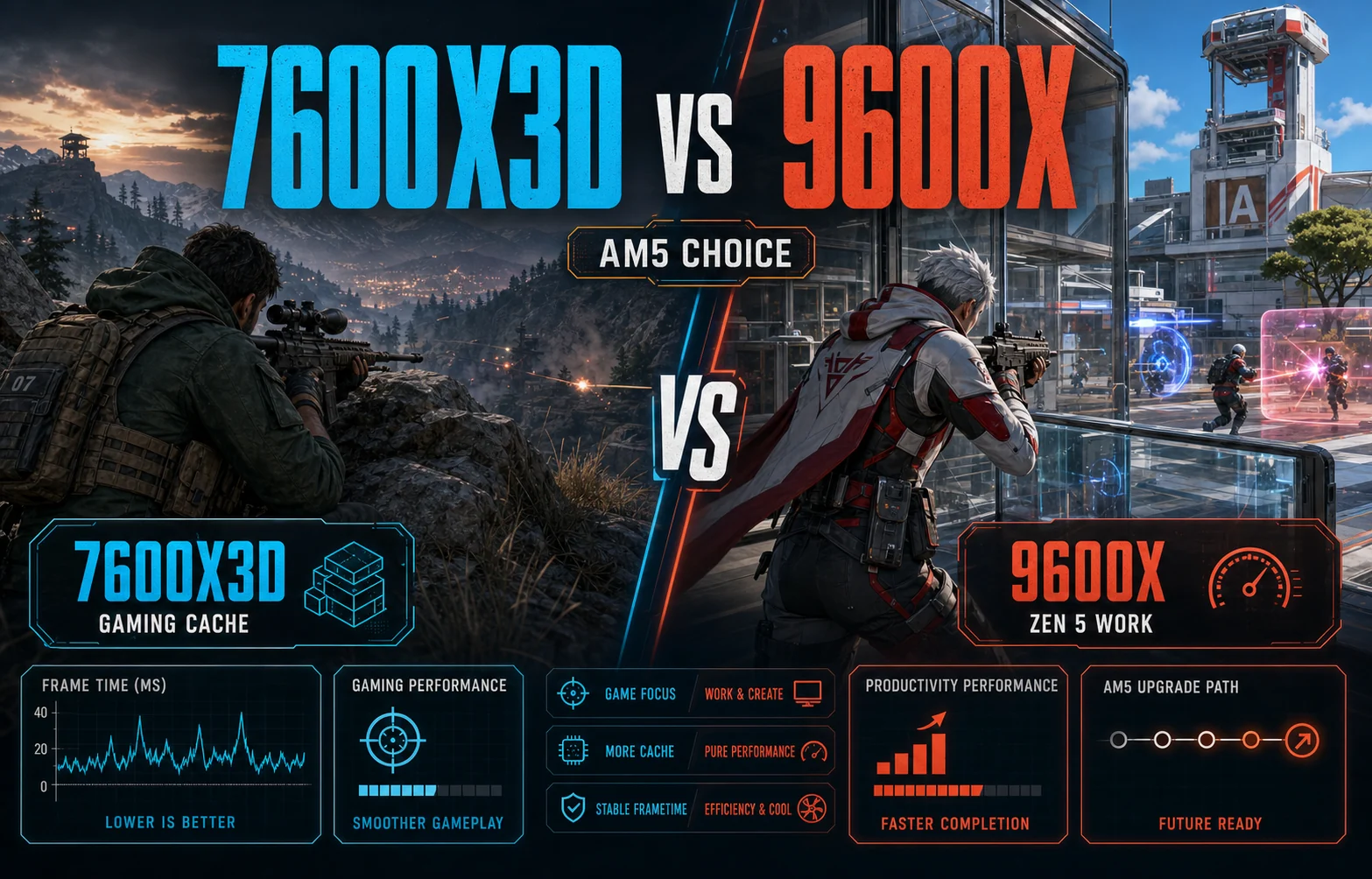
Two AMD chips, same socket, prices within about forty bucks of each other. One has a stack of extra cache glued under the lid; the other is a generation newer. For a budget gaming build in 2026, that gap decides more than the spec sheets let on.
The short version: the Ryzen 5 7600X3D usually plays games faster, and the Ryzen 5 9600X usually does everything else faster. If you only ever look at one of those facts, you’ll buy the wrong chip. So let’s look at both.
The cache trick, in plain terms
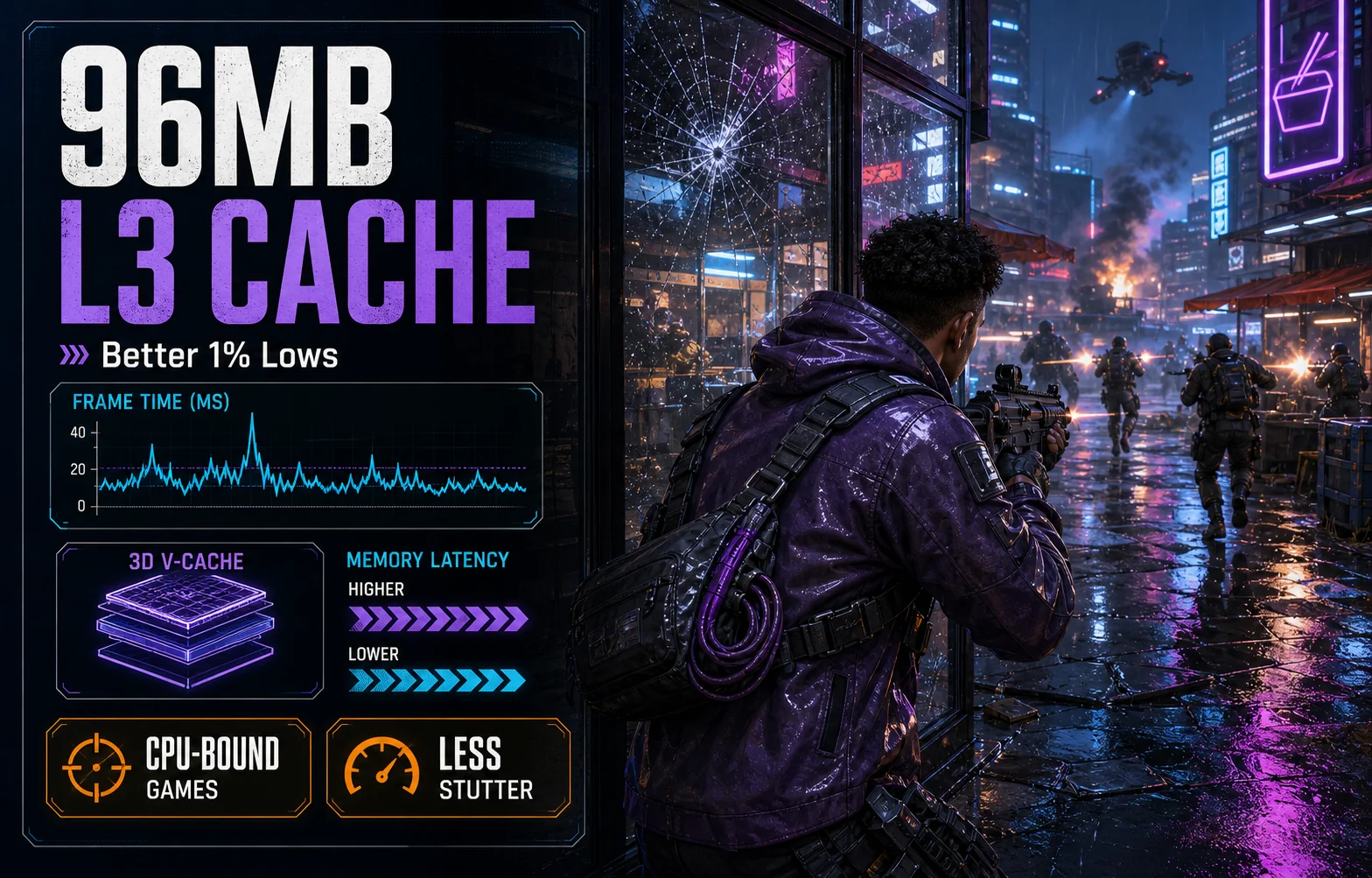
The 7600X3D is a 6-core Zen 4 part with AMD’s 3D V-Cache bolted on — 96MB of L3 instead of the usual 32MB. Games love that. A lot of frame-rate bottlenecks come from the CPU waiting on memory, and a giant cache means it waits less. That’s the whole pitch, and it’s a real one.
The 9600X is the newer design: 6 Zen 5 cores, no extra cache, higher clocks, better instructions-per-clock. On paper it’s the more modern processor. In a spreadsheet, it is. In a game, the cache often matters more than the newer architecture. That’s exactly the kind of wrinkle that makes “newer = better” fall apart.
Both drop into the same AM5 boards and both eat the same DDR5. We’ll get to why that second part stings right now.
What the frame counter actually says
Across a broad spread of games, these two trade blows, with the 7600X3D nosing ahead on average and pulling a real lead in the titles that hammer cache. Think large-world games, simulators, strategy titles, busy multiplayer maps, the stuff where 1% lows tank and the game starts to stutter. That’s where the extra cache earns its keep, and it’s the difference you actually feel, not just the average number you screenshot.
- Cache-sensitive titles. Sims, strategy, MMOs, and CPU-bound esports can swing notably toward the 7600X3D, especially on the 1% lows that cause stutter.
- GPU-bound titles. In a lot of modern AAA games at 1080p or 1440p, your graphics card is the limit and both CPUs post near-identical frame rates. The chip stops mattering.
So the honest read on gaming: the 7600X3D is the faster gamer more often than not, and it’s never meaningfully slower. For a build that exists to play games, that’s the column that counts.
Where the 9600X earns its slot
Step away from games and the picture flips. The 9600X is the better all-rounder. It’s quicker in single-threaded work, quicker in multi-threaded work, and the Zen 5 cores give it a productivity edge the 7600X3D can’t answer.
If your PC also compiles code, renders video, runs heavy spreadsheets, or streams while it games, the 9600X is the smarter chip. It’s not a small gap in those workloads either — the V-Cache part trades raw compute for that gaming cache, and you feel the tradeoff the moment you stop playing and start working. If you’re still mapping out priorities, our take on what actually matters in a budget gaming CPU lines up here: match the chip to what the machine does most.
Same platform, same brutal RAM bill
Here’s the part nobody on a budget can ignore. Both of these are AM5, which means both demand DDR5, and DDR5 is expensive right now in a way that genuinely hurts. A 32GB DDR5 kit can sit around $550 to $600 as of mid-2026, often more than the CPU you’re pairing it with. That’s not a footnote on a budget build.
It cuts both ways, though. Because the RAM tax is identical for the 7600X3D and the 9600X, it doesn’t tip the choice between them — but it should push you toward 16GB this year instead of stretching for 32GB. We dug into why the math changed in our look at DDR4 vs DDR5 in 2026. One upside both share: AM5 is supported well past 2027, so the platform has a real upgrade path. That longevity is also why we still lean AM5 over older sockets in the Ryzen 5 7600 vs 5600 breakdown.
The stock asterisk
One catch on the 7600X3D: it’s been a Micro Center-leaning part, and supply can be thin. The flip side is the deal. In-store it has dipped to around $200, which makes it one of the best gaming-per-dollar CPUs you can buy — we said as much when we covered the 7600X3D budget gaming deal. Third-party sellers list it higher, sometimes well past $300, so the price you see swings hard depending on where you look.
The 9600X is the easier buy. It’s stocked widely, sits around $240 to $279, and you won’t be hunting for it. If you can’t get a 7600X3D near $230 — or you don’t live near a store that has it — the calculus shifts, because a $300+ V-Cache chip is a different value argument entirely.
The gamer’s pick
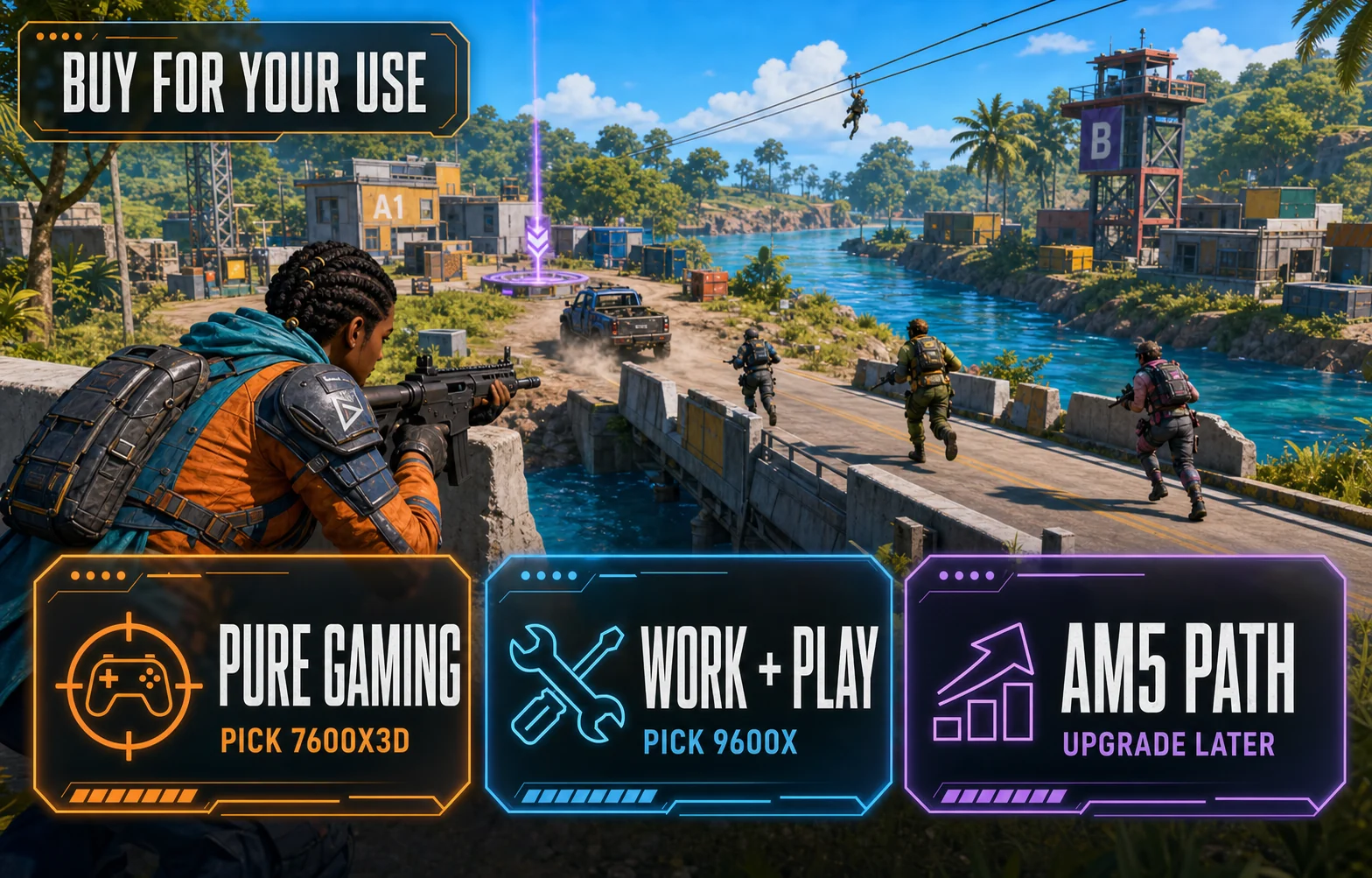
For a pure gaming build, get the 7600X3D if you can find it at a fair price. It’s the faster gamer in the titles that stress a CPU, it never gives up meaningful frames elsewhere, and near $200 to $230 it’s a steal. That’s the pick.
For a machine that doubles as a work or content rig, the 9600X is the saner buy. You give up a little gaming performance, you gain a real productivity bump, and you get a chip that’s actually on shelves. It’s the better all-rounder, and that matters if the PC isn’t only a console replacement.
If you ever outgrow six cores, the upgrade ceiling on this platform is high — the Ryzen 7 9800X3D is still the gaming CPU to beat, and it drops into the same board. Buy the cheaper chip now, ride the socket, upgrade later. That’s the budget move.
Quick answers
Is the Ryzen 5 7600X3D better than the 9600X for gaming?
Usually, yes. The 7600X3D’s 96MB of 3D V-Cache gives it the edge in cache-heavy games like sims, strategy, and busy multiplayer, and it holds even in titles where both are GPU-limited. The 9600X only pulls ahead once you leave games for productivity work.
Why is the 9600X more expensive if it loses in games?
The 9600X uses the newer Zen 5 architecture, so it’s faster in general computing, single-threaded tasks, and multi-threaded workloads. You pay for that all-round speed and for wide availability. For pure gaming, though, the cheaper 7600X3D is often the better value.
Do both chips need expensive DDR5 RAM?
Yes. Both are AM5 processors, so both require DDR5, which is pricey in 2026. A 32GB kit can run $550 to $600 right now, so most budget builders should target 16GB this year and add more later when prices ease.
Can I find the Ryzen 5 7600X3D in stock?
It can be hard to find. The 7600X3D leans on Micro Center supply, where it has dropped to around $200 in-store, but third-party listings run higher and stock comes and goes. If you can’t get it near $230, the 9600X is the easier buy.