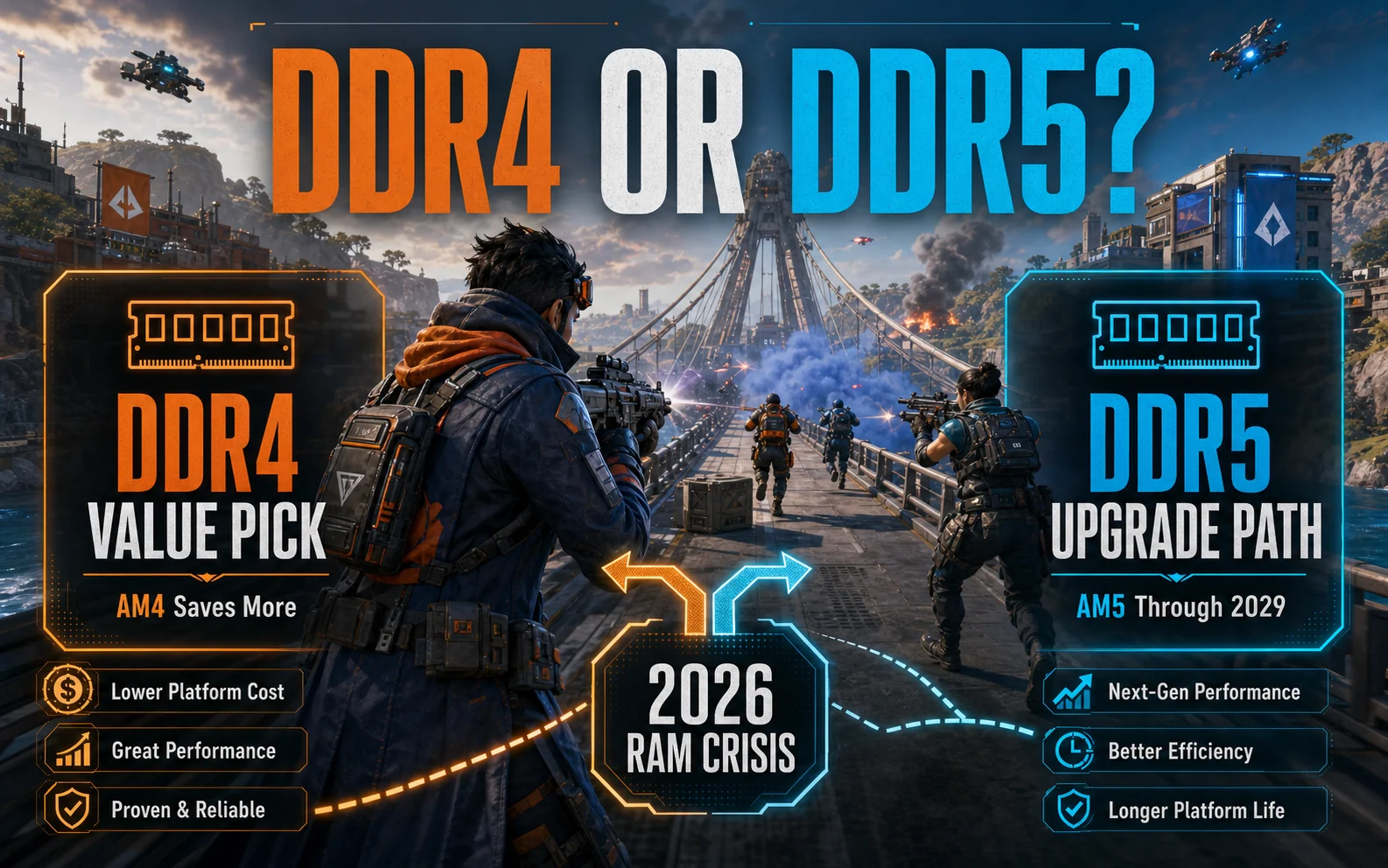
Twelve months ago this question had a boring answer: build on DDR5, it’s the future, the small price premium is worth it. Then the memory market caught fire. AI data centers started buying DRAM by the truckload, DDR5 prices roughly tripled, and a decision that used to be a footnote turned into one of the biggest cost swings in a 2026 budget build. So it’s worth asking honestly: does a budget gamer still want DDR5, or has DDR4 earned a second life?
The answer in June 2026 is genuinely “it depends,” and the deciding factor probably isn’t what you think.
The price gap is the whole story
Start with what each costs right now, keeping in mind these numbers move daily as the shortage churns:
| Memory | 16GB kit | 32GB kit | Trend |
|---|---|---|---|
| DDR4-3600 | ~$60–90 | ~$150–180 | Up, but far cheaper |
| DDR5-6000 | ~$130–150 | ~$250–285 | Spiked hard, easing slowly |
Both went up — that’s the part people miss. DDR4 isn’t the $30 afterthought it was in 2024. But the gap between them is still large, and it widens once you factor in the platform. DDR5 only runs on newer sockets (AMD’s AM5, Intel’s LGA1851/1700), which also carry pricier motherboards. DDR4 lives on AMD’s AM4 and Intel’s LGA1700, where boards are cheap and plentiful. Stack it all up and choosing DDR4 can save $150–200 across RAM and motherboard combined.
What you give up in performance (less than you’d guess)
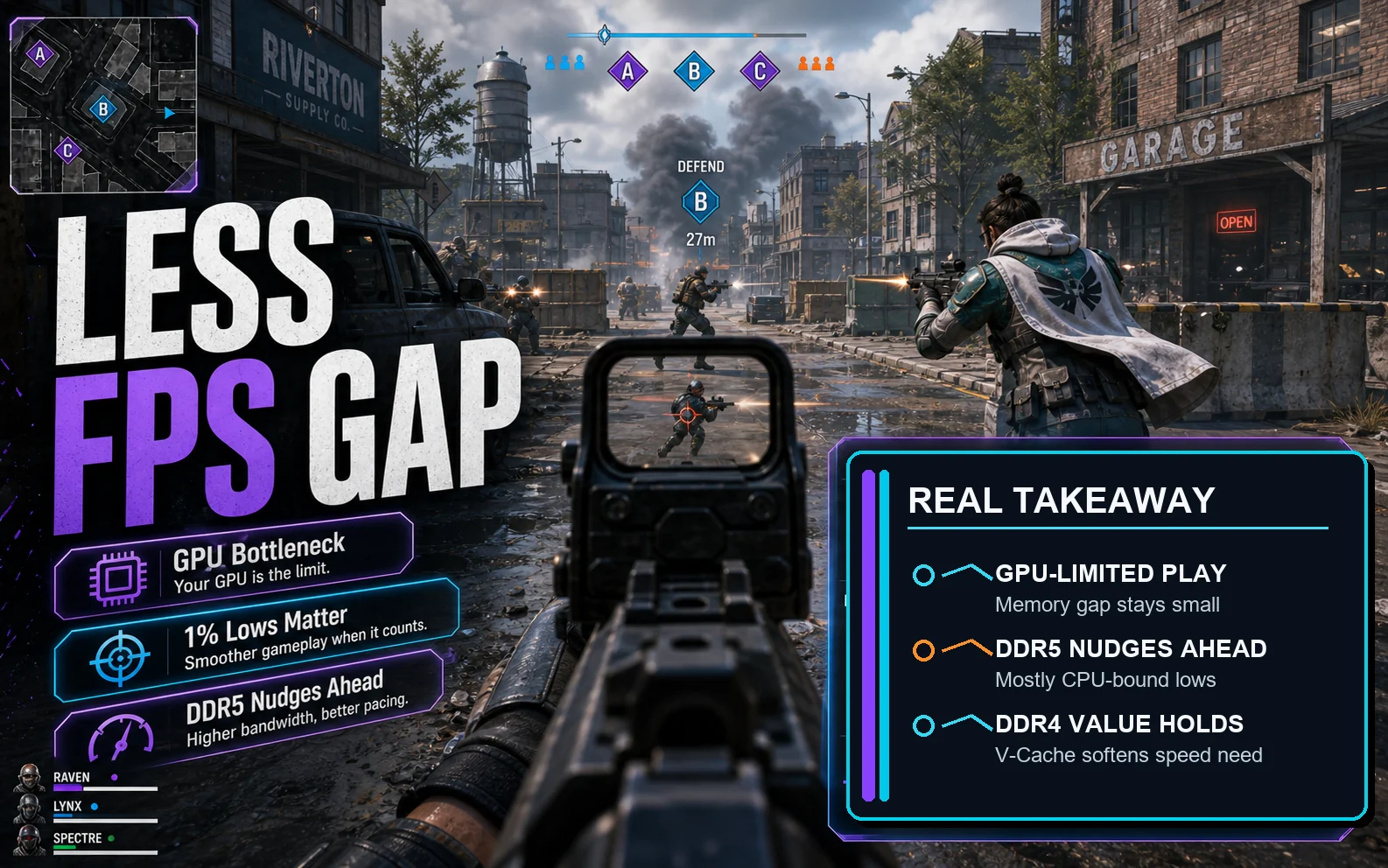
DDR5 is faster on paper, and in a handful of CPU-bound scenarios — high-refresh esports, simulation games, 1% lows in a few titles — it shows a real if modest lead. But at the resolutions and settings most budget gamers actually play, the graphics card is the bottleneck, not the memory. Push the resolution to 1440p and the difference between DDR4 and DDR5 mostly disappears into margin of error.
There’s a wrinkle that makes DDR4 look even better: AMD’s 3D V-Cache chips. A processor like the Ryzen 7 5700X3D carries a huge slab of on-die cache that softens its dependence on memory speed, which is a big reason those AM4 X3D chips stay competitive with newer hardware despite running “old” DDR4. For gaming specifically, fast memory matters less than the internet sometimes implies.
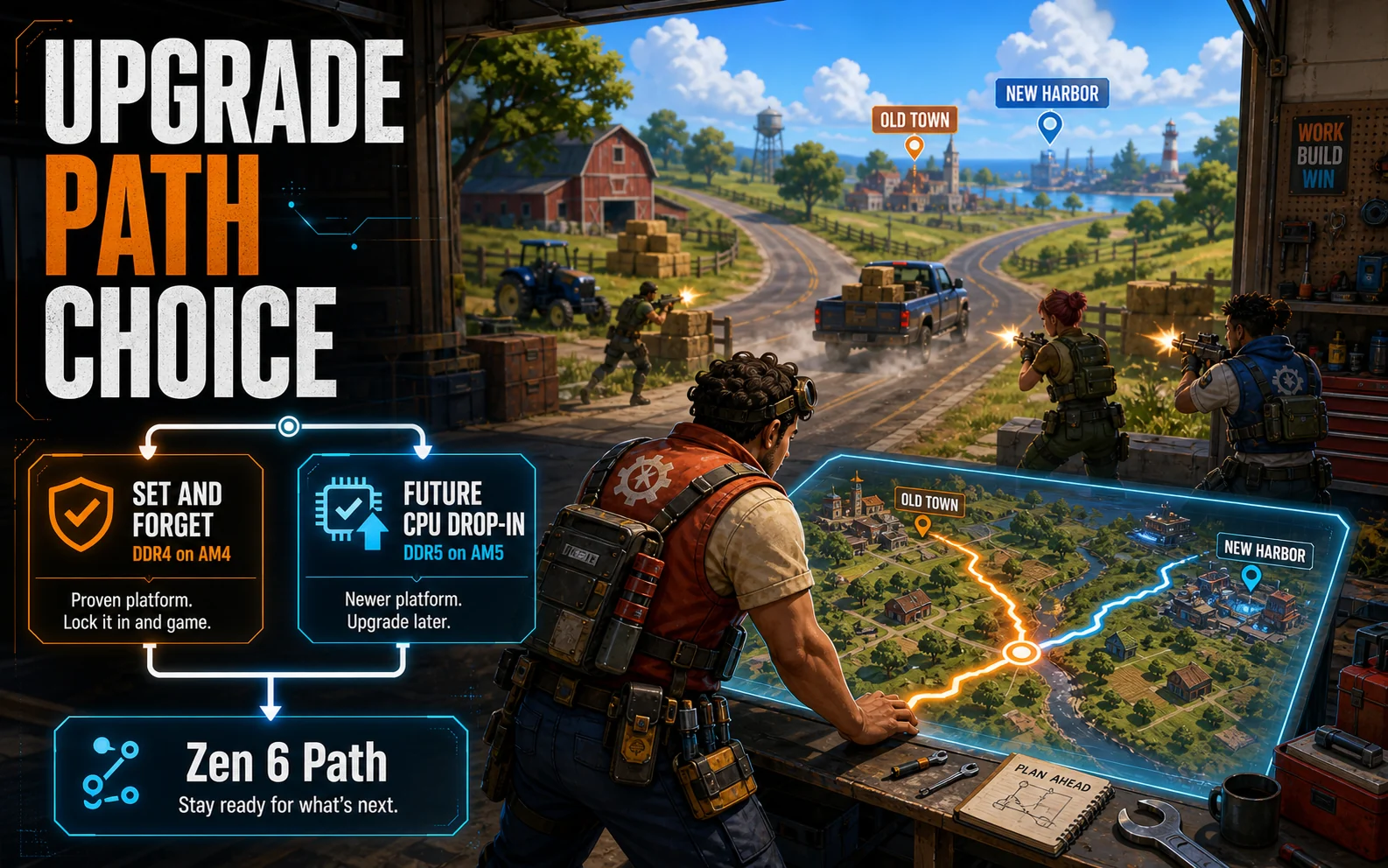
The real deciding question: do you want a CPU upgrade later?
This is the fork in the road, and it has nothing to do with frame rate.
Choose DDR4 (and AM4) if you’re building a complete machine you’ll run for years without touching the CPU. You’ll save real money today, game at essentially the same level, and AMD just reinforced the platform by relaunching the Ryzen 7 5800X3D at Computex — there are still strong chips to buy. The tradeoff is that AM4 is a dead end; the 5800X3D is the last stop.
Choose DDR5 (and AM5) if you want a foundation. AMD has committed to supporting AM5 through 2029, with Zen 6 chips expected to drop into today’s boards. You pay the DDR5 tax now — and it’s a steeper tax than usual in 2026 — in exchange for the option to slot in a much faster CPU in two or three years without a full rebuild.
That’s the trade. Money now versus flexibility later. The memory crisis simply made “money now” a louder argument than it’s been in years, which is why so many budget builders who’d reflexively have gone DDR5 are landing on DDR4 in 2026.
A quick decision matrix
- Tightest budget, pure gaming, no upgrade plans → DDR4 on AM4. Save the $150–200, spend it on the GPU.
- You already own DDR4 → DDR4, easily. Reusing memory you have is the single biggest saving available in this market.
- You want to drop in a Zen 6 chip in 2027 → DDR5 on AM5. Pay the tax, keep the path.
- High-refresh esports as your main use → either works; DDR5 nudges ahead in 1% lows, but a V-Cache AM4 chip closes most of the gap for less.
What about Intel?
Intel muddies it nicely: the LGA1700 platform (think the budget-favorite Core i5-12400F) supports both DDR4 and DDR5 depending on the motherboard, so you can buy a cheap Intel chip and pair it with cheap DDR4 today. It’s a tidy way to get a modern-ish Intel build without the DDR5 premium. Intel’s newer LGA1851 platform is DDR5-only and priced like it, so it doesn’t make much sense for a budget build right now.
Still deciding?
Is DDR4 still good for gaming in 2026?
Yes. For budget gaming, DDR4 performs within a few percent of DDR5 at the resolutions most people play, and it’s significantly cheaper during the 2026 memory shortage. It’s only the wrong call if you specifically want a future CPU upgrade path, which requires DDR5 platforms.
How much money does choosing DDR4 actually save?
Roughly $150–200 once you account for both the cheaper memory and the cheaper motherboards that DDR4 platforms use. That gap is wider than usual in 2026 because the shortage hit DDR5 harder than DDR4.
Will DDR4 hurt my frame rate?
Barely, if at all, for gaming. The graphics card is the bottleneck at common budget settings, and AMD’s 3D V-Cache chips further reduce sensitivity to memory speed. DDR5’s lead shows up mainly in CPU-bound esports 1% lows.
Should I buy DDR5 anyway to future-proof?
Only if you plan to upgrade the CPU later. DDR5 on AM5 buys you an upgrade path through 2029, which is its real value. If you’re building a set-and-forget gaming PC, DDR4 saves money for no meaningful gaming loss.
Our call
For a budget gaming build in 2026, DDR4 on AM4 is the value pick, full stop — the memory shortage handed it a comeback nobody saw coming a year ago. Build on DDR5 only if a CPU upgrade down the line is part of your plan and you’re willing to pay a real premium to keep that door open. Both will game great. The right answer is about your next three years, not your next benchmark.