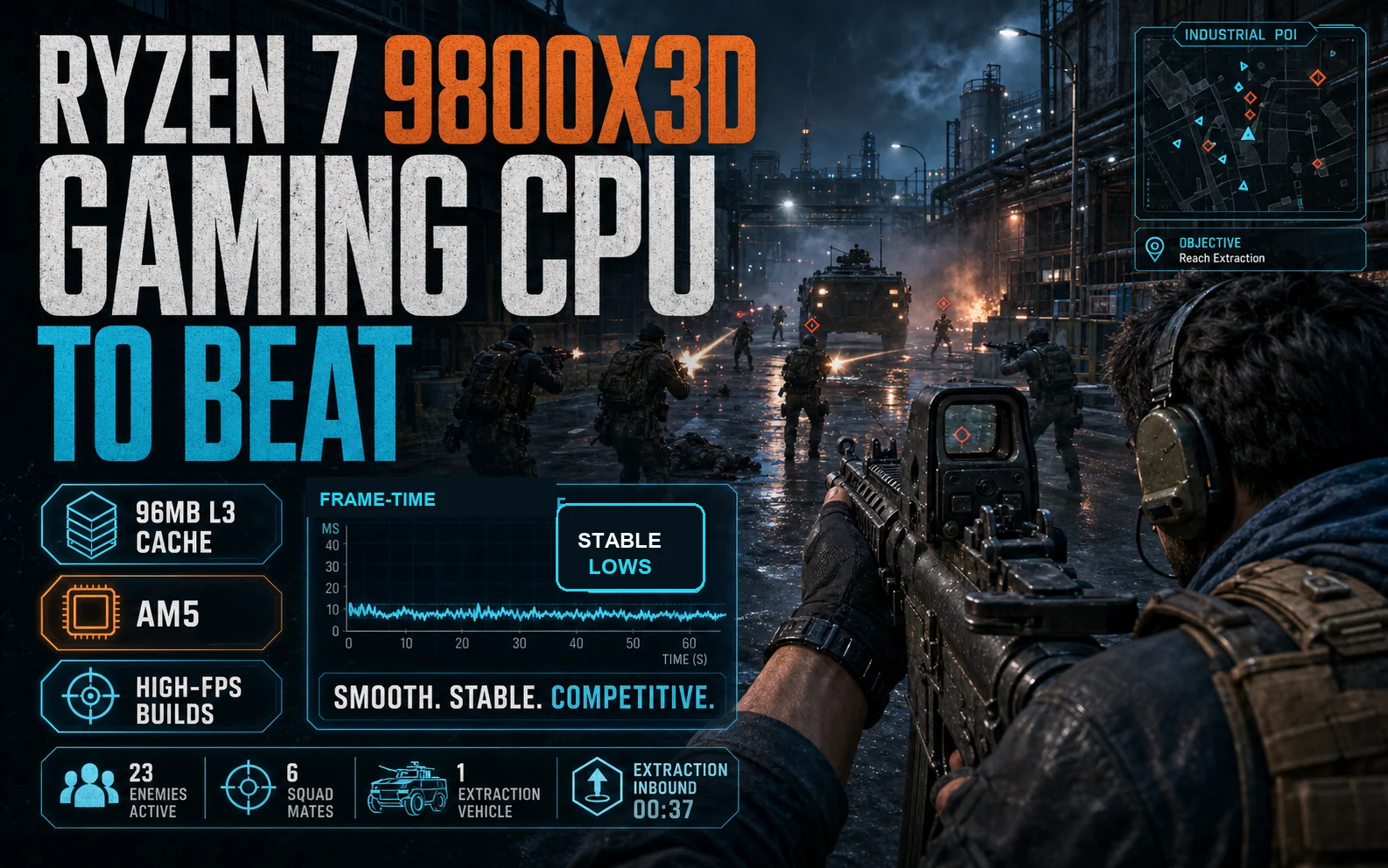
This 9800X3D review has a simple buy call. At the checked Amazon price of $419.99, AMD’s cache-heavy gaming chip is still the first processor I would choose for a strong AM5 gaming build.
The Amazon page showed Amazon’s Choice, 4.8 stars from 5,408 reviews, and 3K+ bought in the past month. That is current buyer traction, not just launch-week hype. The clean caveat is platform cost. AM4 owners are adding a motherboard and DDR5 kit to the cart, so the real upgrade bill can jump fast.
Ryzen 7 9800X3D review verdict
The deal score is 8.7/10 at the checked Amazon row. Good fit when the PC is a new AM5 gaming build with an RTX 5070 Ti, RX 9070 XT, or faster card. I would skip this lane for a creator-first workstation because higher core count is the better spend.
| Buyer lane | CheapFPS call | Good fit when | Skip if | What would change the call |
|---|---|---|---|---|
| New AM5 gaming PC | Pass | You have an RTX 5070 Ti, RX 9070 XT, or faster card that can expose processor limits. | Your graphics-card budget would drop a tier to afford it. | A stronger bundle pushes total platform cost down. |
| Existing 7800X3D owner | Caution | A favorite game has rough lows even after tuning. | Your current games already feel smooth. | Resale value covers most of the swap. |
| Intel 12th/13th/14th gen gamer | Pass with platform math | You want stronger lows in cache-sensitive games. | Board and DDR5 cost eat the graphics-card fund. | An AM5 board bundle cuts the platform tax. |
| Creator-first workstation | Skip as the main answer | Gaming still decides the purchase. | Rendering, encoding, or compiling earns the upgrade money. | A higher-core desktop deal gets worse. |
| Strict budget build | Compare first | The 7800X3D savings only buy a small cooler upgrade. | The savings move you to a faster graphics card. | The older chip loses its discount. |
Check the current price on Amazon. I’d buy the 9800X3D for a new gaming build when the listing is clean, the seller path is clear, and the GPU budget stays intact.
Why the cache layout matters
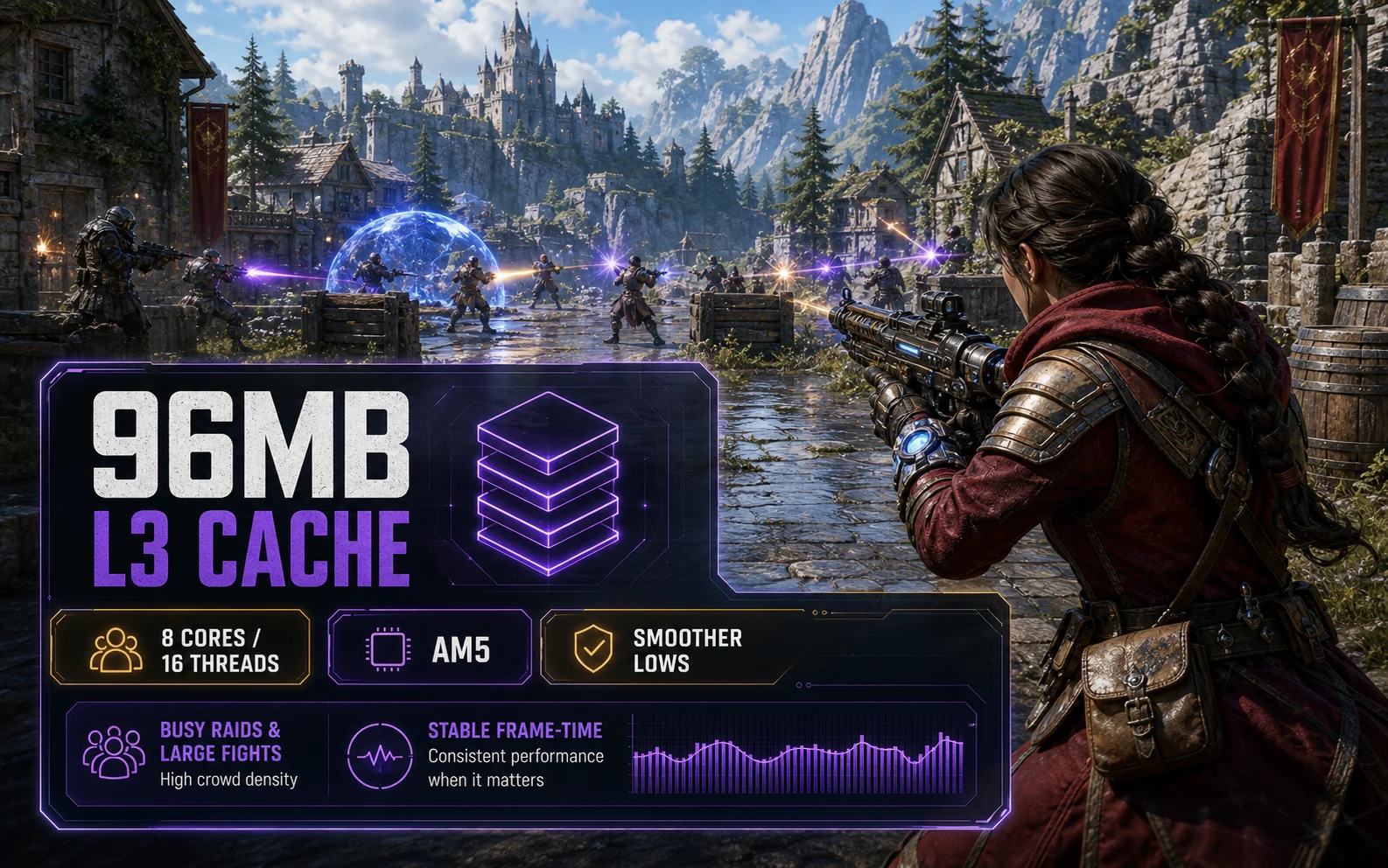
The 9800X3D is not a core-count flex. It has eight cores and sixteen threads. The useful trick is the 96 MB L3 cache pool. That cache gives game engines more local data before they wait on system memory.
Large cache helps most when a game keeps asking for nearby data. That can raise average frame rates. It can also improve low-frame consistency, which is what players notice during raids, large fights, or busy sim turns.
The Zen 5 version changes the physical stack. TechPowerUp explains that AMD moved the 3D V-Cache under the cores. That improves the heat path to the heatspreader. The result is a cache-heavy chip that clocks higher than the older layout allowed.
AMD’s own spec page lists a 4.7 GHz base clock and up to 5.2 GHz boost. It also lists 96 MB of L3 cache, a 120W default TDP, AM5 support, and unlocked tuning. That last point matters for buyers who use PBO instead of running everything at stock forever.
Gaming performance is the reason to pay
Tom’s Hardware gave the chip a blunt headline: devastating gaming performance. In that launch test suite, it beat Core Ultra 9 285K by about 35% on average. It also beat Core i9-14900K by about 30% on average.
GamersNexus reached the same broad conclusion from a different bench set. Its RIP Intel review called the 9800X3D the new gaming king. One useful example was Final Fantasy XIV Dawntrail. GN measured a 16.2% uplift over the 7800X3D and roughly 23% over 285K in that test.
Those numbers do not apply evenly to every game. PCMag found smaller gaps in some AAA tests. At 4K, the graphics card often decides more of the chart than the processor does.
The best use case is narrower and stronger. Buy this chip for high-refresh 1080p or 1440p play with a fast graphics card. It also fits simulation games and big multiplayer maps where the processor keeps feeding the card. One average benchmark cannot describe every title.
The current price makes it easier to recommend
The launch price was $479. The live Amazon row checked for this article was lower. Tom’s Hardware and PC Gamer also showed backup comparison widgets from roughly the high $430s to mid $460s.
The lower street price removes the launch-tax argument. It also narrows the gap against older X3D deals. That helps most when you are already buying a fresh board, memory kit, and cooler.
The 7800X3D is still the pressure point. A big discount on the older chip can protect $80 to $120 for the graphics card, SSD, or monitor. A small gap favors the newer chip because the rest of the AM5 build costs the same.
For cheaper AM5 thinking, read the CheapFPS 7600X3D buying check. That lane fits shoppers who need the saved money for the graphics-card budget.
The 7800X3D question
I would not upgrade from a healthy 7800X3D just to win a benchmark screenshot. The older chip remains excellent. It still has the cache behavior that made the X3D line famous. The upgrade only becomes sensible for a specific pain point.
The real upgrade case is low-frame consistency in a favorite game. A title that leans hard on memory latency can expose the old chip. Smooth games do not justify the swap.
New builders have a different choice. They are not paying an upgrade tax from a good chip. They are choosing the first part for a new platform. In that case, I prefer the newer X3D chip unless the older one funds a higher GPU tier.
Where it is the wrong tool
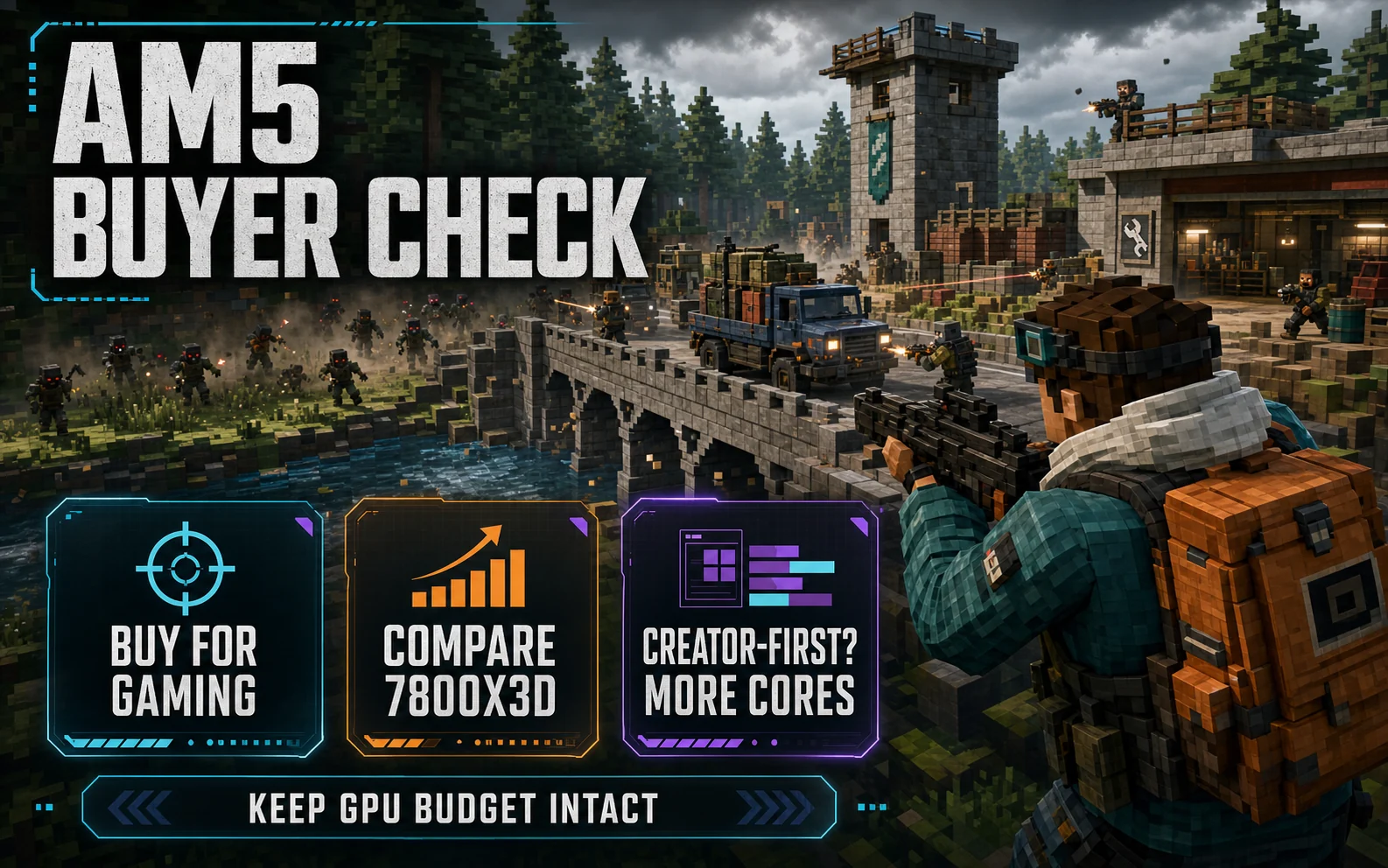
GamersNexus points out the obvious weakness. This is not the most competitive production-work chip. Heavy rendering, long video exports, compile jobs, and multi-app creator workloads can reward more cores.
That is where a higher-core desktop chip makes more sense. A 9900X or 9950X can be a better work machine. The gaming lead is not enough when the PC earns its keep through thread-heavy work.
The other blocker is platform cost. AM5 means a compatible motherboard and DDR5. It also means no boxed cooler. A quality tower cooler is fine for many builds. A good liquid cooler makes sense if you plan to tune PBO and keep boost behavior steady.
Bottom line
This 9800X3D review lands on a clear answer. For a gaming-first AM5 build, this is still the processor to beat. Intel’s recent high-end desktop chips do not change that call.
Buy the 9800X3D on Amazon when the live price is close to the checked lane and the listing looks clean. Compare the current 7800X3D price on Amazon before checkout. The older chip gets interesting when the savings can fund a better graphics card.
Checked today
This page uses a live Amazon product-page check, AMD’s official spec page, and named reviews from Tom’s Hardware, TechPowerUp, PC Gamer, GamersNexus, and PCMag.
Prices and availability checked May 17, 2026. Amazon showed $419.99, Amazon’s Choice, 4.8 stars from 5,408 reviews, and 3K+ bought in the past month. Backup merchant context came from Tom’s Hardware and PC Gamer price widgets.
Listing caveat: Amazon also showed other sellers and used options, so check the active seller and return path before buying. Update trigger: revise this page if the Amazon row moves below the old budget gap, jumps above the launch-value lane, loses a clean listing path, or a higher-core X3D deal changes the gaming-build math.
Affiliate disclosure: CheapFPS may earn a commission from qualifying purchases through Amazon links.