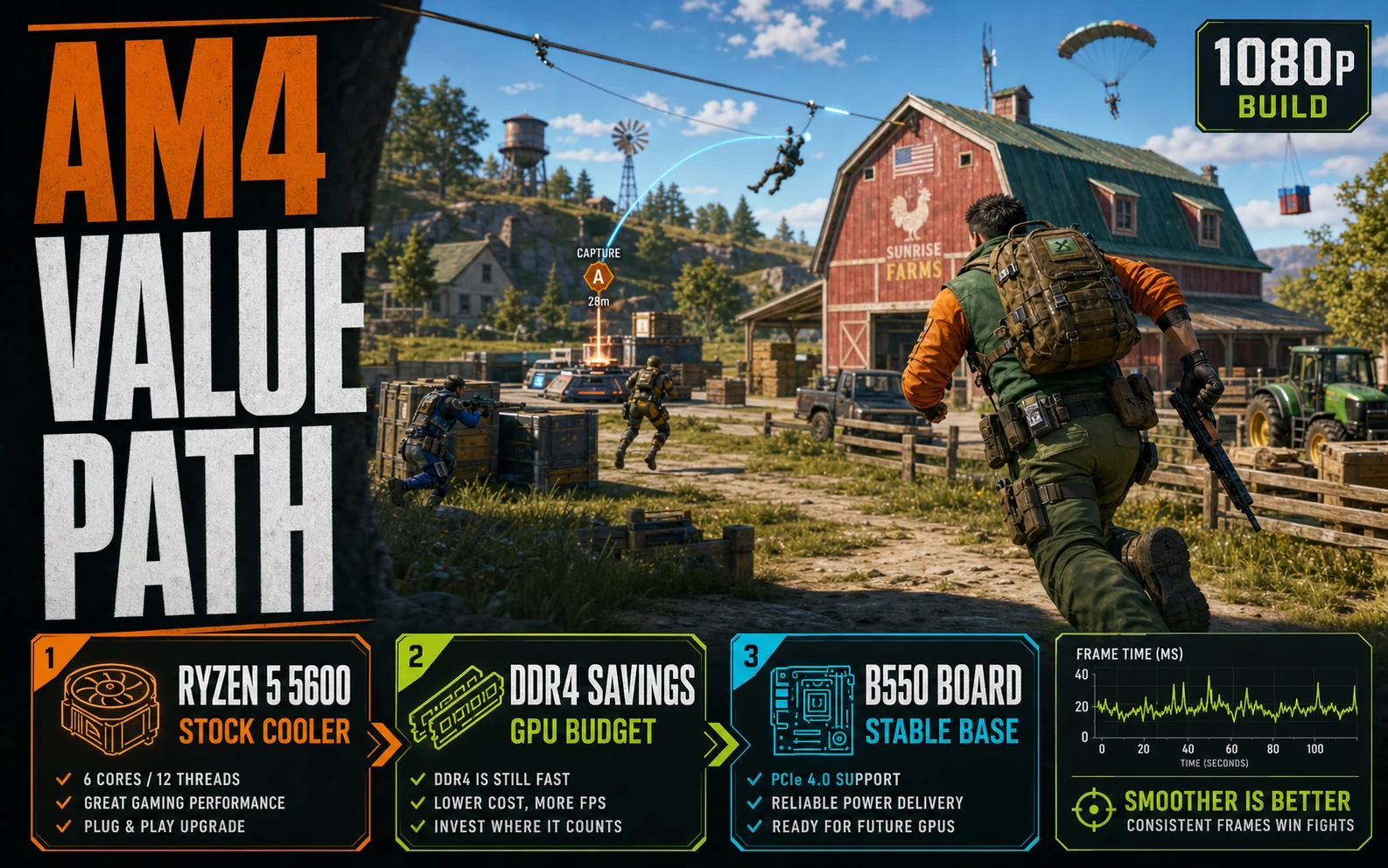
On a $650 to $800 parts list, the budget gaming CPU is the wrong place to chase a small spec win if the graphics-card tier drops afterward. On April 26, Newegg showed Ryzen 5 5600 rows from about $129.99, and Walmart showed the boxed chip at $147.95. Newegg also showed usable AM4 board rows starting around $69.99-$94.99, so that older platform still had the lowest finished-cart path I found today.
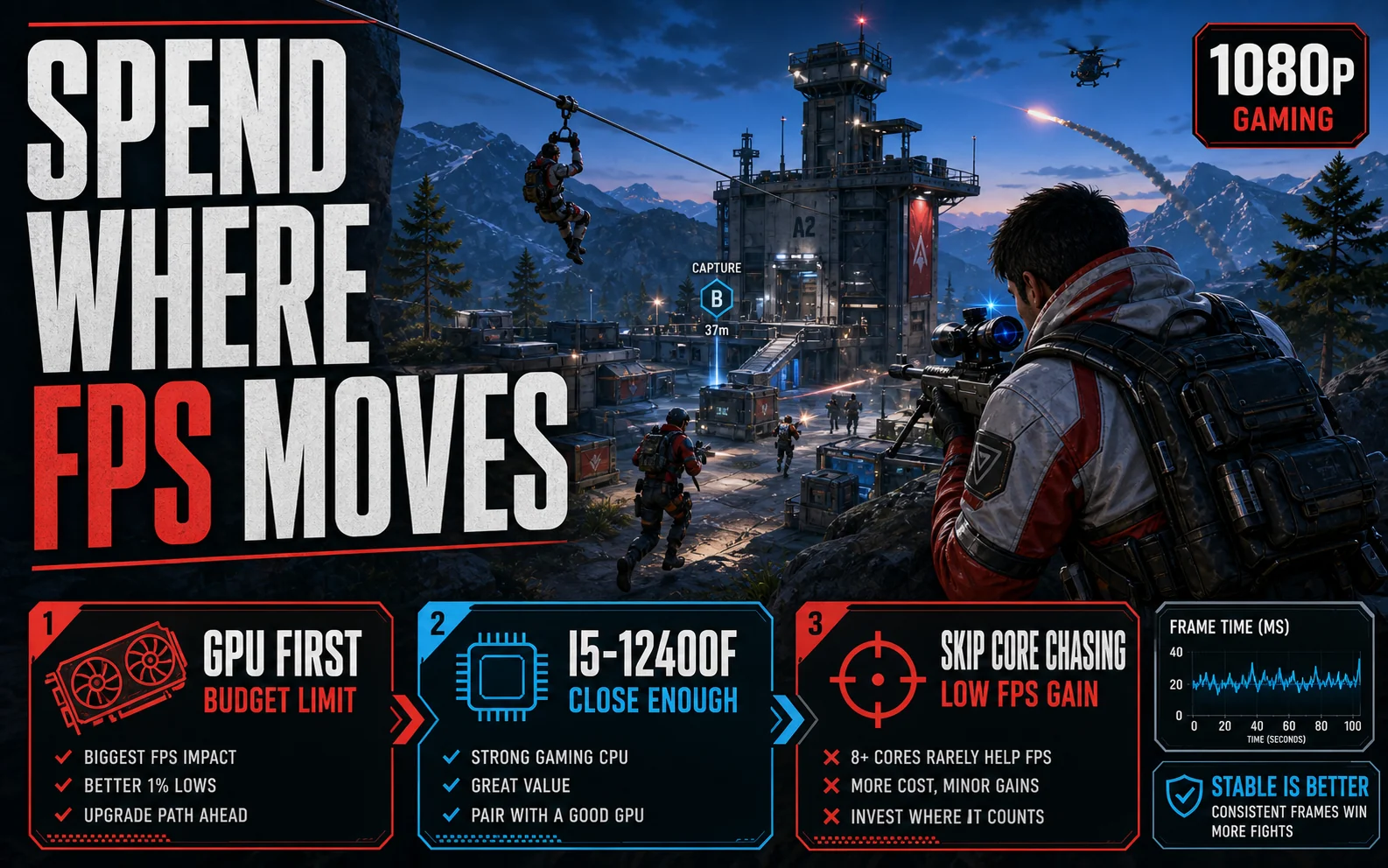
Core i5-12400F stayed close on the processor line: Newegg showed $157.47, and Walmart showed a retail-pack row at $159.16. The board line changes the Intel cart. A low LGA1700 row under one hundred dollars helps keep the same GPU class in the cart; the $140.99 Gigabyte row makes that harder.
How this page was checked: This page uses live Newegg and Walmart CPU searches, Newegg motherboard searches, Intel’s official 12400F spec page, and Tom’s Hardware’s April 26, 2026 game-test data for the AM5 X3D step-up; the work here is listing analysis rather than hands-on lab testing.
Affiliate disclosure: CheapFPS may earn a commission from some retailer links below, but the call here is based on platform total, stock quality, and source-backed game testing.
The CPU lanes I would actually price first
AM4 six-core + B550: pass, deal score 8/10 after April 26 Newegg and Walmart checks. Best for: a new-parts gaming GPU cart where the processor stays near $130-$150. Skip if: Newegg board rows under one hundred dollars dry up and the platform becomes harder to keep cheap. What would change my mind: a clean Intel cart lands within about twenty dollars, or an AM5 X3D bundle avoids any GPU downgrade.
Intel six-core + DDR4 board: caution, pass with the right board, deal score 7/10 after Newegg/Walmart CPU checks. Best for: buyers starting from zero who find the ASUS LGA1700 board row checked under one hundred dollars, because that helps keep the same GPU class. Skip if: the motherboard turns a small processor gap into a forty-dollar platform gap that makes the GPU choice harder. What would change my mind: repeated Newegg board rows near $100-$120 stay easy to buy instead of becoming one-off search results.
AM5 cache chip + AM5: pass as the game-first step-up, deal score 7/10 with Tom’s Hardware April 26 testing and Walmart/Tom’s $229.99 price boxes checked. Best for: CPU-limited games in the 17-game 1080p source suite. Skip if: the newer platform forces a weaker graphics card and makes mainstream 1080p gaming slower. What would change my mind: clean stock near two hundred dollars, or a bundle brings the full platform near the older carts.
AM5 non-X3D six-core: caution, deal score 6/10 after the $188.50 Newegg CPU row. Best for: buyers who want a newer socket and can keep the same gaming GPU. Skip if: the AM5 board and DDR5 cost eats the GPU step you meant to keep and makes 1080p gaming slower. What would change my mind: Newegg or Walmart AM5 board and memory bundles make the total land near the mature-platform carts.
The motherboard line decides more builds than the CPU box
The AM4 route works because Newegg showed multiple board rows that fit the cheap CPU lane: ASRock B550M PRO4, GIGABYTE B550M K, and MSI PRO B550M-VC WIFI. Those three Newegg rows keep the CPU-plus-board cart from depending on one odd listing.
The Intel route needs tighter filters. An ASUS B760M-AYW WIFI D4 II row kept that cart close to the AM4 lane during this Newegg check because it sat under one hundred dollars. MSI PRO B760M-P DDR4 and GIGABYTE B760M GAMING PLUS WIFI DDR4 rows pushed the LGA1700 cart higher, which is where Intel can stop protecting the rest of the machine.
A processor-only comparison misses the motherboard row that actually changes the cart. If a Newegg B760 or B550 board spread pushes the graphics card down a tier, the buyer gets a slower 1080p gaming PC with a nicer CPU receipt. If the board still lets you keep the same graphics-card class, the Intel route stays live.
Board features also change the first upgrade. Four memory slots are easier to live with than two. A second M.2 slot makes adding a larger game drive cleaner. Wi-Fi is useful when the PC will sit far from Ethernet; paying a large premium for wireless is worse than buying a cheaper board and adding an adapter later.
Pay for AM5 when the game or upgrade plan earns it
Tom’s Hardware gave the X3D step-up a fresh proof point on April 26, 2026. In its 17-game CPU suite with an RTX 5090 FE at 1080p, Ryzen 5 7600X3D landed 4.5% behind the eight-core 7800X3D, 10% ahead of Core Ultra 5 250K Plus, and 22% ahead of 7600X in the geomean. Tom’s Hardware used an RTX 5090 FE at 1080p to expose CPU gaps, so a budget GPU build should treat those percentages as processor proof rather than a whole-PC FPS promise.
Tom’s Hardware’s game-level results explain where the cache money can pay off: the review reported a 35% uplift over 7600X in Baldur’s Gate 3. The same review put the AM5 cache chip 44% ahead of both Core Ultra 5 250K Plus and 7600X in Final Fantasy XIV. Counter-Strike 2 and Cyberpunk 2077 showed smaller leads, so the step-up fits specific game behavior rather than every budget build.

I would pay for that step-up for Counter-Strike 2-style competitive play, Flight Simulator-style workloads, or MMO raids where Tom’s Hardware-style CPU-limited testing matches the buyer’s games. I would not pay for it in a tight $600-style cart if the newer socket forces the graphics card down. A CPU upgrade that costs the GPU tier usually hurts more in mainstream 1080p games than it helps.
Newegg showed a non-X3D AM5 six-core row below two hundred dollars, which makes the newer socket tempting before the board and memory are counted. Walmart and Tom’s price boxes showed the cache model in clean low-two-hundreds rows, while Newegg’s higher rows made merchant choice an upgrade-risk check for the AM5 step-up.
No iGPU, weak boards, and the double-pay trap
The Ryzen 5 and Core i5 lanes checked here both need a discrete graphics card. Intel’s official page lists the 12400F as a six-core, twelve-thread processor with a 65W base-power rating, and the F-series part has no integrated graphics. Newegg’s 5600 rows also showed no integrated graphics. A buyer waiting two weeks for a GPU cannot use the Intel F-series chip or the Newegg 5600 row as a temporary display output.
The bigger risk is a $40 Newegg board gap that weakens the GPU tier and makes the finished 1080p PC slower. A pricier AM5 or LGA1700 platform can look smarter on a processor chart while giving the finished PC a slower graphics card. In most budget gaming builds, that slower GPU changes game settings before a small CPU lead helps.
Board underspending creates a different repair bill. A single M.2 slot can make the first storage upgrade more awkward. A board that costs too much erases the reason you picked a budget processor, while a board that cuts too far turns the first upgrade into cleanup work.
The regret case is paying twice: once for the CPU badge, then again when the finished PC needs the graphics card, drive room, or board feature that got cut to afford the badge.
What I checked today and when this changes
For most cheap new-parts gaming builds, the older AMD lane still gets the first cart check because live CPU and board rows keep the total low. The Intel path works when the board stays near the lowest checked row. The AM5 cache part is the step-up when the buyer can pay for the newer platform without downgrading the graphics card.
- Checked today: Newegg and Walmart supplied live CPU lanes. Newegg supplied the board-row checks. Tom’s Hardware supplied April 26 game-test context. Intel supplied official 12400F specifications.
- Price lane: AM4 CPU-plus-board examples were roughly $210-$225 at Newegg, which helps protect the GPU budget. Representative Intel DDR4 examples were roughly $257-$280, which makes the board-price check more important. The AM5 X3D low row sat in the low two-hundreds before board and memory cost, so the full platform can still make the GPU choice harder.
- Merchants checked: Newegg, Walmart, Best Buy search/splash, Tom’s Hardware price comparison, and Intel product specs.
- Availability: Newegg and Walmart CPU rows were usable. Best Buy did not provide a reliable fetched product price. Newegg’s AM5 X3D rows were marketplace-noisy above the low Walmart/Amazon price boxes.
- Stock caveat: search pages mix boxed, OEM, international, used, and marketplace rows, so this guide uses rounded price lanes instead of treating one row as the whole market.
- Update trigger: a clean AM5 X3D row near two hundred dollars, sustained low Intel-board stock, or a 5600 price jump above roughly one hundred fifty dollars would change the recommendation.
For a budget gaming CPU, the checkout test has three separate parts: keep the graphics-card class you meant to buy, keep enough drive room for your actual game library, and pick a motherboard that makes the first upgrade straightforward instead of turning it into cleanup work.
- Check current AMD AM4 CPU rows at Newegg
- Check current AM4 CPU rows at Walmart
- Check current Intel six-core rows at Newegg
- Compare current AM4 motherboard rows
- Compare current Intel DDR4 motherboard rows
Prices and availability checked April 26, 2026.