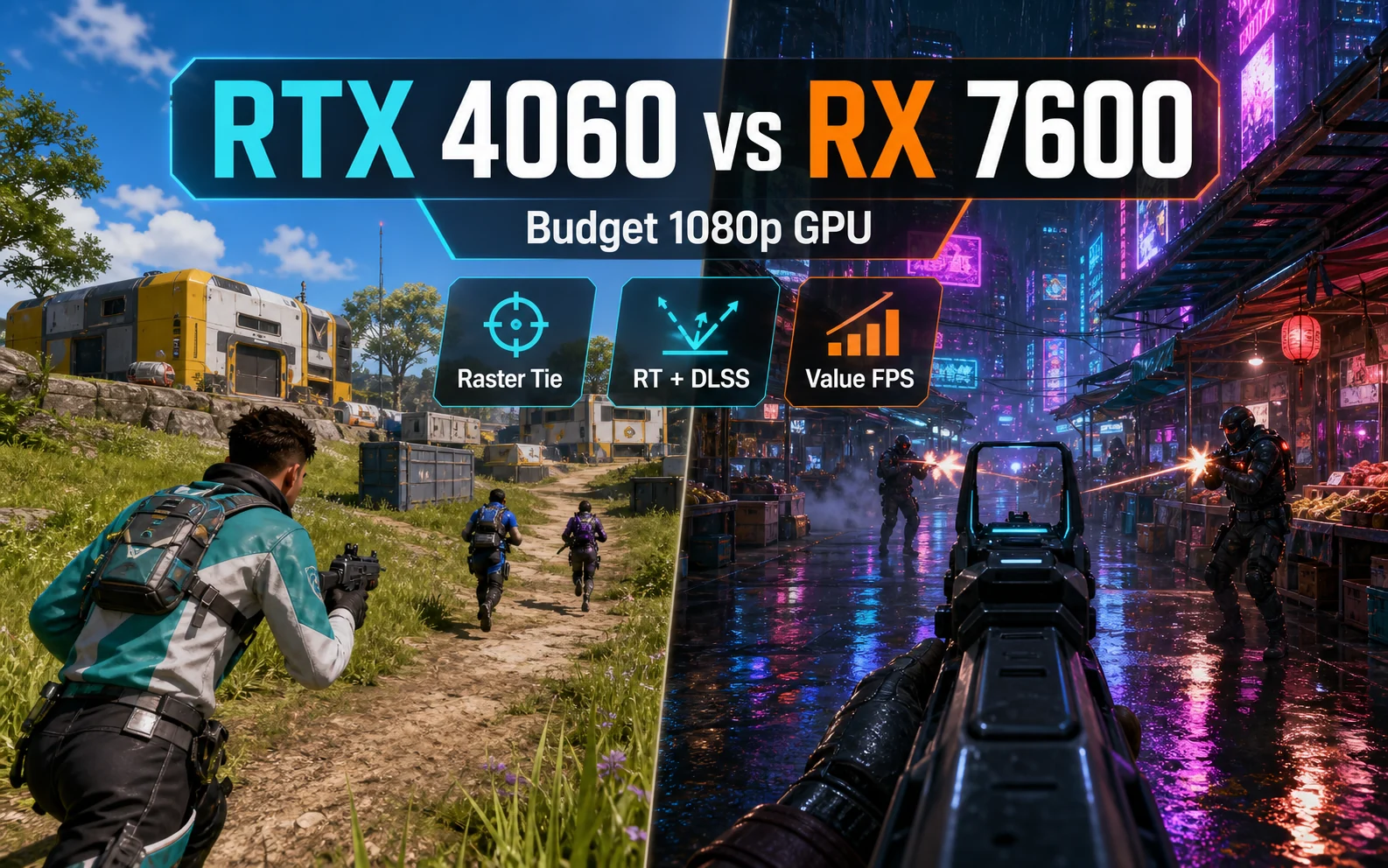
The RTX 4060 and RX 7600 have been fighting over the same shelf space for over a year now — and in 2026 they’re still the two most sensible cards to consider if you’re gaming at 1080p on a budget. One costs $50–70 more. The other has a few things the pricier card doesn’t. Here’s the honest breakdown.
| Spec | RTX 4060 | RX 7600 |
|---|---|---|
| Street price (May 2026) | $259–$289 | $189–$219 |
| VRAM | 8 GB GDDR6 | 8 GB GDDR6 |
| TDP | 115 W | 165 W |
| 1080p rasterized (avg) | ~Tie | ~Tie |
| Ray tracing | 40–42% faster | Functional |
| Upscaling | DLSS 3 + Frame Gen | FSR 3 + Frame Gen |
| Recommended PSU | 550 W | 600 W |
| Best for | Ray tracing, efficiency, DLSS titles | Frames-per-dollar, competitive 1080p |
Price and what you actually pay
Street pricing in May 2026 puts the RX 7600 at roughly $189–$219 and the RTX 4060 at $259–$289. That gap is consistent and meaningful — you’re looking at a $50–70 difference depending on the specific model and retailer. Check live prices at Amazon and Newegg for the 7600; for the 4060 try Amazon and Newegg. GPU pricing shifts week to week.
RTX 4060 vs RX 7600 at 1080p — closer than you’d expect
Across a wide game library at 1080p, these two cards trade blows almost constantly. Some sources give the RX 7600 a slight edge in pure rasterized performance averaged over 100+ titles; others show the RTX 4060 a few percent ahead. The honest summary: at 1080p medium-to-high settings, neither card consistently dominates the other in traditional rendering. If you’re playing The Witcher 3, Cyberpunk 2077 (rasterized), Spider-Man Miles Morales, or most competitive titles, you’re splitting hairs between them.
Both cards deliver 60+ fps in virtually all current titles at 1080p high. In less demanding games — Fortnite, Valorant, CS2 — they’ll push 100–144+ fps easily, making them solid picks for high-refresh-rate 1080p monitors.
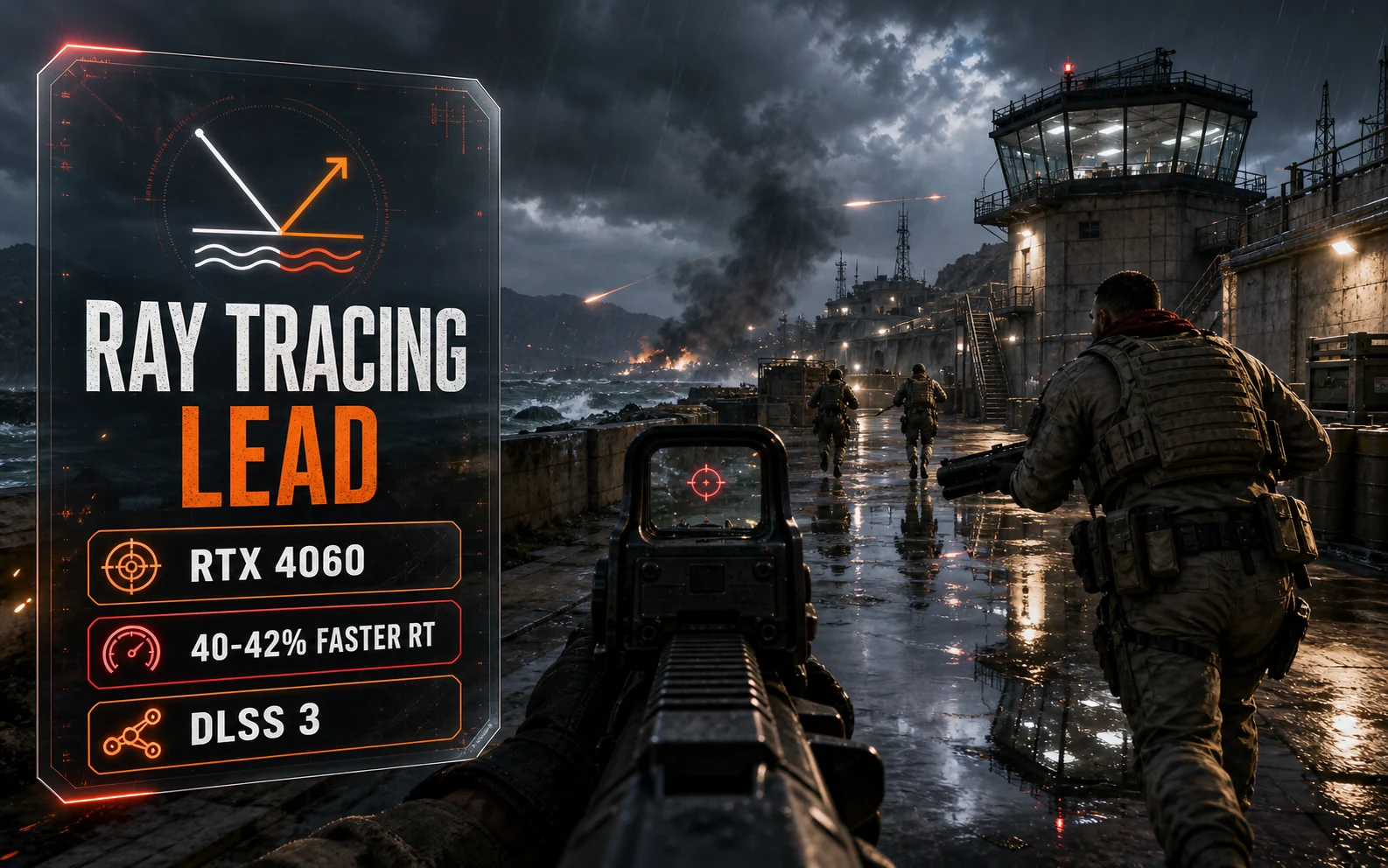
Ray tracing: Nvidia wins clearly
Turn on ray tracing and the gap opens up fast. The RTX 4060 is roughly 40–42% faster than the RX 7600 in ray-traced workloads on average. In Cyberpunk 2077 with RT Ultra and DLSS enabled, the 4060 pulls 20%+ more frames than the 7600 with FSR. AMD’s RT implementation in RDNA 3 is functional, but Nvidia’s is in a different league at this price.
If you play RT-capable games and actually want to use those features, the RTX 4060 is the only real choice between these two.
Upscaling: DLSS 3 vs FSR 3
Both cards have upscaling. DLSS 3 (RTX 4060) uses AI-based upscaling with Frame Generation — an extra AI-generated frame inserted between rendered frames, available in a growing list of supported titles. It’s genuinely good, and in supported games it can push framerates well beyond what raw rasterization delivers.
FSR 3 (RX 7600) is AMD’s answer. It works on any GPU, including Nvidia, but the card-specific Frame Generation benefit is only for AMD hardware. FSR’s image quality has improved significantly and it now supports most major titles. It’s not as sharp as DLSS at equivalent quality settings, but the gap has closed. For older or less technically demanding games, FSR 3 is good enough that you won’t notice the difference most of the time.
If you’re building a rig for AAA releases with heavy upscaling support (Cyberpunk, Warhammer 40K: Space Marine 2, Alan Wake 2), DLSS 3 is a real advantage. If your game list skews older or competitive, the FSR vs DLSS difference barely matters.
VRAM: 8GB on both, for now
Both cards ship with 8GB of VRAM, which is adequate for 1080p gaming in 2026 in most titles. Some newer releases push past 8GB at high textures at 1440p and above — at native 1080p, it’s rarely an issue today. If you’re planning to run either card for 3+ years, the 8GB ceiling is worth noting, but it’s not an immediate problem for either card.
If VRAM longevity is your top concern, the Intel Arc B580‘s 12GB at around $249 is worth a look as a third option.
Power draw and thermals
The RX 7600 draws roughly 165W under load; the RTX 4060 sits around 115W. That’s a meaningful difference — the 4060 runs cooler, generates less heat in your case, and is friendlier on your power supply. If your PSU is a 550W unit already under moderate load, the 4060’s lower TDP is a quiet but real benefit. The RX 7600 still falls within safe margins for any modern build, but the efficiency gap is real.
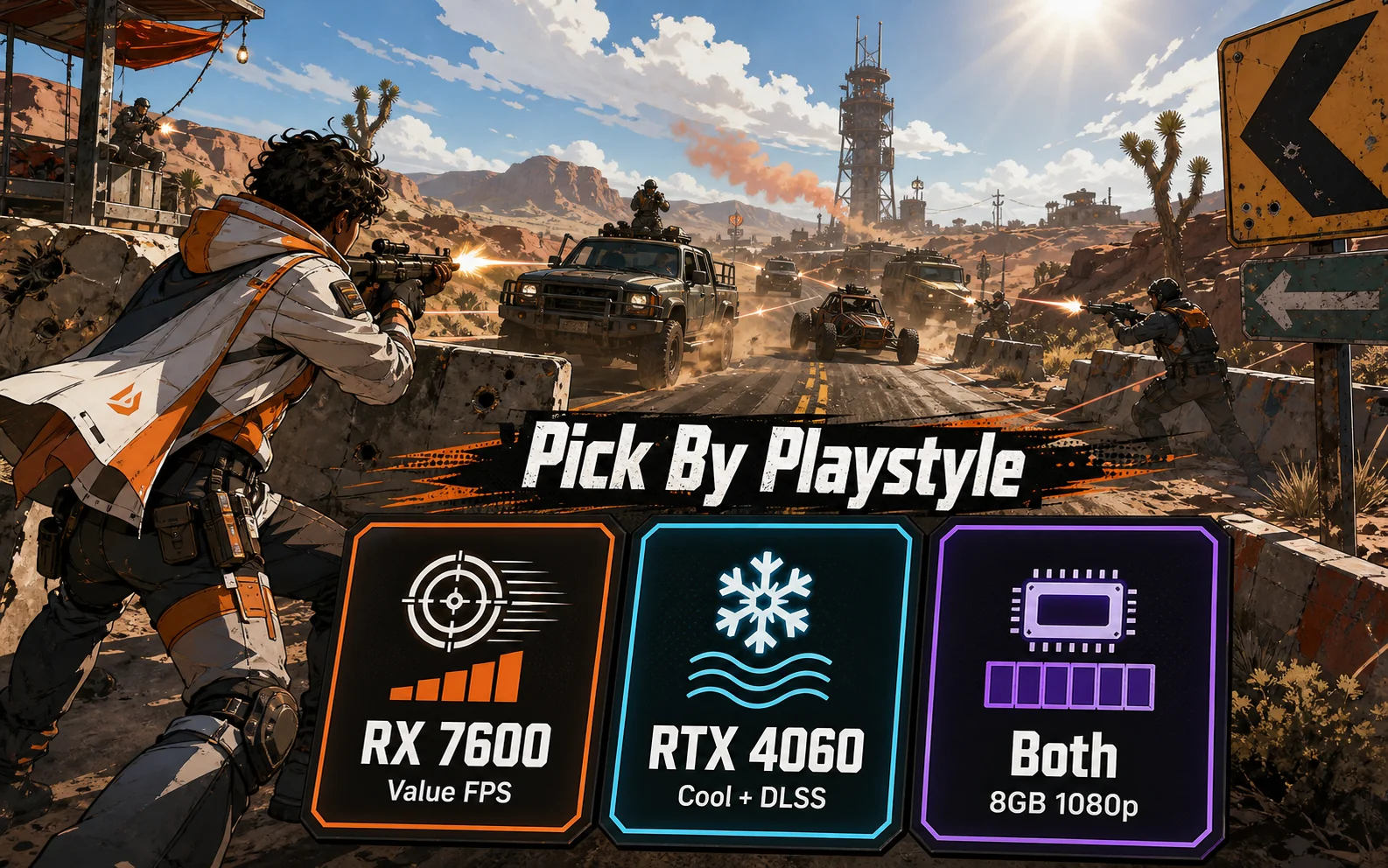
Who should buy the RX 7600
- Your budget ceiling is firmly under $230 and you want maximum frames per dollar at 1080p
- You play competitive games (Warzone, Apex, Fortnite) where RT doesn’t matter and raw FPS is the goal
- Your game list is mostly older or non-RT titles where FSR 3 vs DLSS 3 is irrelevant
- You’re fine with slightly higher power draw and want the cheapest path to solid 1080p gaming
Who should buy the RTX 4060
- You want ray tracing to actually be usable — 42% faster RT is the deciding factor here
- Your game list is heavy on supported DLSS 3 titles and you want that Frame Generation boost
- You care about power efficiency and case temperatures in a smaller build
- You have the extra $50–70 and want the better long-term Nvidia ecosystem (driver stability, feature support)
Frequently asked questions
Is the RTX 4060 worth $50–70 more than the RX 7600?
For ray tracing or DLSS 3 Frame Generation, yes. The 4060 is roughly 40–42% faster in ray-traced workloads and has measurably better power efficiency. For pure 1080p raster in competitive games, no — the cards are essentially tied and the RX 7600 wins on frames per dollar.
Is 8 GB of VRAM enough in 2026?
At native 1080p, yes — both cards run modern AAA titles at high settings without VRAM-bound stuttering. At 1440p or with ultra textures the 8 GB ceiling shows. If you want headroom for 3+ years or you mix in 1440p, the Intel Arc B580 (12 GB, ~$249) is the better long-term pick.
Which PSU do I need?
A quality 550 W unit comfortably handles the RTX 4060. The RX 7600’s higher 165 W TDP pushes you toward a 600 W PSU, especially if you’re pairing it with a higher-end CPU or running tight cable margins.
Will the RX 7600 work with DLSS?
No. DLSS is Nvidia-only because it depends on Tensor cores. The RX 7600 uses FSR 3, which works on any GPU but produces slightly softer image quality at equivalent presets.
Should I wait for the RTX 5060 or RX 9060 instead?
Both are on shelves, but neither delivers a compelling jump in 1080p value at the $250–350 tier yet. If you can wait three to six months for price corrections you’ll likely see better $/frame ratios. If you need a card now, the 4060 and 7600 are at mature, stable street prices.
The verdict
At pure 1080p rasterized gaming, the RTX 4060 vs RX 7600 comparison is effectively a tie in rasterization. The $50–70 gap is what makes the decision: if you can stretch to the RTX 4060, you get meaningfully better ray tracing, better upscaling, and lower power draw. If you’re watching every dollar and rarely touch RT settings, the RX 7600 at $199–$219 is genuinely hard to argue with. Neither card is a bad purchase — it comes down to budget ceiling and what features you actually use.