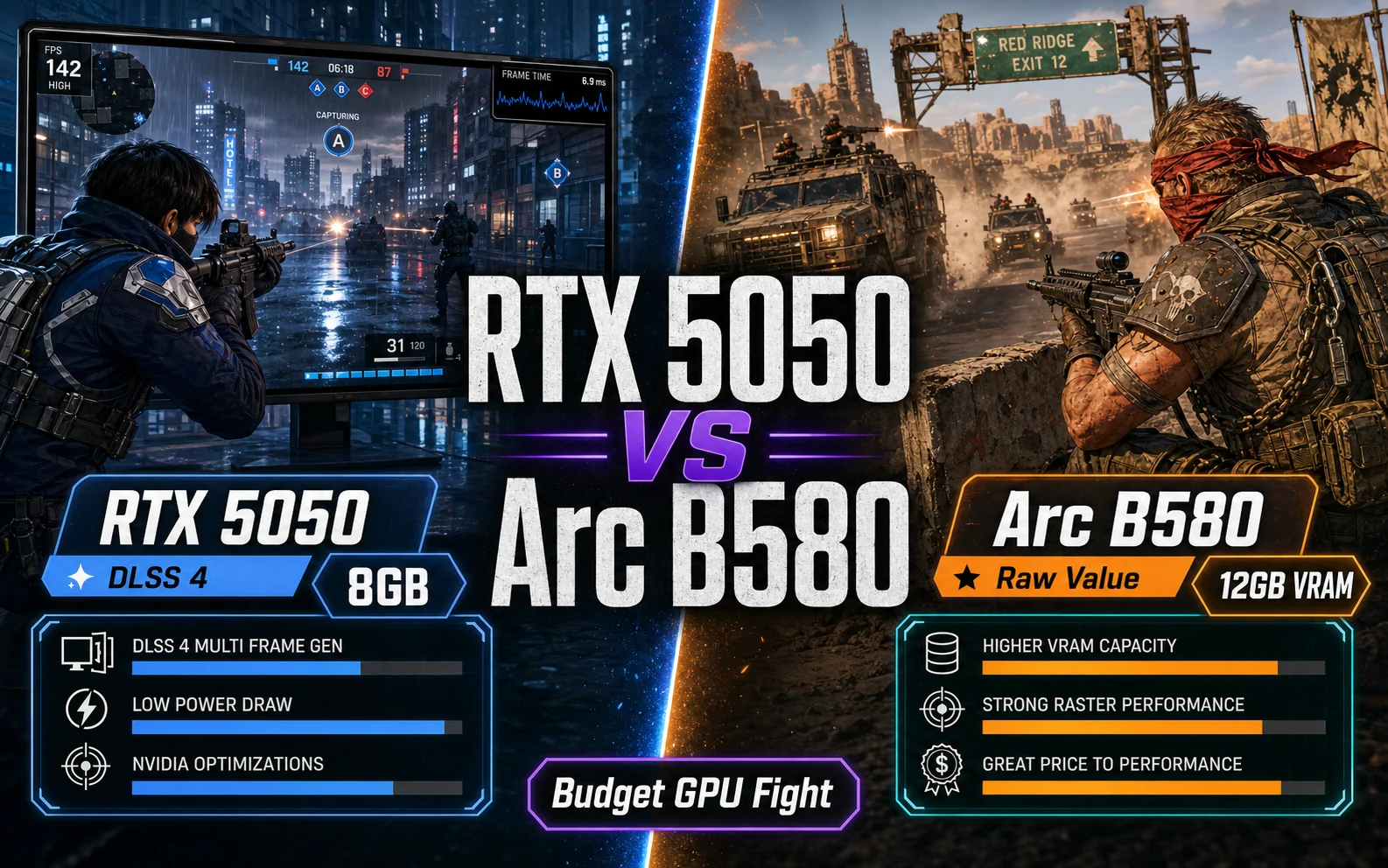
Nvidia finally has a card near the bottom of the stack again, and it walks straight into a fight Intel has been winning for over a year. The RTX 5050 lists at $249. The Arc B580, the card a lot of budget builders already wanted, sits right next to it.
On paper this looks close. In practice it’s two very different bets — one sells you 12GB and raw frames, the other sells you 8GB and a software trick that’s either brilliant or beside the point depending on what you play. So which is actually which?
What you’re actually choosing between
The RTX 5050 is a Blackwell card with 8GB of GDDR7 and a real-world price that’s drifted to roughly $270-300, though MSRP is $249 and it dipped near $219 during last year’s Black Friday rush. The Arc B580 carries 12GB and, after a rough launch where you couldn’t find one, has settled into the $250 to $290 range through most of 2026, near its $249 MSRP. Pricing on both has bounced around all year, so check before you commit.
At 1080p the two trade blows in raster, and it’s genuinely close — close enough that aggregate test suites put the B580 a couple percent ahead, with the 5050 landing within about 6% of an RTX 4060. That’s the headline a lot of people miss. Nvidia’s newest budget card is, in pure rasterized frames, a touch slower than a competitor that’s been on shelves since late 2024.
So why would you pay the same money, or more, for fewer frames and less VRAM?
The DLSS 4 wildcard
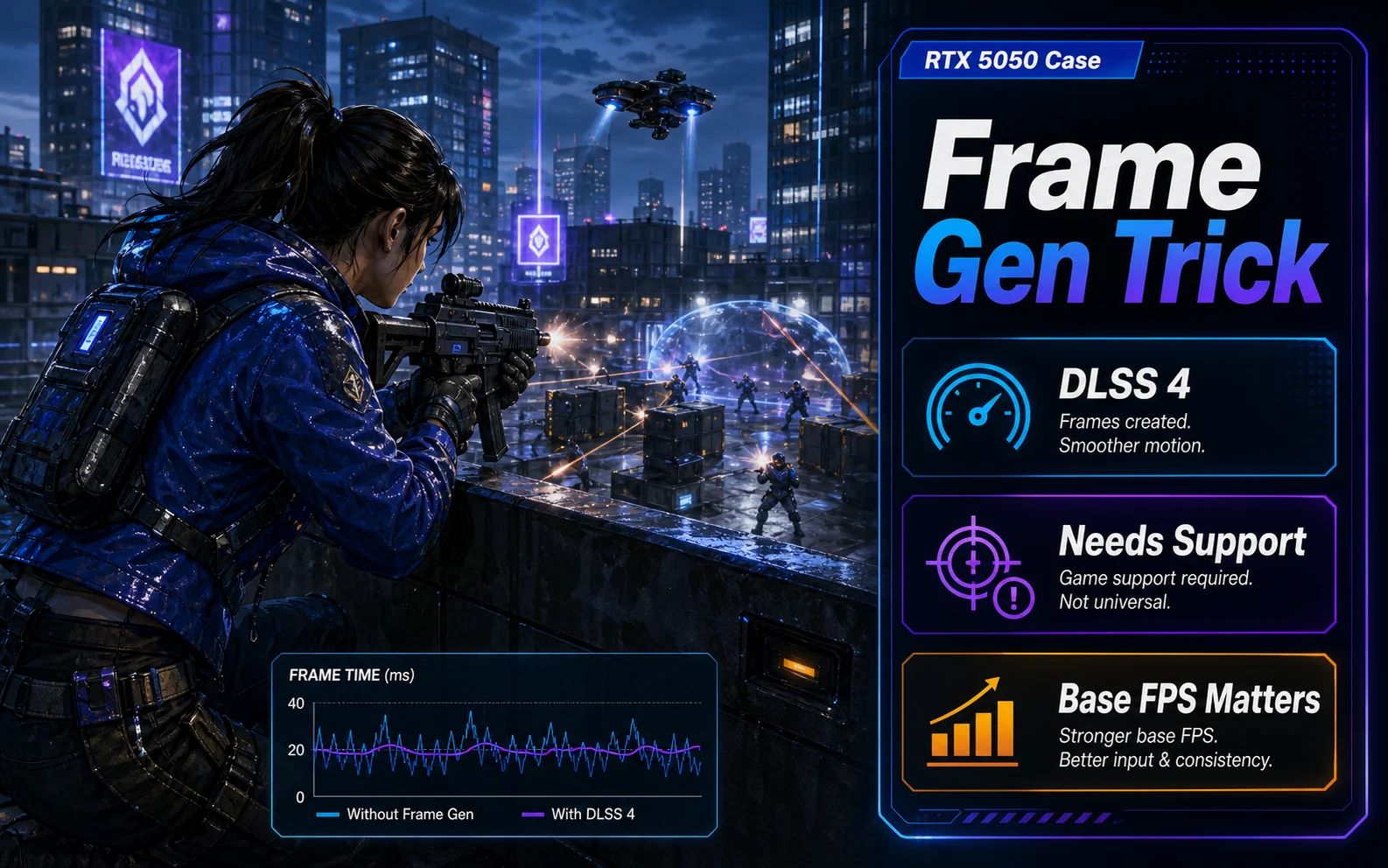
It comes down to frames you didn’t render. The RTX 5050 supports DLSS 4 multi-frame generation, which inserts up to three AI frames for every one the GPU actually draws. In a supported new release, that turns a borderline 45 fps into something that feels like 120+ on the display. It’s the single reason this card exists at this price.
It’s real and it works, but read the asterisks before you buy on it:
- It needs the games to support it. Multi-frame gen is per-title. Your favorite five-year-old shooter or your indie backlog won’t see it.
- It’s frame generation, not free performance. If your base framerate is already low, MFG smooths motion but doesn’t fix input lag — you feel the underlying 40 fps even when the counter says 130.
- 8GB is the hard ceiling. Modern titles at max settings can ask for more than 11GB, and when the 5050 runs out of buffer, no amount of frame generation saves it. Textures pop, 1% lows tank, and the experience falls apart.
For a buyer chasing new AAA games at 1080p with DLSS turned on, that trick is worth real money. For everyone else, it’s a feature you’ll mostly read about.
The VRAM argument for the B580
Intel’s card answers the 5050’s biggest weakness by simply having more memory. 12GB versus 8GB doesn’t matter much in older esports titles, but it absolutely matters the moment you turn on high textures or nudge toward 1440p. We dug into exactly that gap in our Arc B580 review, and the takeaway holds up: it’s the better card when VRAM is the bottleneck, which in 2026 is more often than budget buyers expect.
The B580 also tends to push more raw raster frames in the titles where its drivers behave, and Intel’s XeSS upscaling has matured into something you can actually leave on. If your library mixes newer and older games, that 12GB buffer is the safer long-term call. We laid out where it ranks against the rest of the entry tier in our best budget GPU for 1080p guide.
Where the B580 falls apart
It’s not a clean sweep for Intel, and pretending it is would be dishonest. The Arc cards still carry two real warts.
- Frame pacing isn’t always smooth. In some titles the B580 posts a fine average fps while the frame-time graph looks like a heartbeat monitor. You feel that as micro-stutter even at numbers that should be buttery.
- Driver overhead punishes weak CPUs. Pair a B580 with an older or low-end processor and it can lose a chunk of its lead to CPU-side overhead — exactly the kind of cheap chip a budget builder is likely to own.
The RTX 5050, for all its 8GB stinginess, just behaves. Nvidia’s drivers are boring in the good way, frame pacing is consistent, and it sips power — roughly 60W less than the B580 under load, a genuine perk on a tight 450-500W supply. Predictable has value when the card costs as much as your monthly grocery run.

Which cheap card to grab
Neither card is exciting, and that’s the fair way to frame this whole comparison — 2026 is a rough year to shop the bottom of the GPU stack, with budget VRAM stretched thin and prices that don’t reward patience. But if you’re buying one of these, the split is clean.
Get the RTX 5050 if you mostly play current AAA releases at 1080p, you want DLSS 4 multi-frame generation, you value rock-steady frame pacing, or you’re working with a small power supply. The 8GB ceiling is real, so keep your texture expectations at 1080p and don’t dream about 1440p.
Get the Arc B580 if you want the most raw value, you care about that 12GB buffer aging gracefully, and you’re pairing it with a reasonably modern CPU rather than a hand-me-down quad-core. It’s the better card for a mixed library that you don’t want to upgrade again in a year.
If your budget can stretch, the RX 9060 XT vs RTX 5060 matchup is where the actual value lives this year. And if you’re open to going used, a relaunched 12GB card like the one in our RTX 3060 piece can still hold the line for less. But between these two? B580 for value and VRAM, 5050 for new games and frame-gen. Match your library, not the spec sheet.
Quick answers
Is the RTX 5050 faster than the Arc B580?
In raw 1080p raster, no — the two are roughly even, with the B580 a couple percent ahead in aggregate testing. The 5050 only pulls clearly ahead in games that support DLSS 4 multi-frame generation, where it can render far higher perceived framerates.
Is 8GB of VRAM enough for 1080p gaming in 2026?
For most 1080p games, yes, but it’s right on the edge. Some modern titles at maximum settings exceed 11GB, which forces the RTX 5050 to drop texture quality or stutter. The B580’s 12GB gives you more breathing room as games keep getting hungrier.
Does the Arc B580 work fine on a budget CPU?
Not always. Intel’s drivers carry overhead that can sap performance when paired with older or low-end processors. If you’re building around a cheap CPU, the RTX 5050 tends to deliver more consistent results despite its smaller frame buffer.
Is the RTX 5050 worth buying at $249 in 2026?
Only if DLSS 4, low power draw, or smooth frame pacing matter to you. At that price you’re paying for Nvidia’s feature set, not raw performance. If you just want the most frames and VRAM per dollar, the Arc B580 is the better straight value buy.