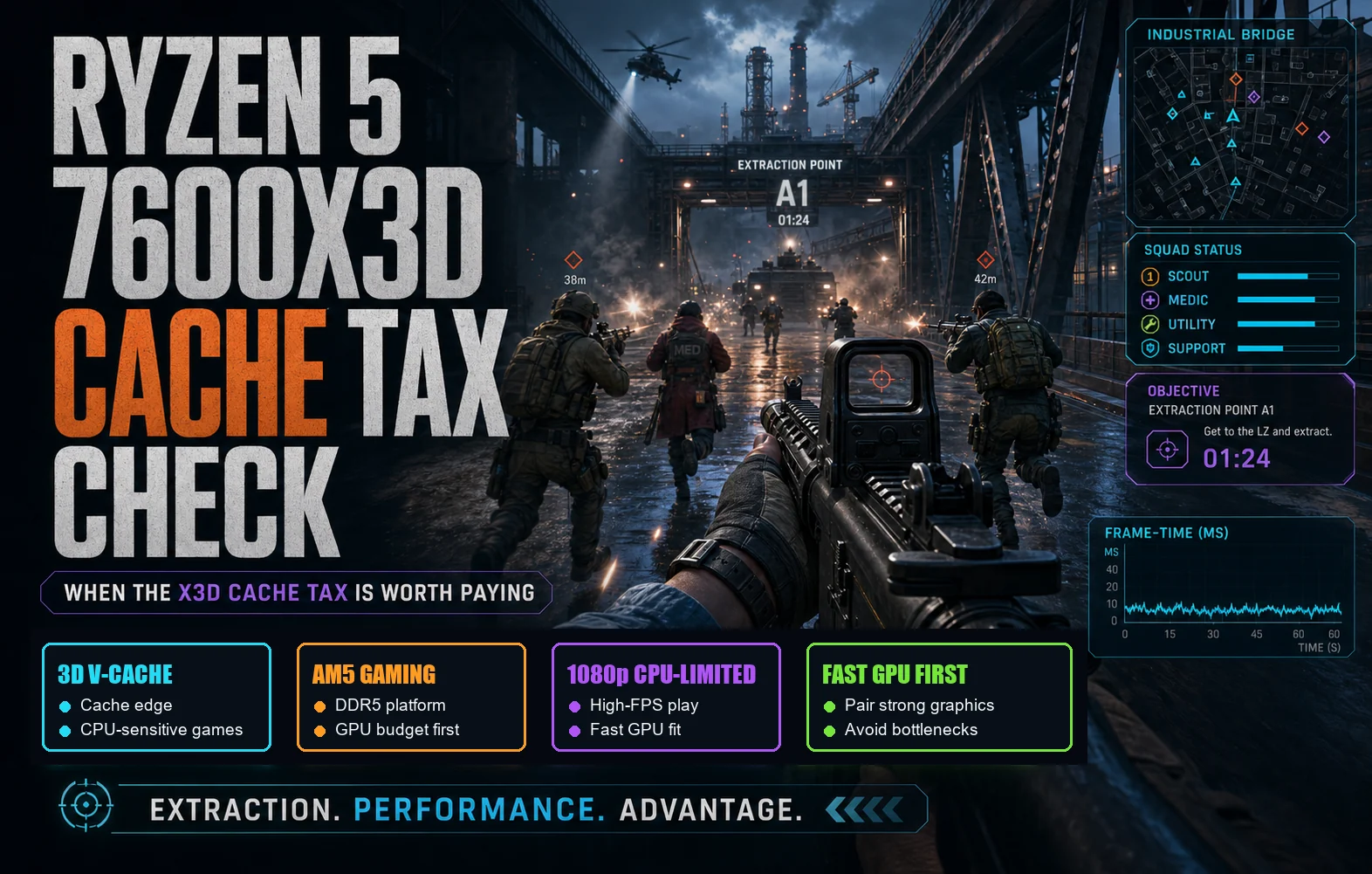
The Ryzen 5 7600X3D is AMD’s 3D V-Cache treatment on the 6-core AM5 chip — the same cache technology that makes the Ryzen 7 9800X3D the dominant gaming CPU at the high end, applied to a six-core part. The question isn’t whether 3D V-Cache helps in gaming. It does. The question is whether the price premium over the standard Ryzen 5 7600X or the Ryzen 5 9600X justifies it, and when that math actually works out.
What 3D V-Cache actually does in games
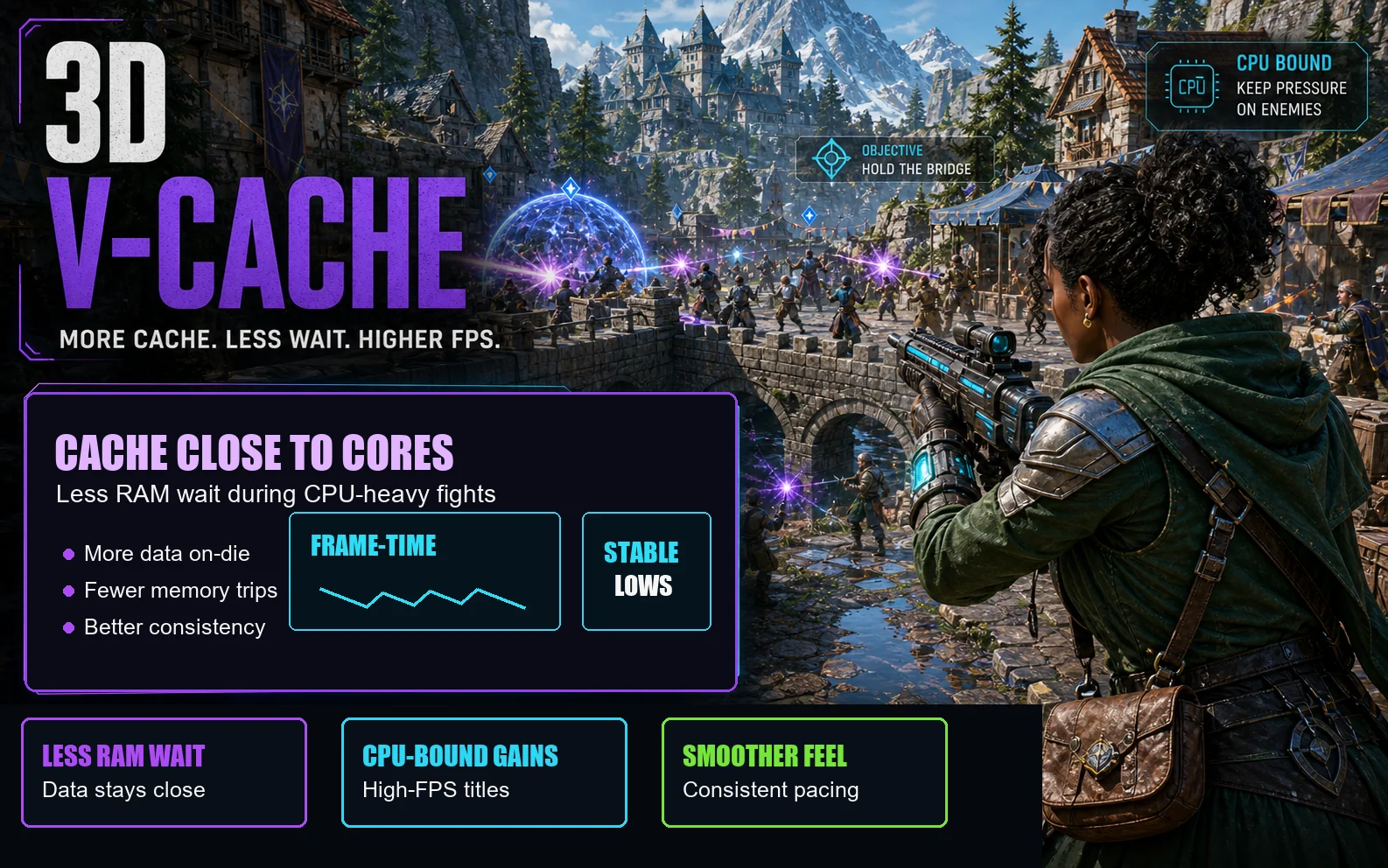
AMD’s 3D V-Cache stacks additional L3 cache directly on top of the CPU die, dramatically increasing the amount of data that can be stored close to the processor cores. In gaming, this reduces the frequency of cache misses — situations where the CPU has to reach out to slower system RAM for data it needs immediately. In CPU-limited scenarios (high framerates, fast-paced titles, games that heavily stress the processor), the result is a meaningful FPS improvement over the standard chip.
In GPU-limited scenarios — which describes most budget gaming builds paired with a mid-range GPU — the difference between the 7600X3D and a standard 7600X or 9600X is smaller. When the GPU is the bottleneck, the CPU rarely gets the chance to demonstrate its advantage. The 7600X3D earns its price premium most clearly in CPU-bound situations: 1080p gaming with a fast GPU, competitive titles with high framerate targets, and games that are known to be CPU-intensive.
The price comparison that matters
The Ryzen 5 7600X3D typically runs $200–$235 depending on where you shop and whether it’s on sale. The standard Ryzen 5 7600X runs $155–$175, and the newer Ryzen 5 9600X (a step-up chip on the same AM5 platform) runs $170–$190.
The 7600X3D’s premium over the 9600X is roughly $30–$50. For that you get 3D V-Cache gaming performance in CPU-sensitive scenarios but lose some multi-threaded throughput compared to the 9600X (the newer Zen 5 architecture in the 9600X is faster for productivity work). For a dedicated gaming build: the 7600X3D is the stronger choice. For a build that also does video work or heavy multitasking: the 9600X’s broader performance profile often wins.
The AM5 platform cost reality
The CPU price is only part of the equation. AM5 requires DDR5 memory and a new motherboard if you’re coming from AM4. A B650 motherboard runs $110–$140 for a solid option. DDR5-6000 (the sweet spot for Ryzen AM5 performance) costs $65–$85 for 32GB (2x16GB). An aftermarket cooler is recommended since the boxed cooler isn’t included with X-series chips — budget $30–$50 for something adequate.
Total AM5 platform cost (CPU + board + DDR5 + cooler) for a 7600X3D build: roughly $405–$510. Compare that to AM4 (Ryzen 5 5600 + B550 board + DDR4 + included cooler) at around $210–$240 for the same GPU and you understand why AM5 6-core builds make more sense for people upgrading an existing system than for first-time budget builders starting from nothing.
Where it fits in a build
The Ryzen 5 7600X3D makes the most sense in these scenarios:
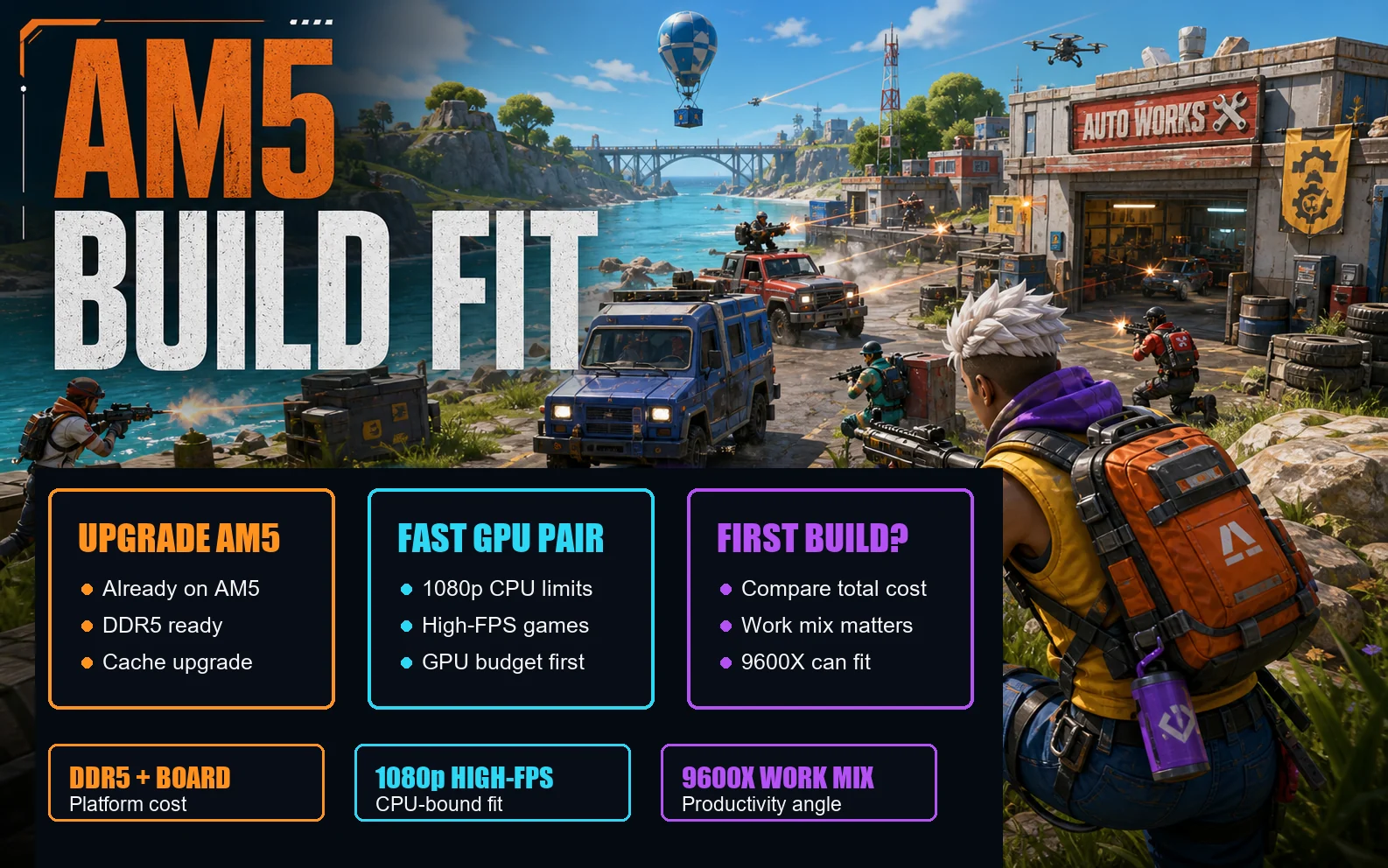
- You already have an AM5 platform (board + DDR5) from a previous build and are upgrading the CPU
- You’re pairing with a fast GPU (RTX 5060 or better) and plan to game at 1080p where CPU limits appear first
- You play competitive titles (CS2, Valorant, Fortnite) at high framerates where CPU headroom directly affects consistency
It’s harder to justify as the starting CPU in a first-time AM5 build when the total platform cost pushes past $450 before the GPU, case, storage, and PSU. At that point the Ryzen 5 9600X at $170–$190 delivers similar all-round performance for less money, and the 7600X3D’s gaming edge appears mainly in scenarios where you’re already bottlenecked by the CPU rather than the GPU.
Check current prices at Amazon and Newegg. The 7600X3D goes on sale periodically and the value case improves significantly when the gap to the 9600X narrows.