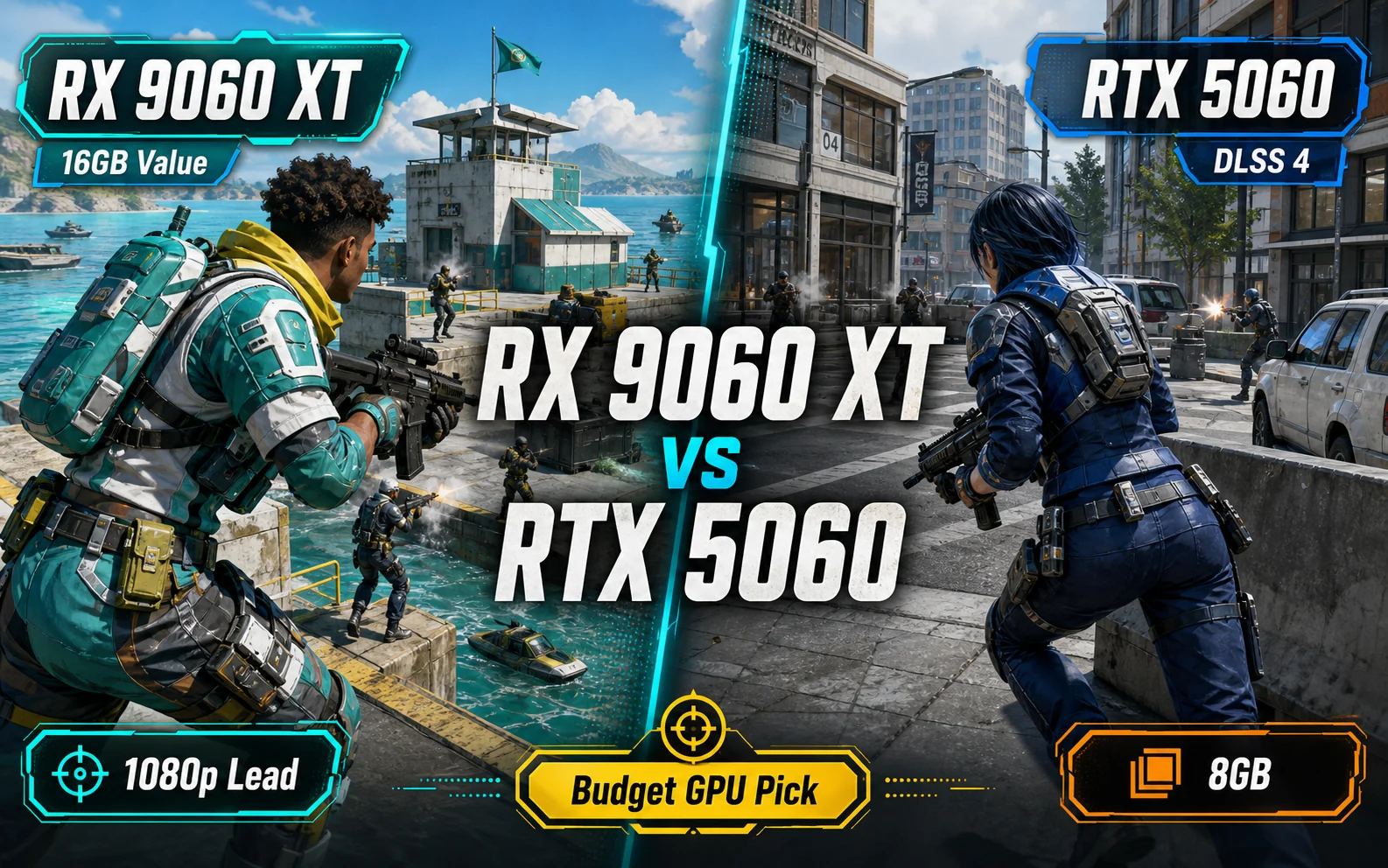
The math is uncomfortable for Nvidia in 2026: spend about $100 more than an RTX 5060 and AMD hands you a faster card with twice the memory. Not a little more memory. Double.
The RX 9060 XT vs RTX 5060 fight is the one most budget builders are actually having right now, and on paper it looks close. It isn’t, really. The 9060 XT 16GB lands around $448 as of early June 2026, the RTX 5060 sits near $330-350 depending on the day, and the gap between them tells a clearer story than the spec sheets do.
RX 9060 XT vs RTX 5060: what you’re paying for
Both cards target 1080p, both are this generation’s $300-class chips, and both lean hard on upscaling to hit their marketing numbers. That’s where the similarities thin out.
The RX 9060 XT 16GB carries 16GB of GDDR6 on a 128-bit bus. The RTX 5060 ships with 8GB of GDDR7 on the same width. Nvidia’s faster memory type narrows the bandwidth gap, but it cannot conjure capacity out of thin air — 8GB is 8GB, and in 2026 that number does real damage. The 9060 XT also draws a bit more power and runs a slightly larger die, which is the boring engineering reason it ends up ahead in raw raster.
Prices are jumpy right now, so treat both numbers as moving targets. The 5060 in particular has crept up from its $299 MSRP thanks to the same memory crunch hammering RAM and SSD buyers. If you can find a 5060 near $330, that’s a genuinely good price this year.
The 1080p raster gap is real, not a rounding error
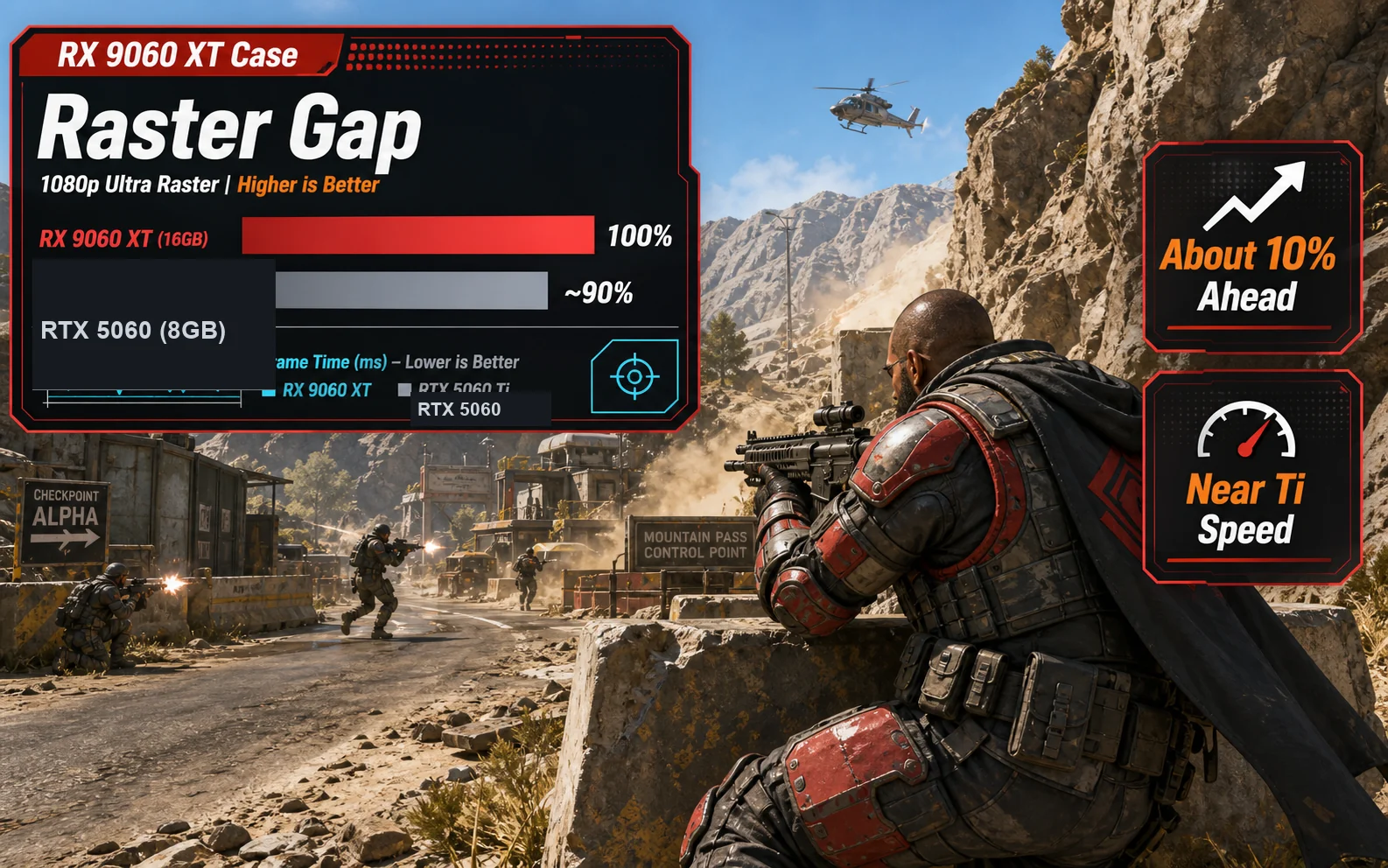
Across aggregate testing at 1080p, the RX 9060 XT 16GB runs roughly 10% ahead of the RTX 5060 — call it about 94 fps versus 83 fps averaged across a wide game suite. Some reviews push that lead as high as 13-17% depending on the title mix. Either way, it’s a margin you’d feel in a demanding game, not one you’d need a frame counter to notice.
That 10% puts the 9060 XT 16GB within a few percent of an RTX 5060 Ti, which is the more interesting comparison. You’re getting near-5060-Ti raster for clearly less money. We spelled that fight out in our RX 9060 XT vs RTX 5060 Ti breakdown, and the upshot is that the gap up to the Ti is smaller than the price jump suggests.
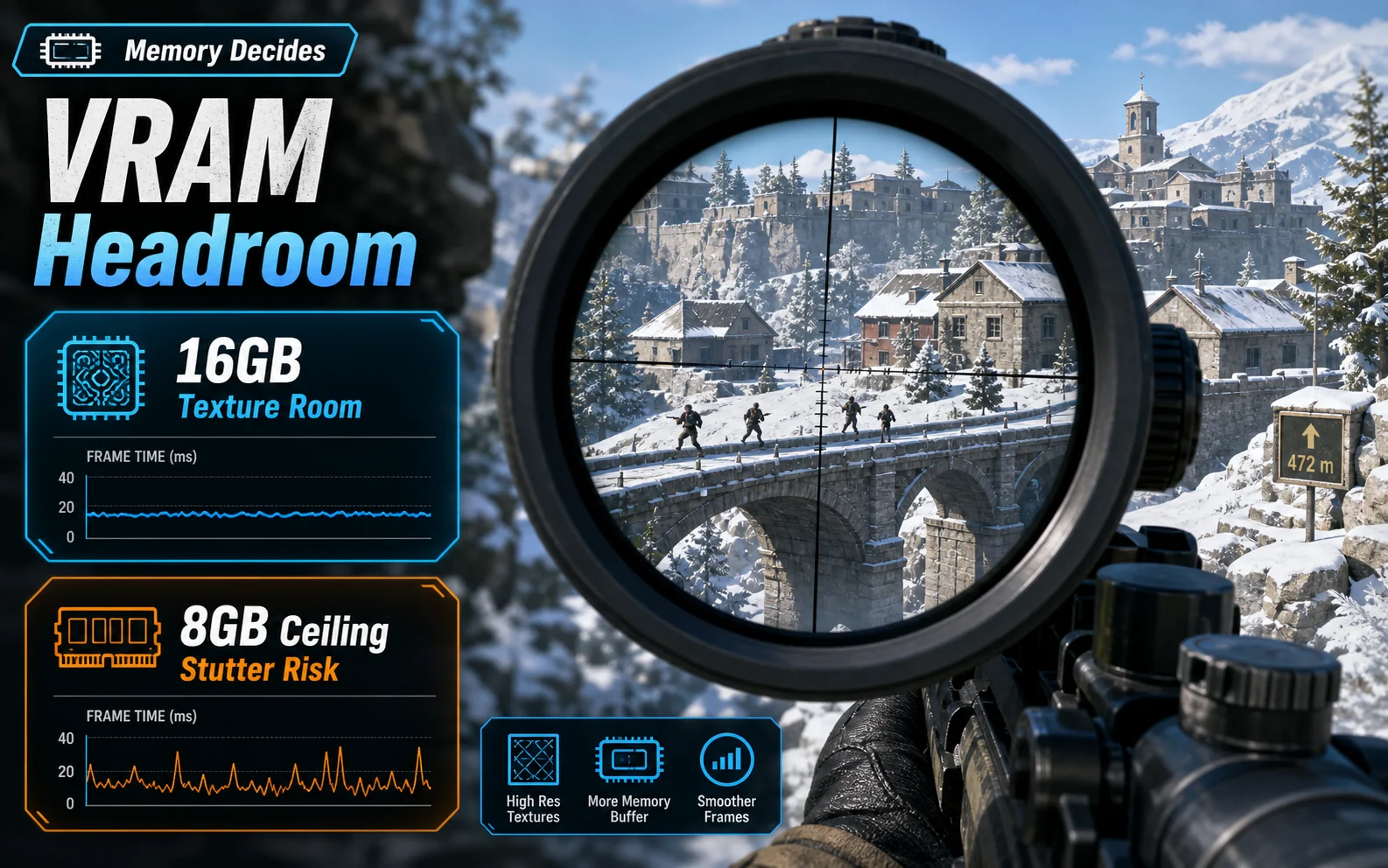
Push to 1440p and the picture gets even more lopsided. That’s where 8GB starts choking on texture-heavy modern games, and the 9060 XT’s extra memory keeps frametimes smooth while the 5060 stutters or quietly drops texture quality on you.
The VRAM question that decides it
This is the whole argument, so it’s worth being blunt. 8GB was a fine budget target in 2022. In 2026 it’s a liability, and not a future one — a present one.
- Texture settings get clipped. Several recent titles will silently drop to lower-res textures or hitch when an 8GB card runs out of headroom, even at 1080p with the settings you’d actually want.
- Ray tracing eats VRAM. Turn on RT and memory use climbs fast, which is the cruel irony for the 5060 — the feature Nvidia sells you needs the memory Nvidia didn’t give you.
- Longevity. A 16GB card has runway to stay relevant for years. An 8GB card is already negotiating with current games, and that conversation gets worse, not better.
This is the same trap that makes the 8GB version of Nvidia’s own step-up card a bad buy — we got into it in our look at the RTX 5060 Ti 8GB. The pattern keeps repeating: don’t buy an 8GB card in 2026 if a 16GB one is within reach of your budget.
Where the RTX 5060 earns its keep
I’m not here to pretend the 5060 is a bad card. It isn’t, and it genuinely suits some buyers better.
- Heavy ray tracing. Nvidia’s RT hardware is simply ahead. In path-traced or RT-heavy titles, the 5060 closes the raster gap and sometimes flips it, VRAM permitting.
- DLSS 4 and multi-frame generation. DLSS still has the edge on image quality and adoption, and its frame generation can output up to 4x frames where AMD’s tops out at 2x. In supported games that’s a real smoothness boost.
- Price and pure 1080p esports. It’s about $100 cheaper. If you live in Valorant, CS2, or Rocket League at 1080p, both cards already blow past your monitor’s refresh rate, and the cheaper one wins on value.
AMD has closed the upscaling gap more than people give it credit for, though. FSR 4 is now AI-based and looks genuinely close to DLSS in motion, a different story than the blurry FSR of two years ago. It’s not quite ahead, and it’s in fewer games, but close enough that you’d struggle to tell mid-fight.
How they stack up against the rest of the budget shelf
Neither of these is the cheapest way to game at 1080p, and that matters when money’s tight. If your ceiling is closer to $300, the RTX 5060 versus the older RTX 4060 is still a live question. Drop the budget further and Intel gets interesting: the Arc B580 offers strong raster value around $250 to $290 depending on stock.
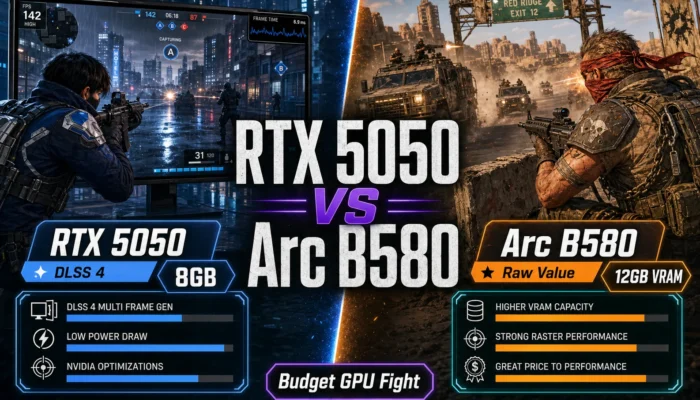
For the full ladder across every price point, our budget 1080p GPU guide lays out where each card fits. Shopping even lower? The RTX 5050 versus Arc B580 matchup covers the sub-$300 tier these two sit comfortably above.
So which one wins?
For most budget gamers in 2026, the RX 9060 XT 16GB is the buy. It’s faster at 1080p, it pulls further ahead at 1440p, and the 16GB of VRAM is insurance that pays off the longer you keep the card. Paying roughly $100 more to never think about your memory ceiling is, frankly, the easy call.
Buy the RTX 5060 instead if you’re firmly cash-capped at that lower price, if ray tracing is a priority you’ll genuinely use, or if you’re an esports player who just wants the cheapest card that already maxes your monitor. Those are real reasons, not consolation prizes.
But if you walked in undecided and your wallet can stretch the extra hundred bucks? Get the 16GB AMD card. It’s the one you won’t be apologizing for in two years.
Quick answers
Is the RX 9060 XT 16GB worth $100 more than the RTX 5060?
For most people, yes. You get roughly 10% more raster performance at 1080p plus double the VRAM, which keeps the card viable for years longer. The main exceptions are tight budgets and ray-tracing-first buyers.
Is 8GB of VRAM enough for 1080p gaming in 2026?
It’s becoming a real limitation even at 1080p. Several modern games will drop texture quality or stutter when an 8GB card runs out of headroom, and ray tracing makes it worse. 16GB is the safer target this year.
Is FSR 4 as good as DLSS 4?
It’s much closer than older FSR versions because FSR 4 is now AI-based and looks clean in motion. DLSS 4 still holds a slight image-quality edge, broader game support, and up to 4x frame generation versus FSR’s 2x.
Which is better for ray tracing, the RX 9060 XT or RTX 5060?
The RTX 5060 is better at ray tracing thanks to stronger RT hardware, and it can close or flip the raster gap in RT-heavy games. Just remember that ray tracing eats VRAM, which is where the 5060’s 8GB can bite back.