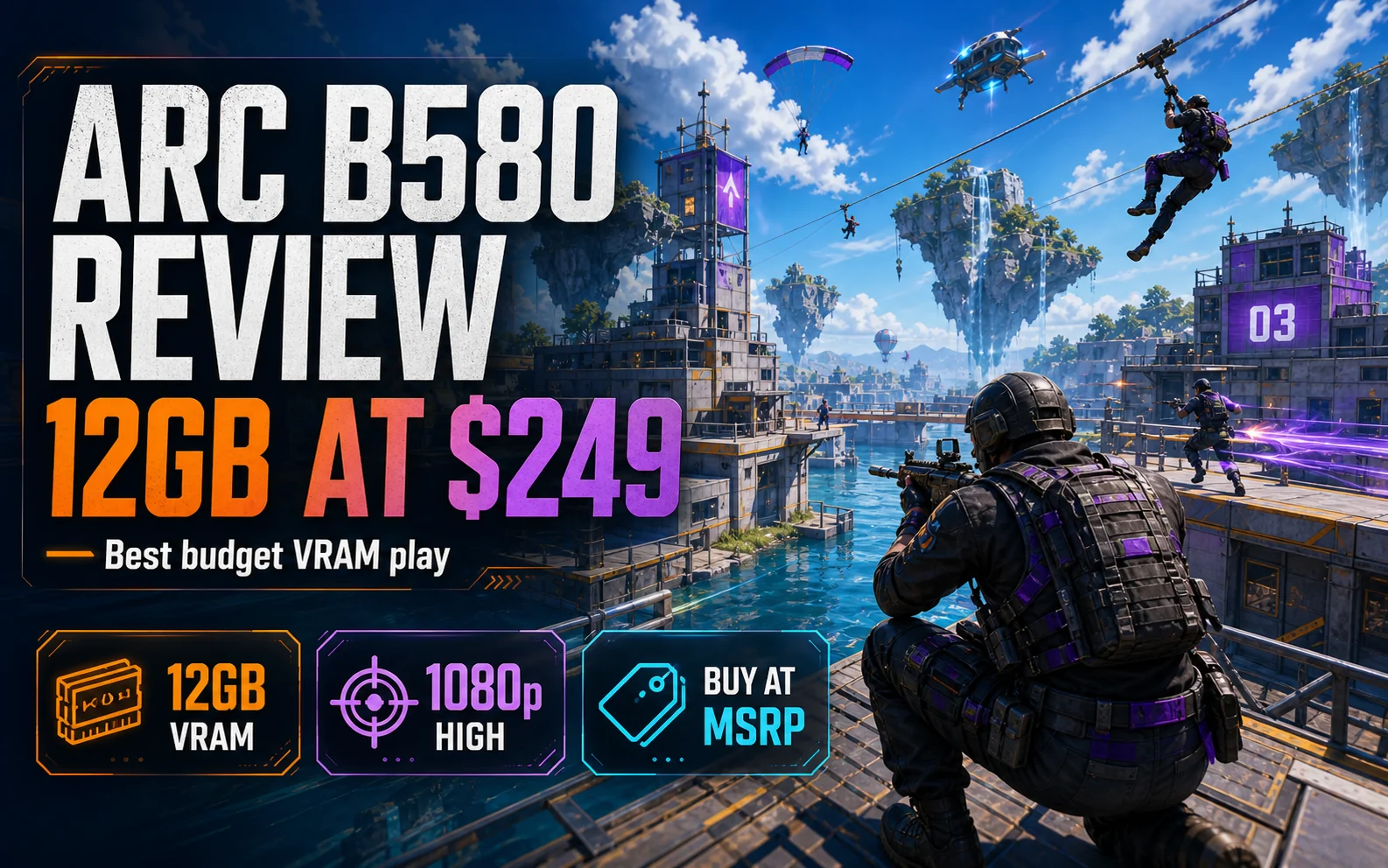
Intel’s Arc cards have had a rough reputation since the A-series launched with driver problems and weird performance inconsistencies. The B580 is different. It’s genuinely good — and at $249 with 12GB of VRAM, it undercuts every other card at that price by a significant margin on memory capacity alone. Whether that’s enough depends on what you’re actually trying to get out of a GPU at this price, and on whether you can find it in stock.
Twelve gigabytes changes the comparison
The RTX 4060 and RX 7600 both ship with 8GB. The Arc B580 ships with 12GB. At 1080p today that gap is mostly theoretical — the majority of games don’t blow past 8GB at 1080p high settings. But “mostly theoretical today” and “irrelevant” aren’t the same thing. Some 2026 AAA releases are already brushing 9–10GB at 1440p with high textures, and that number moves in one direction over time.
If you’re buying a GPU you want to still feel current in 2028, the B580’s 12GB buffer is the most concrete future-proofing available at this price point. The RTX 5060 also has 16GB, but costs $50 more. The Arc B580 is the cheapest route to 12GB you can currently buy new.
How it actually performs at 1080p and 1440p
At 1080p, the B580 sits within a few percent of the RTX 4060 in rasterized workloads across most of the game library. Some titles it beats, some it loses — the average is close enough that you won’t feel the difference in practice. It handles 60+ fps at 1080p high settings in everything current without breaking a sweat, and it pushes past 100fps in competitive titles.
At 1440p is where the B580 starts pulling away from the 8GB competition. The extra VRAM means it doesn’t have to manage texture compression the way the 4060 and 7600 do at that resolution, and in titles that stress the framebuffer you’ll see the gap open up. It’s not a 1440p powerhouse — demanding games at ultra settings still need XeSS assistance to stay consistently above 60fps — but it’s a more credible 1440p card than anything else at $249.
XeSS 3 and frame generation
Intel shipped XeSS 3 Multi-Frame Generation support for the B580 in early 2026, and it works. In supported titles it can triple framerates — the raw numbers show over 200% FPS increases with 4x MFG enabled. That puts Intel’s upscaling ecosystem in the same conversation as DLSS 4 MFG, which was previously Nvidia’s exclusive Blackwell feature.
The catch is game support. DLSS 4 has a longer supported title list right now, and FSR 4 works across any GPU. XeSS 3 MFG is B580-specific and the list of supported titles is still growing. If you’re buying primarily for frame generation in specific games, check whether those games support XeSS 3 before assuming you’ll get the full multiplier.
The stock situation is genuinely annoying
The B580 launched at $249 and keeps selling out. Price tracking data shows it hit $450 in early March 2026 — nearly double MSRP — during one of the longer stock gaps. Right now (May 2026) availability has stabilized somewhat, but it still fluctuates. If you see it at $249–$269, that’s the buying window. If it’s $299 or above, the value case against the RTX 4060 starts collapsing quickly, and at $329+ you’re better off with a different card entirely.
Set up a stock alert on NowInStock if you’re serious about getting one at MSRP. It’s one of the few GPUs right now where the difference between MSRP and inflated street price is large enough to materially change the recommendation.
Where Intel still has ground to cover
Path tracing at max settings is out of reach — not a B580 problem specifically, but worth stating since the 12GB VRAM might make you think it handles everything. It doesn’t. Memory capacity and shader throughput are different things, and the B580’s compute headroom runs out before the RTX 4060 in the most demanding RT workloads.
A handful of games still show unexpectedly low performance on Arc hardware due to engine-specific rendering paths that were optimized for Nvidia or AMD. Intel has closed a lot of these gaps with driver updates over the past year, but you’ll occasionally hit a title that runs 15–20% worse than benchmarks suggest. If you game heavily in one specific title, check Arc-specific benchmark data for that game rather than relying on averages.
CPU pairing also matters more than it does on Nvidia and AMD. Early Arc cards had significant CPU overhead issues that tanked performance on mid-range processors. The B580 has largely resolved this — testing shows equivalent performance whether paired with a Ryzen 5 5600 or a 9800X3D in most titles — but if you’re running a genuinely old CPU (pre-Ryzen 3000, pre-i7-8000), it’s worth verifying compatibility before buying.
Is it worth it right now?
At $249, yes — the 12GB VRAM at this price is a real differentiator that no other card matches. The raw gaming performance is competitive with the RTX 4060, XeSS 3 MFG works well in supported titles, and the driver situation has genuinely improved since the A-series days.
The honest frustration is the stock problem. It’s hard to confidently recommend a card that might be $350 or unavailable when you go to buy it. Check live pricing at Amazon, Best Buy, and Newegg before reading any further — if it’s under $270, stop here and buy it. If it’s over $300, read through the RTX 4060 and RX 7600 reviews instead and pick one of those.