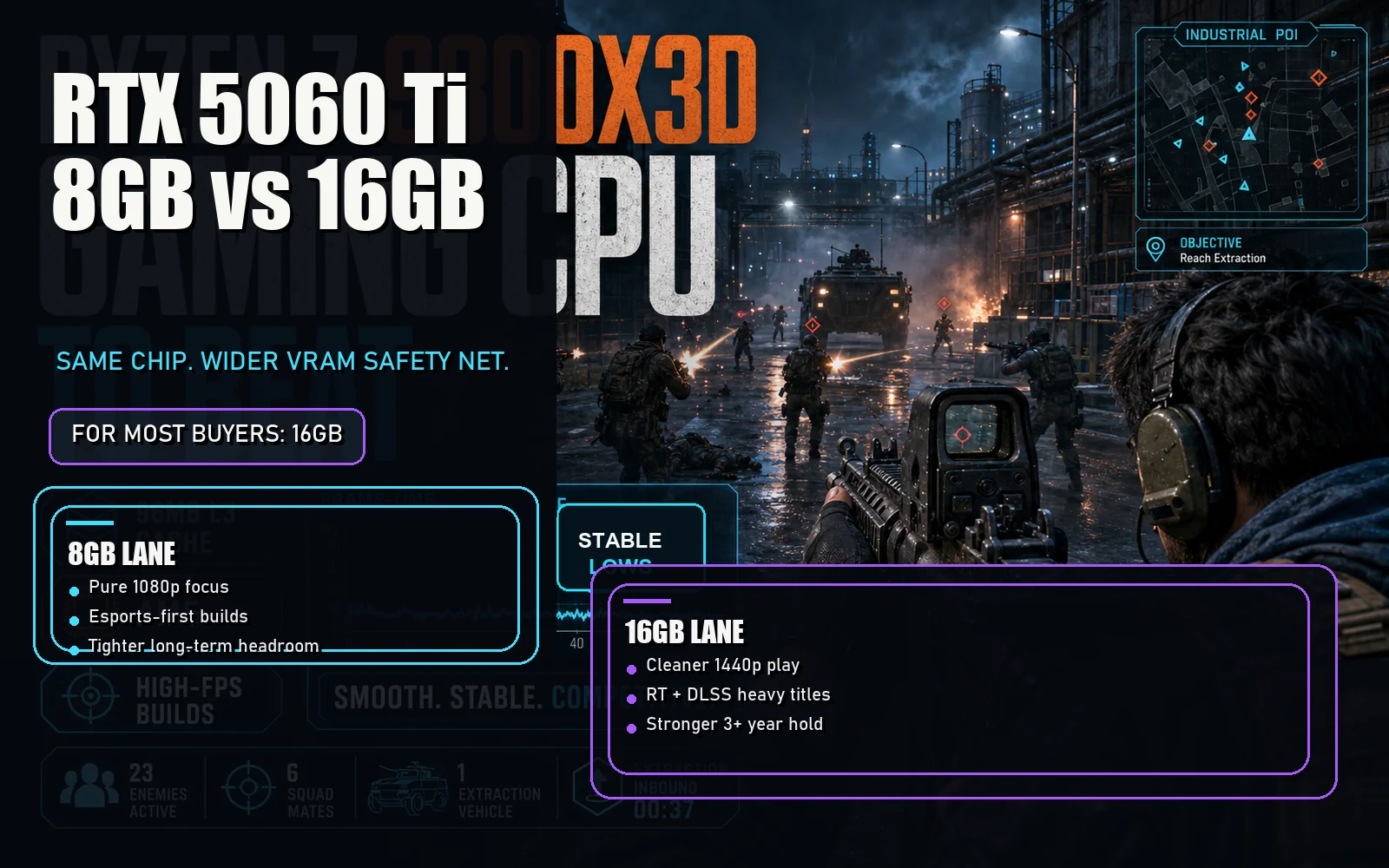
Nvidia launched the RTX 5060 Ti in two configurations: 8GB and 16GB. The 8GB model launched at $379; the 16GB at $429. That $50 gap is the most important decision in this tier right now — and for most buyers, it’s not actually close.
| Spec | RTX 5060 Ti 8GB | RTX 5060 Ti 16GB |
|---|---|---|
| Street price (May 2026) | $379–$399 | $429–$449 |
| VRAM | 8 GB GDDR7 | 16 GB GDDR7 |
| Memory bus | 128-bit | 128-bit |
| TGP | 180 W | 180 W |
| 1080p high | Smooth | Smooth |
| 1440p high | VRAM-limited in newer AAA | Clean — plenty of headroom |
| RT + DLSS heavy titles | Stutter risk | Stays smooth |
| Best for | Pure 1080p, esports | 1440p, 3+ year longevity |
Why the 8GB version is the harder sell
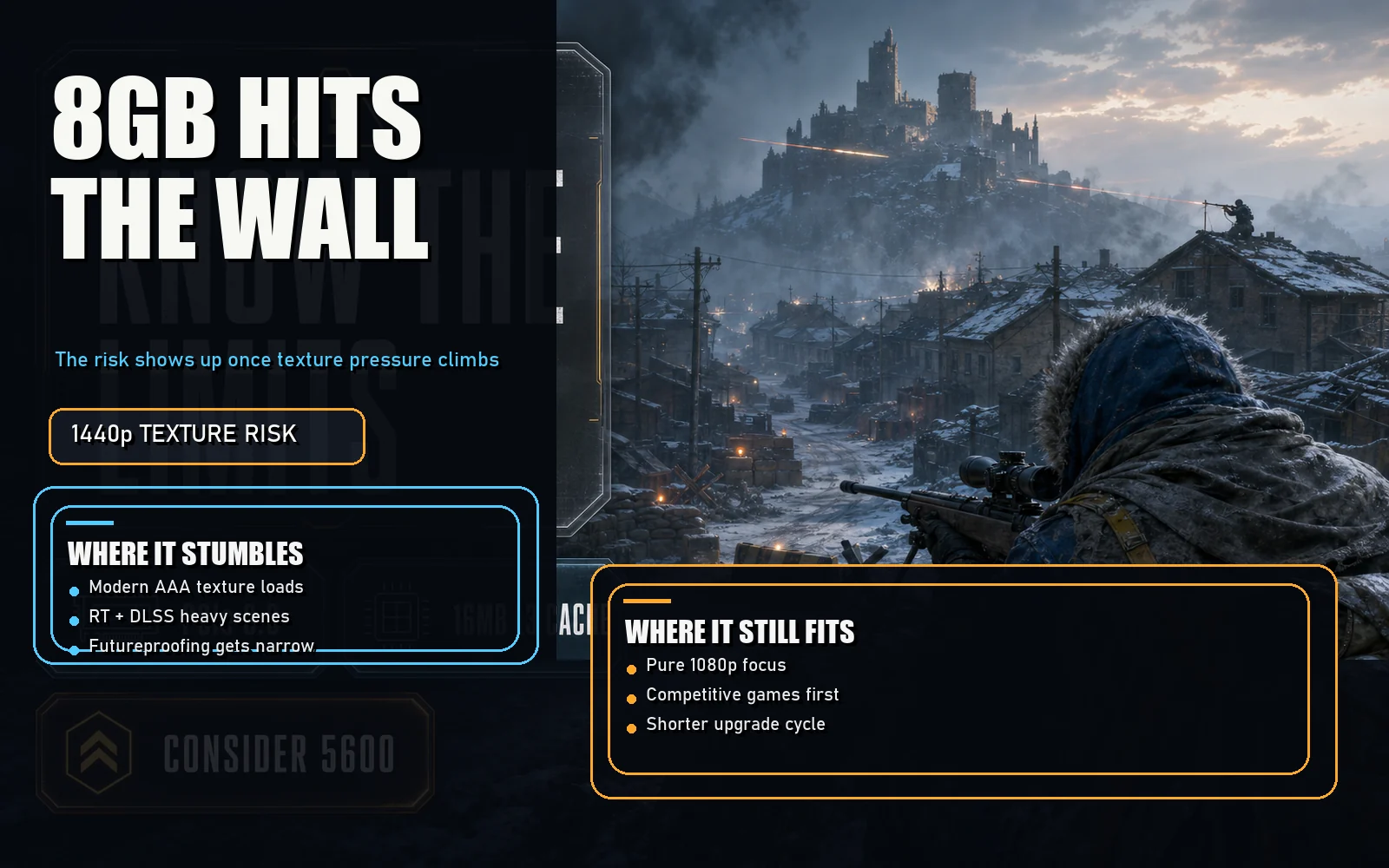
The RTX 5060 Ti is a capable card, but 8GB of VRAM on a GPU that will be used through 2027 and beyond is a real concern. Some 2026 titles are already pushing past 8GB at 1440p with high texture settings. The 5060 Ti is positioned as a 1080p–1440p card, and the 8GB version starts running into its framebuffer ceiling in the upper half of that resolution range today.
Nvidia’s own recommended settings sometimes ask for more than 8GB at 1440p in demanding releases. Buying the 8GB version and running 1440p on future titles means you’re already managing texture quality settings to avoid VRAM overflow at launch — that’s not a great position on a current-generation card.
What the 16GB version gives you for $50 more
The 16GB RTX 5060 Ti eliminates the VRAM concern for the foreseeable future. At $429, it costs the same as the RTX 5060 (the non-Ti) while offering meaningfully better rasterization performance. It also fully unlocks DLSS 4 Multi-Frame Generation — the Blackwell-exclusive feature that can multiply framerates by up to 4x in supported titles.
16GB GDDR7 with a reasonable 128-bit bus and Nvidia’s cache architecture handles both 1080p and 1440p gaming without texture management becoming a concern. For $50 more, the upgrade case is straightforward.
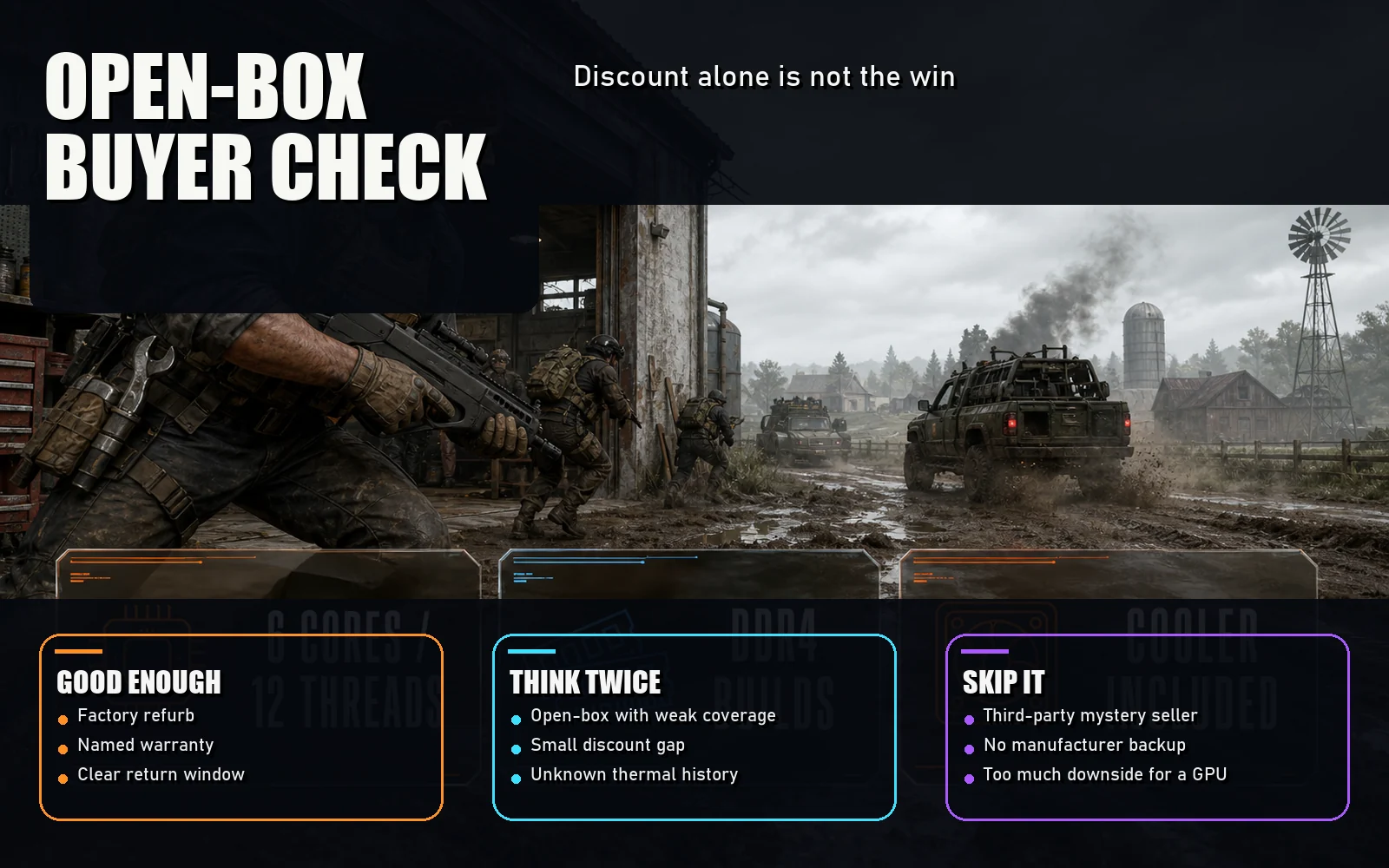
Open-box and refurbished — is it worth it?
Open-box RTX 5060 Ti cards appear on Woot, Newegg, and occasionally Best Buy at $320–$360 for the 8GB version and $370–$400 for the 16GB. The discount is real, but the calculus depends on the warranty. A factory-reconditioned card with a named manufacturer warranty (180-day MSI, 90-day ASUS) is acceptable if the discount is $60 or more off new retail. A “seller refurbished” or “open-box — like new” listing from a third-party marketplace seller with no manufacturer warranty is not worth the risk on a GPU.
At current pricing, the 16GB RTX 5060 Ti at $429 new is often the better buy than the 8GB at $360–$380 open-box. You’re paying $50–$70 more for double the VRAM, full manufacturer warranty coverage, and a card that won’t be the limiting factor in your build for the next 3 years.
Frequently asked questions
Is the 8 GB version a bad buy?
Not bad — just narrower. At pure 1080p it performs identically to the 16 GB. The problem is futureproofing: 8 GB is already the ceiling for ultra textures and 1440p in modern AAA titles.
Will 8 GB VRAM be enough at 1440p?
Often no. Hogwarts Legacy, The Last of Us, Indiana Jones, and Cyberpunk 2077 with RT all push past 8 GB at 1440p ultra. You'll see texture pop-in or hard stutters where the 16 GB stays clean.
Is the 16 GB worth $50 more?
For anyone planning to keep the card 3+ years, or who games at 1440p, yes — it's the cheapest insurance you'll buy. For pure 1080p with esports games, the $50 is better spent on the rest of the build.
Should I get a 4070 instead?
If the 4070 is within ~$50 of the 16 GB 5060 Ti at street price, it's usually the better card — 12 GB on a wider 192-bit bus + meaningfully more shader throughput. Below that gap, the 16 GB 5060 Ti is fine.
Are open-box 5060 Tis worth the discount?
Open-box at 10–15% off through Best Buy or Newegg with their return window is a real win. eBay open-box from random sellers, no — GPU thermal pads and fans hide damage well, and you have no recourse.
How it fits against other options at this price
At $429 the 16GB RTX 5060 Ti competes with the RTX 5060 (16GB, $299 — faster to acquire, same VRAM) and the RX 9070 (which reviews consistently place above both in rasterization but costs more). The 5060 Ti sits in a slightly awkward tier: faster than the RTX 5060, more expensive, but not decisively enough ahead to be the obvious pick for every buyer.
For a build targeting 1080p: the RTX 5060 at $299 covers the use case for less money. For 1440p gaming where framerate consistency across a 3-year lifespan matters: the 16GB RTX 5060 Ti at $429 is the more complete answer. Check current pricing at Newegg and Amazon before deciding.