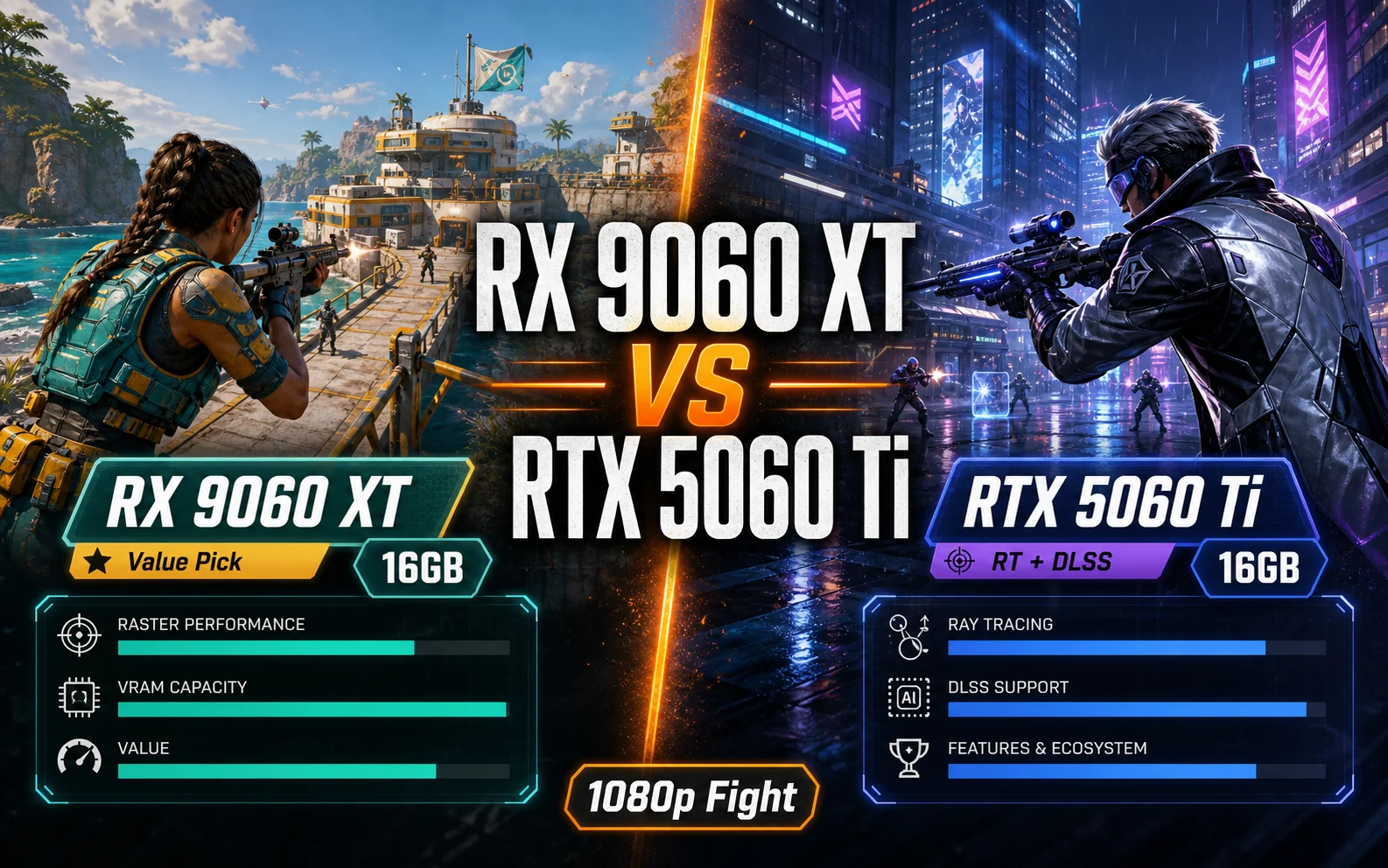
Here is the matchup nobody expected to be this close. AMD’s RX 9060 XT 16GB launched at $349, Nvidia’s RTX 5060 Ti 16GB at $429, and on paper that $80 gap should make the choice easy. It doesn’t.
The Ti is a few percent faster in raster and pulls clearly ahead in ray tracing. The Radeon answers with the same 16GB of memory, near-identical frame rates in most games, and a lower sticker. So the real question isn’t which card is better. It’s whether the things Nvidia does better are worth paying for.
The part where they are basically twins
Put both cards on a 1080p monitor and run through a stack of modern games, and the gap is small enough to embarrass anyone hoping for a blowout. Aggregate testing puts the RTX 5060 Ti 16GB around 99 fps average at 1080p, with the RX 9060 XT 16GB trailing by roughly 3 to 5 percent. In a lot of titles you are looking at a 2 to 4 fps difference. You would never feel that without a counter on screen.
Both cards carry 16GB of VRAM, and that matters more than the raw frame numbers in 2026. Texture packs, ray tracing buffers, and lazy console ports have all gotten hungrier, and 8GB cards are starting to choke at settings these chips can otherwise handle fine. Sixteen gigs is the headroom that keeps either of these relevant for years instead of months.
So if you only cared about pure raster frames per dollar at 1080p, the Radeon already won and you could stop reading. But that is not all of it.
Where Nvidia earns its premium
The Ti’s case rests on two things, and both are real.
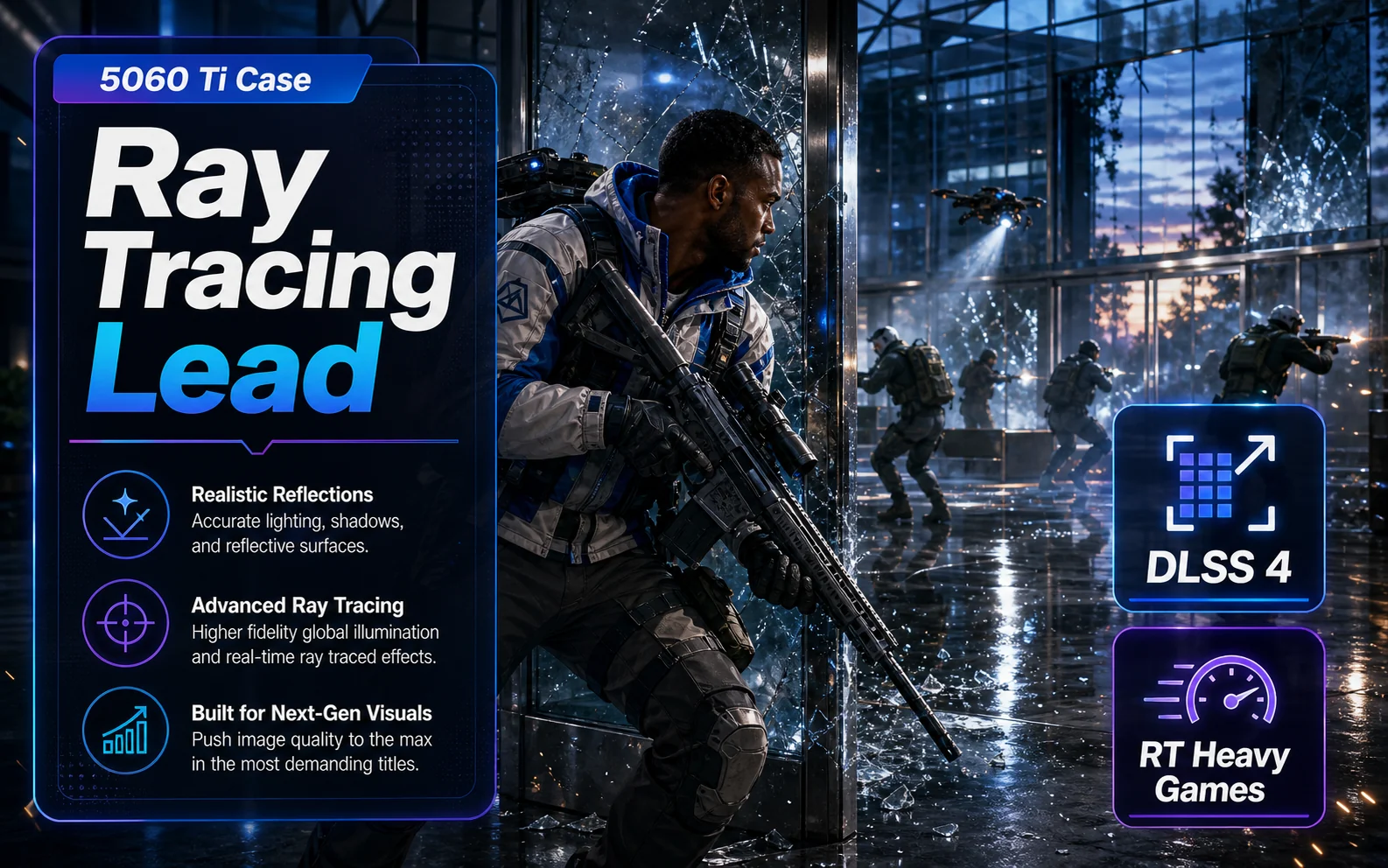
- Ray tracing. Turn on heavy RT in something like Cyberpunk or Alan Wake 2 and the RX 9060 XT’s lead evaporates, then flips. Nvidia’s RT cores are simply better here, and the harder you push lighting, the wider the gap gets. If ray tracing is a box you actually check, the 5060 Ti is the safer card.
- DLSS 4. Nvidia’s upscaler still sets the bar, and multi-frame generation can stack on extra smoothness in supported titles. It is the more mature feature set, with broader game support after years in the wild.
None of that is hype. If your library leans on RT-heavy showcase games, or you want the longest list of titles with first-class upscaling support, you are buying the Nvidia card and the extra money is buying you something.
How AMD closed the gap
For years the easy knock on Radeon was the upscaler. FSR looked soft next to DLSS, and that alone pushed plenty of buyers toward Nvidia even when the AMD card was faster and cheaper. That argument is mostly over.
FSR 4 is AI-based now, and in quality mode it lands close enough to DLSS that you have to pixel-peep paused screenshots to call a clear winner in most scenes. It does not yet match DLSS on game count, and in fast motion Nvidia can still hold a slight edge. But the chasm is a crack now. For the upscaling most people actually use day to day, the gap stopped being a reason to spend $80 more.
That is the wrinkle that turns this whole comparison over. The Ti’s biggest historical advantage got a lot smaller, and it got smaller right when the Radeon was already cheaper. If you want the broader context on where AMD sits against the rest of the field, our look at the best budget GPU for 1080p gaming in 2026 lays out the full ladder.
Watch the street price, not the MSRP
The clean $80 gap is an MSRP fantasy, and you should treat it as one. The DRAM and NAND crunch has made GPU pricing a moving target, and both of these cards have wandered well off their launch numbers depending on the week and the brand.
RX 9060 XT 16GB cards launched around their $349 sticker but have drifted up toward $440-450 at times as stock tightened. The 5060 Ti 16GB has been just as messy: some models have dipped to around $419, near MSRP, while others sat closer to $580-600 when supply got thin. In practice, the “extra $60” can be $80, can be $20, and on a bad week the Radeon can briefly cost more than the Nvidia card. Check live listings the day you buy and let the actual number on the cart decide. These numbers drift constantly right now, so any figure here is a snapshot.
One rule that does not move: ignore the 8GB versions of both. The RX 9060 XT 8GB and RTX 5060 Ti 8GB exist to hit a lower price and a lower ad, and on a chip this capable, 8GB is a bottleneck waiting to happen. We went deep on why in our breakdown of the RTX 5060 Ti 8GB versus 16GB question, and it applies just as hard on the AMD side. Buy 16GB or buy down a tier. Do not pay near-Ti money for a card with half the memory.
Is the Ti worth it?
This comes down to one honest question about you, not the spec sheet.
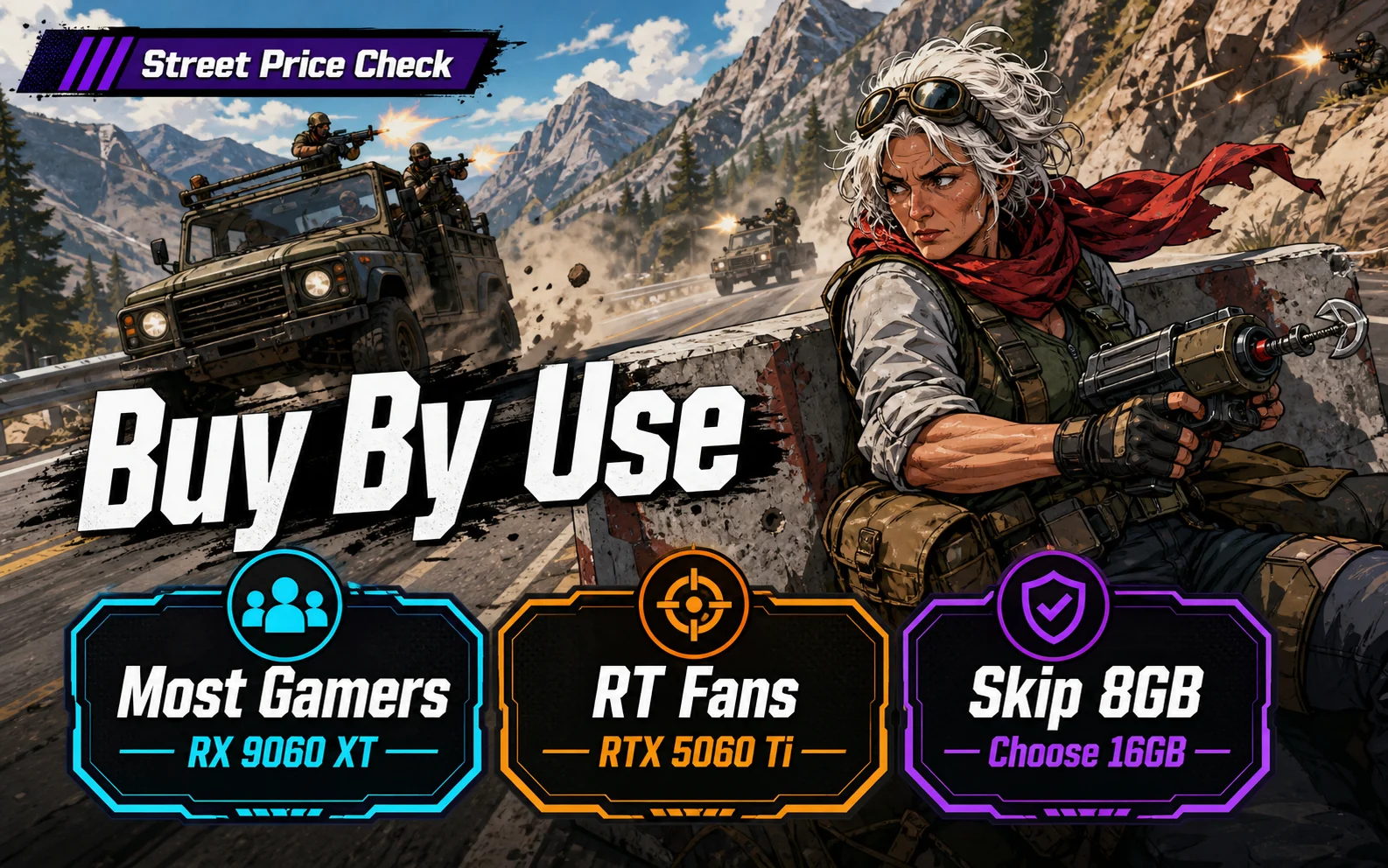
- Buy the RX 9060 XT 16GB if you mostly play at 1080p or 1440p with ray tracing off or low, and you want the most frames and VRAM per dollar. With FSR 4 finally credible, this is the value pick, and for a big chunk of budget gamers it is the smarter buy.
- Buy the RTX 5060 Ti 16GB if ray tracing is a feature you genuinely use, you want the most mature DLSS support, and the street gap on the day is small. The premium buys real things here, just not things every gamer needs.
If those two cards both blow your budget, step down a rung rather than buying an 8GB compromise. The Intel Arc B580 is still the raster value play around $250 to $290 depending on stock, and if you are weighing the cheaper Radeon against Nvidia’s mainstream card instead, our RX 9060 XT vs RTX 5060 comparison covers that fight. Shopping even lower? The RTX 5050 vs Arc B580 matchup is where the entry tier gets decided.
Our call: for most people, the RX 9060 XT 16GB is the one to buy. It gives up a few frames and some ray tracing muscle, and in 2026 that is a fair trade for the money it keeps in your pocket. The 5060 Ti is the right card for RT fans, not the default.
Before you buy: FAQ
Is the RTX 5060 Ti worth $60 more than the RX 9060 XT?
Only if you use ray tracing or want the most mature DLSS support. In pure raster the cards are within a few percent, so for RT-off 1080p and 1440p gaming the cheaper RX 9060 XT 16GB gives you more value. Let the live street price decide on the day.
Which is faster, the RX 9060 XT 16GB or the RTX 5060 Ti 16GB?
The RTX 5060 Ti is a few percent faster in raster, roughly 3 to 5 percent at 1080p in aggregate testing, and clearly faster once you turn on heavy ray tracing. The RX 9060 XT stays close in normal raster games and matches it on the 16GB of VRAM.
Is FSR 4 as good as DLSS 4 now?
It is close. FSR 4 is AI-based and in quality mode it lands near DLSS in most scenes, though Nvidia still leads on supported game count and in fast motion. For everyday upscaling the gap is small enough that it should not push you to spend much more.
Should I buy the 8GB version of either card to save money?
No. Both chips are strong enough that 8GB becomes a bottleneck at the settings they can otherwise run in 2026. If the 16GB cards are out of budget, step down to a cheaper tier instead of buying a memory-starved version of the same GPU.