The RTX 5060 launched at $299, matching the RTX 4060’s price exactly. Same tier, same MSRP — but a generational gap that makes the upgrade math genuinely interesting for anyone sitting on a 4060 or deciding between the two cards right now. Here’s what the benchmarks and the spec sheet actually tell you.
What changed generation to generation
Nvidia’s Blackwell architecture — the same one in the RTX 5090 and 5080 — trickles down to the RTX 5060 with a few key upgrades over the Ampere-era 4060:
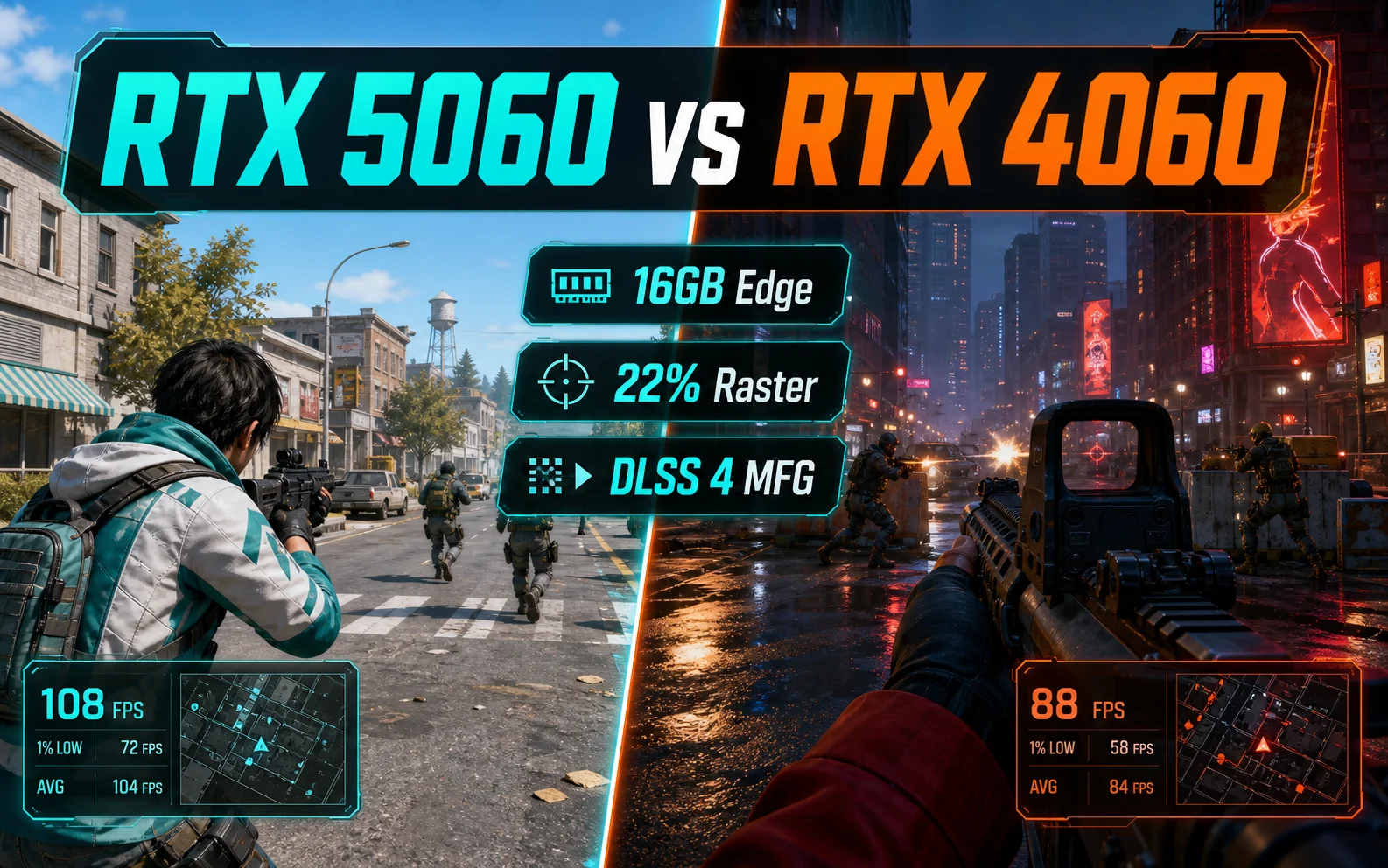
- Memory: 16GB GDDR7 vs 8GB GDDR6. This is the biggest practical difference. The 4060’s 8GB framebuffer has been showing up as a limitation in some 2026 titles at high textures; the 5060 doubles it with faster GDDR7 bandwidth on top.
- Rasterization performance: Roughly 22% faster than the RTX 4060 in traditional rendering workloads. Meaningful but not a generational leap.
- Ray tracing: Approximately 30–35% improvement over the 4060, per early benchmarks.
- DLSS 4 Multi-Frame Generation: This is the wildcard. MFG is exclusive to Blackwell (RTX 50-series) and can multiply perceived framerates by up to 4x using AI-generated frames. DLSS 3 Frame Generation on the 4060 generates one additional frame; DLSS 4 MFG generates up to three. In supported titles, this is the bigger performance gap than the raw rasterization numbers.
Raw benchmark summary
Without DLSS or frame generation, the RTX 5060 runs about 15–22% faster than the RTX 4060 at 1080p and 1440p in rasterized workloads. That’s a real improvement — comparable to what you’d see going from a GTX 1080 to a GTX 1080 Ti — but it doesn’t justify the jump on raw performance alone if you already own a 4060.
With DLSS 4 MFG enabled in supported titles, the 5060 pulls far ahead. Games like Cyberpunk 2077, Alan Wake 2, and Warhammer 40K Space Marine 2 support it; older titles don’t. If your game list skews toward new AAA releases, the multiplier matters. If you’re playing CS2, Fortnite, or Warzone, it’s irrelevant — competitive games cap or don’t support MFG anyway.
The VRAM question
The 4060’s 8GB is fine for 1080p in 2026 — most games don’t blow past 8GB at medium-to-high settings at that resolution. But “fine for now” isn’t the same as “safe for 3+ years.” Some titles are already pushing 9–10GB at 4K high, and 1080p texture budgets will grow. The RTX 5060’s 16GB eliminates this concern for the foreseeable future.
If you’re buying new and planning to keep the card for 3–4 years, the VRAM headroom alone is a reasonable tiebreaker in the 5060’s favor — assuming street pricing holds near the $299 MSRP.
Upgrade math: sell your 4060?
RTX 4060 used prices are landing around $150–$170 on eBay as owners sell into the 5060 launch. If you can sell your 4060 in that window, the net cost of upgrading to an RTX 5060 drops to roughly $130–$150. At that effective price, the upgrade makes more sense — you’re getting 16GB GDDR7, 22% more raster performance, and DLSS 4 MFG access for the cost of a dinner out a few times.
If you wait too long, 4060 prices will soften further as supply increases and the window tightens. The first month post-launch is usually the best time to flip a last-gen card.
What about the RX 9060 XT?
AMD’s answer to the RTX 5060 is the RX 9060 XT. Benchmarks show it’s 15–20% faster than the RX 7600 in rasterization and carries FSR 4 support. The headline specs look competitive — but the pricing tells a different story. Street pricing has come in around $440–$510 in European markets at launch, significantly above the RTX 5060’s $299 MSRP.
AMD offers the 9060 XT in both 8GB and 16GB variants. Based on early performance data, the 8GB version is uncomfortably close to its VRAM limit in some titles — reviewers have called 8GB “playing with fire” on this card. The 16GB variant is the one worth considering, which pushes the price gap against Nvidia even wider.
If the RX 9060 XT lands near $329–$349 at US retail for the 16GB version, it becomes a genuine competitor. At current European street prices, it doesn’t.
What about a used RTX 3070?
For buyers on a tighter budget, the used RTX 3070 is worth a look. With 4060 owners upgrading, RTX 3070 cards are floating around $220–$260 on eBay — and they’re still capable 1440p cards. The 8GB VRAM is the same concern as the 4060, and the 3070 is further from end-of-life support, but for someone building around an i5-12400F or Ryzen 5 5600 who needs 1080p gaming today, it’s a viable budget route.
The trade-off: no DLSS 4 access, older drivers, no future Nvidia feature support. It’s a hold-over card, not a 3-year investment.
Who should buy the RTX 5060
- Upgrading from GTX 1070/1080 or RTX 2060/2070: Yes, buy. The jump is massive across the board — rasterization, VRAM, DLSS 4 access.
- Upgrading from RTX 3060 Ti or 3070: Worth it if you sell the old card first. The 16GB GDDR7 and MFG access represent a meaningful generational shift.
- Upgrading from RTX 4060: Only makes sense if you can sell the 4060 for $150+ and care about DLSS 4 MFG or VRAM headroom for the long term. Pure rasterization gain alone is ~22% — not a must-upgrade.
- Buying new with no current card: RTX 5060 at $299 is the correct pick in its tier. The VRAM advantage over the Arc B580 (12GB) is narrower, but DLSS 4 MFG is a real differentiator in 2026 if your game list supports it.
Who should stick with the RTX 4060
- You already own a 4060 and play at 1080p medium: Don’t upgrade. You’re not hitting a wall.
- Your game list is competitive shooters (CS2, Warzone, Apex): MFG doesn’t help here. The 22% raster gain is real but not worth $299 minus whatever you’d get for the 4060.
- You can find a 4060 for $200 or less: At that price, it’s still a reasonable 1080p card for a budget build.
Bottom line
The RTX 5060 is the better card at the same price — the 16GB GDDR7, 22% raster uplift, and DLSS 4 Multi-Frame Generation access are real advantages over the RTX 4060. Whether it’s worth upgrading depends on what you’re coming from: for new buyers, the 5060 is the clear pick at $299; for existing 4060 owners, the math only works if you flip the old card quickly. Check live pricing at Newegg, Amazon, and Best Buy before pulling the trigger — launch-window GPU pricing shifts fast.