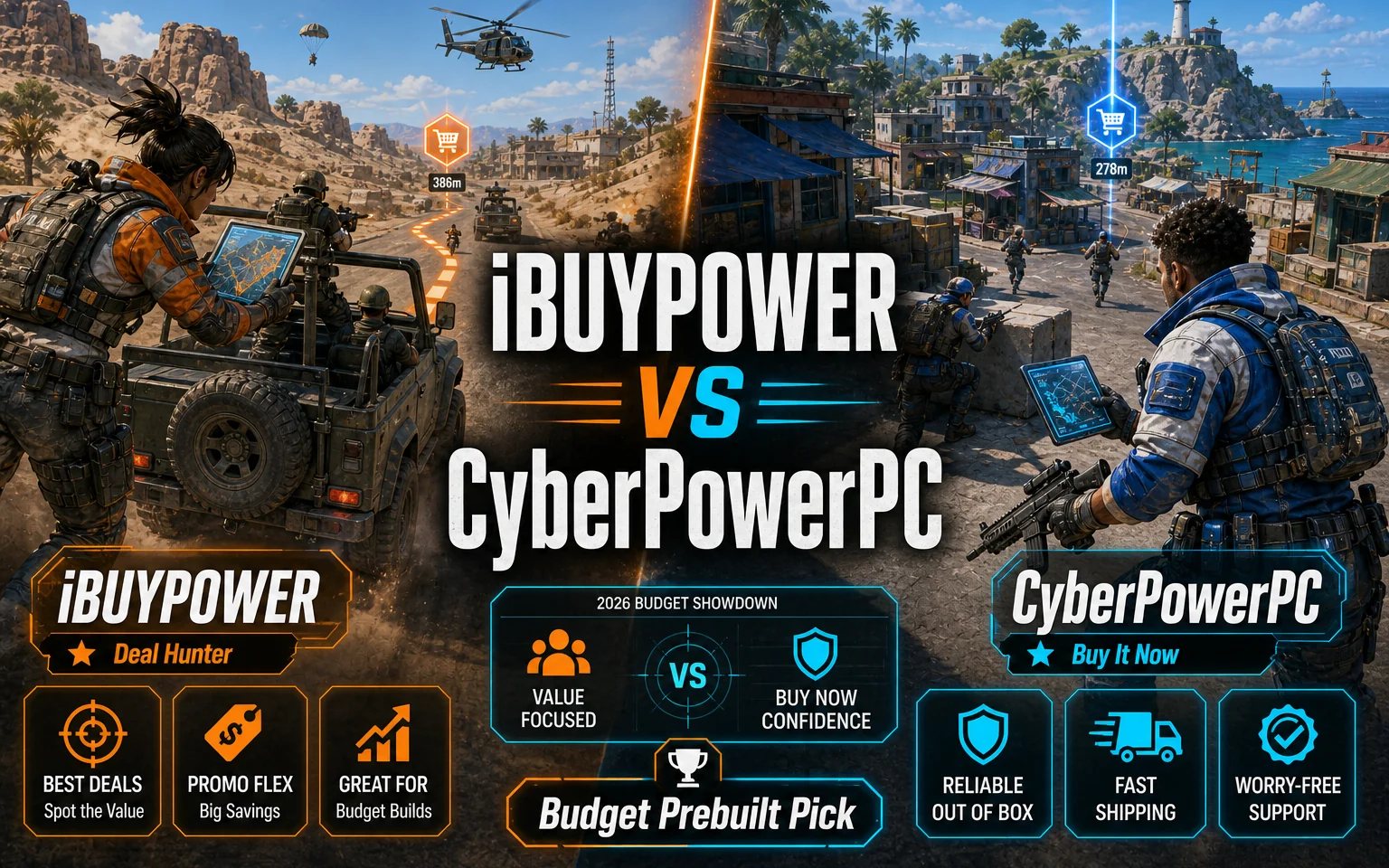
Put an iBUYPOWER and a CyberPowerPC budget tower side by side in 2026 and the spec sheets nearly rhyme. RTX 5060, an i5-14400F, 16GB, a 1TB NVMe, somewhere between $850 and $1,000. On paper you could flip a coin.
The coin is the wrong tool. The whole iBUYPOWER vs CyberPowerPC 2026 question turns on the parts you can’t see on the product page, not the GPU sticker. So the differences below are what actually matter.
The configs you’re really choosing between
Start with what each brand puts in front of you at this price, because the headline parts are closer than the marketing wants you to think.
iBUYPOWER’s Pro and Trace lines tend to anchor the cheap end. A Trace-class build with an RTX 4060 or RTX 5060, an i5-14400F, 16GB and a 1TB SSD has shown up as low as the high $700s on a good week, and the more typical sticker sits around $849. During sales you’ll occasionally catch one with 32GB instead of 16, which, given what a 32GB DDR5 kit costs on its own right now, is a genuinely loud signal that they locked their RAM contracts before the spike. We’ve covered why prebuilts are quietly beating DIY in 2026, and the RAM math is most of the reason.
CyberPowerPC’s Gamer Xtreme plays the same hand a notch up. The common config — i5-14400F, RTX 5060 8GB, 16GB DDR5, 1TB NVMe — has been hovering around $1,000 at Best Buy and creeping past $1,100 for the dressier RGB versions as of mid-2026. Pricing wobbles week to week, so treat those as street estimates, not promises.
So the GPU and CPU are basically a wash. The decision lives one layer down.
PSU, RAM and airflow: the stuff nobody lists
This is the part of the spec sheet that’s usually blank, and it’s the part that decides if your $900 holds up in two years.
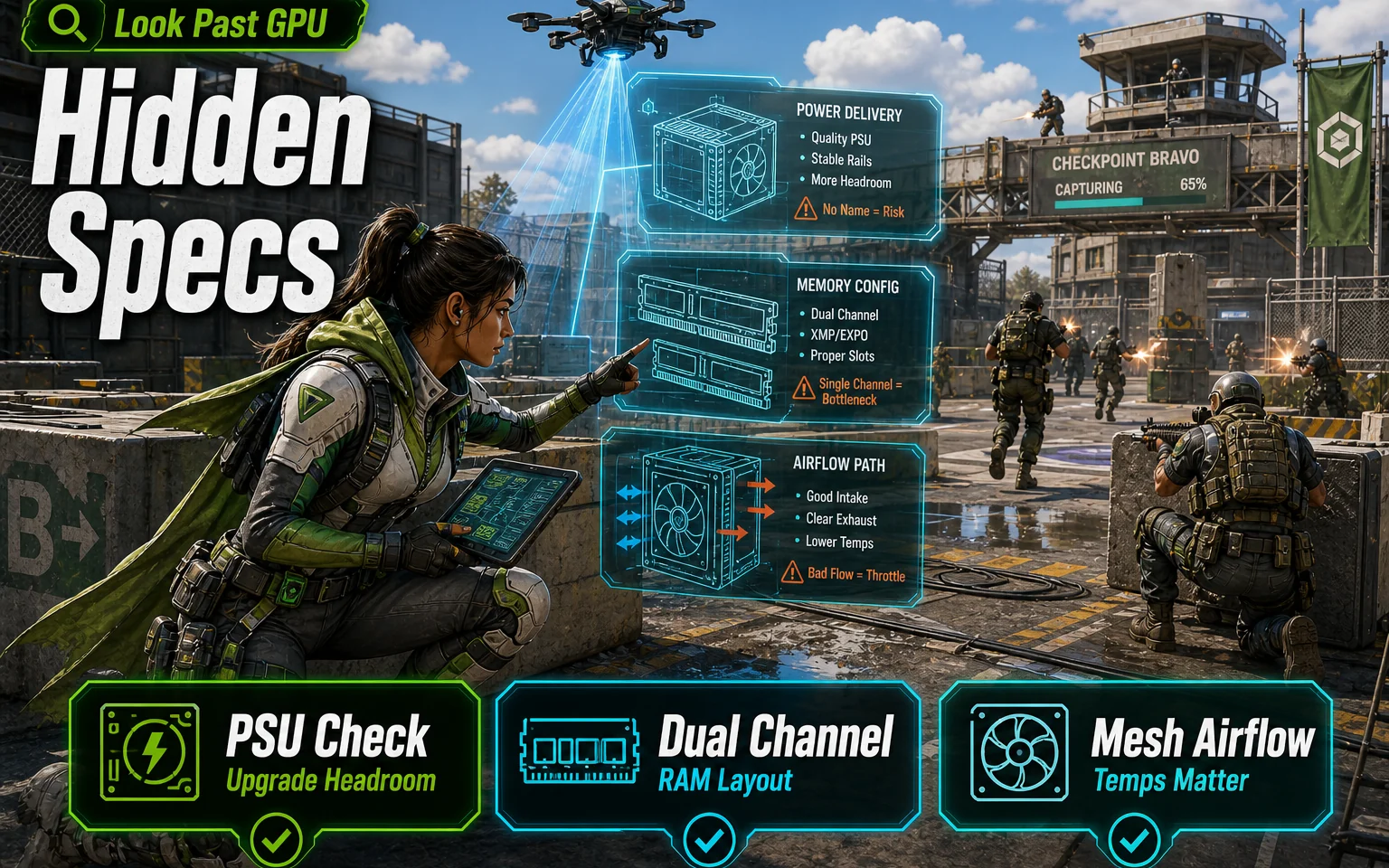
- The power supply. Budget prebuilts from both brands often ship a generic 500W to 600W unit with no 80+ rating you’d recognize. That’s fine for a 4060/5060 today and tight the moment you dream about a 5070-class upgrade. Neither brand is a saint here, but it’s the single spec worth emailing them about before you buy.
- The RAM layout. 16GB as two 8GB sticks in dual channel is what you want; one 16GB stick quietly costs you frames. Both brands are usually fine on this, but “usually” is doing work — confirm it’s a kit, not a single module. If you’re fuzzy on why, our guide to how much RAM you actually need for 1080p spells out the dual-channel penalty.
- The case and airflow. Here CyberPowerPC has a small, real edge. The Gamer Xtreme’s mesh-front cases breathe, and reviewers consistently note good temps under load. They just run loud doing it. iBUYPOWER’s mesh towers are decent too, but the cheaper SKUs sometimes hide behind more restrictive front panels. Mesh over glass, every time.
None of this is exotic. It’s the same three-item checklist we hand out for spotting a good budget prebuilt in the first place: PSU headroom, dual-channel RAM, real airflow.
Warranty and support: a coin flip with real stakes
The romance ends here. Both companies are great at selling you a PC and inconsistent at helping you after.
iBUYPOWER leans on a 2-year parts and 3-year labor warranty, which reads well until you hit the return-shipping reality — some RMA stories involve long waits and shipping costs that sting on a budget machine. CyberPowerPC’s aggregate reviews are the same split personality: plenty of “arrived perfect, runs great” alongside a stubborn pile of “customer service put me on hold for a month.” Pre-sale, both are smooth. Post-sale, you’re rolling dice.
Buy either one expecting the support line to be a last resort, not a safety net. If a flawless five-year warranty experience is the thing you care about most, a budget tower from a high-volume builder isn’t where you’ll find it.
Sale cadence, and how to actually time it
Both brands discount constantly, but the rhythm differs. iBUYPOWER tends to push the aggressive doorbuster pricing — those high-$700s RTX 5060 deals — through big retail events and direct-site flash sales. CyberPowerPC runs steadier retail pricing at Best Buy and Newegg with frequent smaller markdowns, which makes it easier to catch a fair price on a random Tuesday without waiting for a holiday.
Practical move: if you’re not in a hurry, watch iBUYPOWER for the spike-down deal. If you want it this week at a known-good price, CyberPowerPC’s retail presence makes that simpler. Whichever you eye, run the listing through our RTX 4060 prebuilt gut-check before you check out — the same questions apply to a 5060 box.

Our pick between the two
It depends on which version of “budget” you are, so here’s the un-fenced answer.
Buy the iBUYPOWER if you’re chasing the absolute lowest price per frame and you’re willing to wait for a sale. The Trace-class deals dip lower than anything CyberPowerPC reliably matches, and catching a 32GB config during the RAM crisis is the kind of accidental steal that makes the whole prebuilt argument for you.
Buy the CyberPowerPC Gamer Xtreme if you want it now, at a fair price, from a retailer with an easy return window, and if airflow matters to you more than fan noise. It’s the safer week-day purchase. We went deeper on it in our CyberPowerPC Gamer Xtreme review if you want the full teardown.
Still torn, or want to see who else is fighting in this bracket? Our roundup of the best budget gaming prebuilts under $1,000 stacks both of these against Skytech, MSI and the off-lease crowd. But between just these two: iBUYPOWER for the deal-hunter, CyberPowerPC for the person who wants to stop hunting.
Quick answers
Is iBUYPOWER or CyberPowerPC better for a first gaming PC?
For a true first build, CyberPowerPC’s Gamer Xtreme is the slightly easier call because it sells through Best Buy and Newegg with simpler returns and consistent pricing. iBUYPOWER can be cheaper, but its best deals require patience and its direct-site support is more of a gamble.
Are these prebuilts upgradeable later?
Mostly yes — both use standard ATX or micro-ATX parts, so the GPU, RAM and storage swap out fine. The exception is the power supply, which on budget units is often a generic 500-600W. Plan to replace it before you jump to anything above a 5060-class card.
Why is the RAM sometimes 32GB on sale but 16GB normally?
Big builders locked RAM contracts before the 2026 memory shortage hit, so they can occasionally pass through a 32GB config at a price no DIY builder can touch right now. A 32GB DDR5 kit alone costs a small fortune this year, so grab one of those sale units if you see it.
Do I really need to worry about the power supply?
Yes, more than the marketing suggests. A no-name 500-600W unit will run a 4060 or 5060 today, but it leaves zero headroom for a future upgrade and is the part most likely to fail on a cheap prebuilt. Email the brand for the exact PSU model before buying if you can.