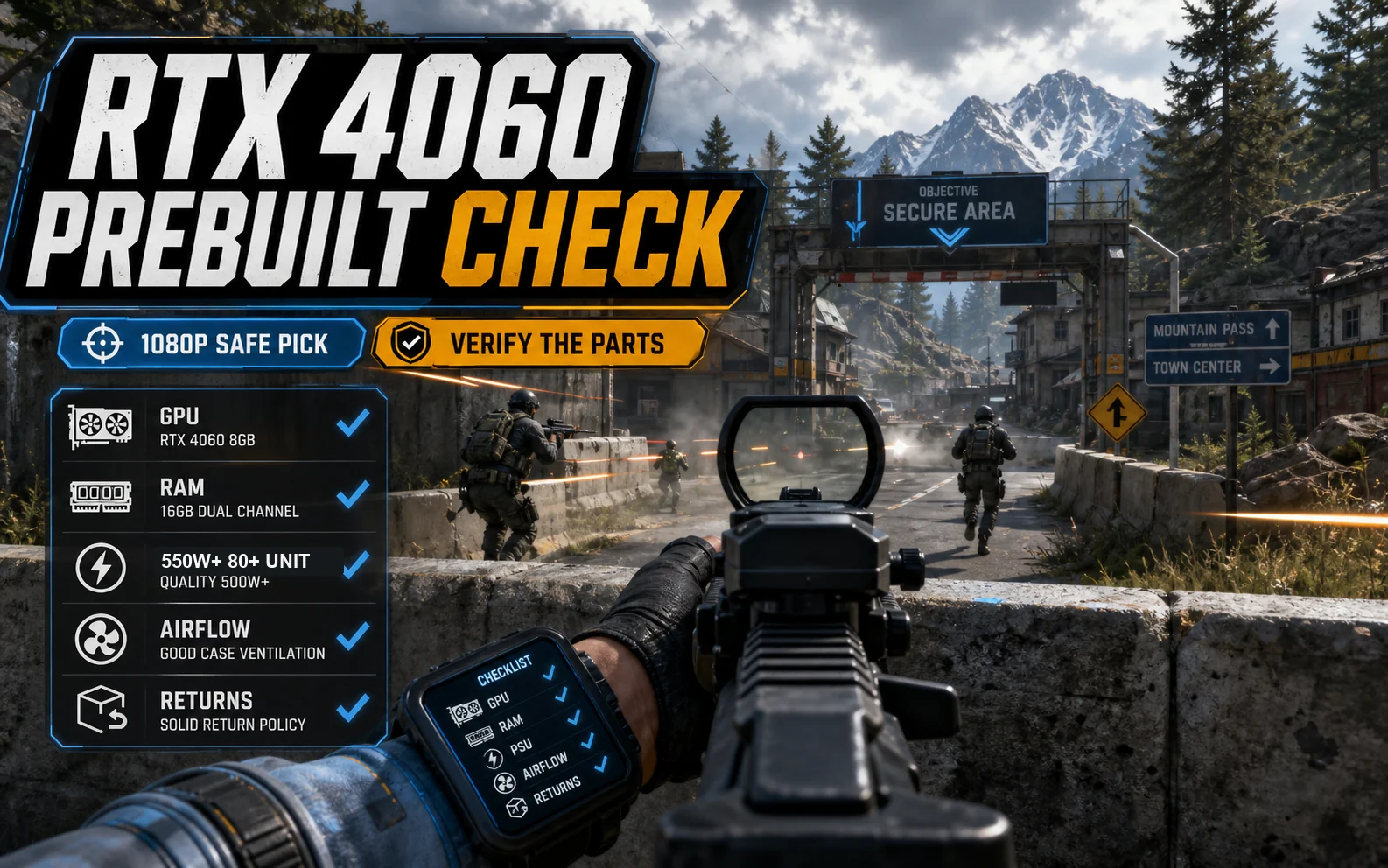
An RTX 4060 prebuilt at the right price is a legitimate shortcut to a capable 1080p gaming machine. The problem is that “RTX 4060” on the listing tells you almost nothing about whether the machine is actually worth buying. The GPU is the one part builders can’t cheap out on without killing the marketing pitch — everything around it is fair game. Here’s what to look at before committing.
| Spec to verify | Acceptable | Red flag |
|---|---|---|
| Power supply | 550 W+ 80+ Bronze, name brand | Generic 500 W, no certification |
| RAM | 16 GB DDR4-3200 dual-channel | 8 GB single stick, slow speed |
| Storage | 500 GB+ NVMe SSD | 256 GB SATA / no SSD |
| Case airflow | Mesh front, 2+ intake fans | Solid front panel, 1 rear fan only |
| Motherboard chipset | B550 / B650 / B660 / B760 | A520 / H610 (no upgrade path) |
| Cooler | Tower air cooler or 120 mm AIO | Stock Intel boxed cooler at 65 W+ |
| Warranty | 1+ year parts & labor | 30-day “no questions” only |

What a fair price looks like in 2026
A legitimate RTX 4060 prebuilt — named CPU (i5-12400F, i5-13400F, or Ryzen 5 5600 level), 16GB DDR4, 1TB SSD, named PSU — costs $799–$899 from a reputable seller at normal pricing. Below $750 for a complete system, something is missing. Above $950 without meaningfully better components, you’re paying a brand tax that doesn’t benefit you.
Sale pricing from iBUYPOWER, Skytech, or CyberPowerPC can bring legitimate builds below $749 temporarily — those are worth jumping on. A permanently $699 RTX 4060 prebuilt from an unknown seller is not the same thing.
Skytech Archangel
Ryzen 5 5600, RTX 4060, 16GB RAM, 1TB SSD. Genuine, brand-name components on a highly upgradable B550 motherboard.
Check Price on Amazon ›Skytech Nebula
Core i5-12400F, RTX 4060, 16GB RAM, 500GB SSD. The absolute lowest entry cost with solid, reliable 1080p performance.
Check Price on Amazon ›iBUYPOWER SlateMesh
Core i5-13400F, RTX 4060, 16GB RAM, 1TB SSD. Features an upgraded 13th-gen Intel CPU, perfect for multitasking and streaming.
Check Price on Amazon ›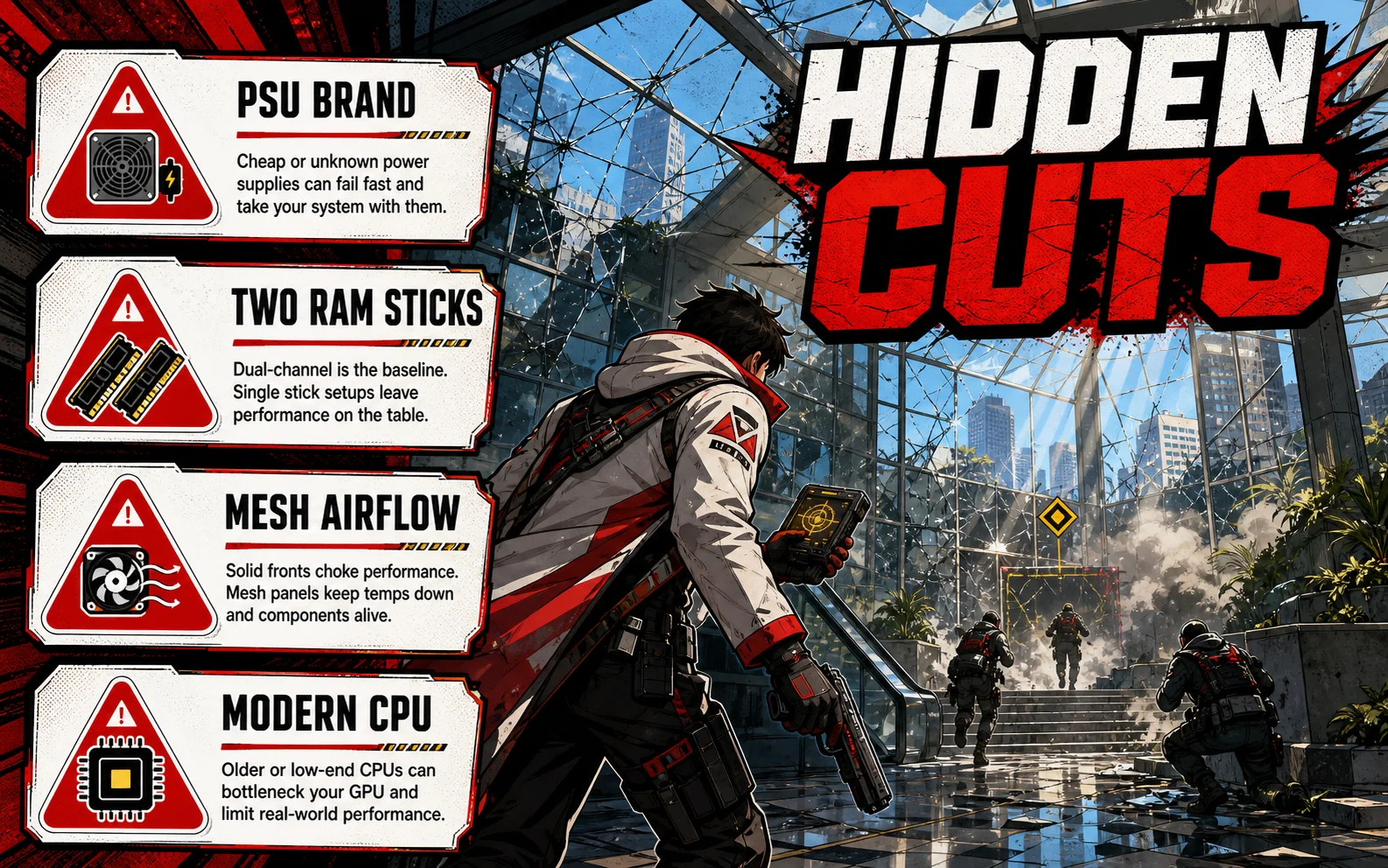
The four parts most prebuilts compromise on
The power supply. This is the single most common hidden cut. An RTX 4060 draws about 115W but your full system under load needs a quality 550W unit to run safely and cleanly. Listings that don’t name the PSU brand are almost always hiding a generic unit you’d replace within a year. Look for Corsair, EVGA, Seasonic, be quiet!, or Thermaltake specifically named in the specs. “650W power supply” with no brand is a red flag.
RAM configuration. 16GB total is fine, but whether it’s one stick or two matters. A single 16GB stick runs in single-channel mode and measurably hurts gaming performance in CPU-sensitive titles. The listing should say “2x8GB” or “dual channel” somewhere. If it’s not specified, it’s probably one stick.
Storage size. 500GB fills up fast. Windows, Steam or Epic, and two or three large games will crowd it immediately. A 1TB NVMe SSD is the correct minimum. Factor in the cost of adding storage if the listing only shows 500GB.
CPU generation. An RTX 4060 paired with an 8th or 9th gen Intel chip (i5-8400, i7-9700) is a mismatched build — the CPU will bottleneck at higher framerates and lacks modern platform features. The CPU should be at minimum a 12th-gen Intel (i5-12400F or better) or Ryzen 5000-series (5600 or better). If the listing says “Intel Core i5” without a generation number, that’s a problem.
🎮 RTX 4060 Prebuilt: Live Gameplay FPS Benchmarks
An RTX 4060 prebuilt is built primarily for high-refresh 1080p gaming. While it can stretch to 1440p with DLSS enabled, its absolute sweet spot is maxing out competitive shooters and running modern triple-A titles at high settings. Here is what you can expect in real-world gameplay tests:
| Game Title | Settings (1080p) | Average FPS | Gameplay Verdict |
|---|---|---|---|
| Fortnite | Performance Mode | 240+ FPS | Perfect match for 240Hz competitive monitors. Lock-solid frames. |
| Call of Duty: Warzone | 1080p High (DLSS Quality) | 120+ FPS | Smooth, competitive gameplay with highly responsive tracking. |
| Apex Legends | 1080p High | 144+ FPS | Sits cleanly at the esports standard with zero stutter in firefights. |
| Cyberpunk 2077 | 1080p High (RT Off) | 85+ FPS | Excellent AAA immersion. Drops to 55 FPS if native ultra ray tracing is on. |
To keep your gameplay fluid, ensure your prebuilt CPU is modern enough to not bottleneck the GPU. A Ryzen 5 5600 or Core i5-12400F will feed the RTX 4060 cleanly, ensuring you get every single frame you paid for.
Brands worth looking at vs brands to skip
iBUYPOWER and Skytech are the two most consistent budget prebuilt builders. Both name their components, have real warranty paths, and have enough of a track record to find model-specific reviews. CyberPowerPC is competitive but PSU quality varies more across their lineup — always verify the PSU spec on any specific model.
Skip: generic brand names on Amazon marketplace, any listing where the specs table doesn’t match the title copy (this happens and it’s always a bad sign), and third-party sellers with no manufacturer warranty path and a 30-day return window as the only recourse.
Frequently asked questions
What's a fair price for an RTX 4060 prebuilt in 2026?
$899–$999 is the sweet spot for a complete system with a 16 GB DDR4 / 500 GB SSD / 550 W PSU spec. Anything over $1,100 needs a real reason — better cooling, better case, or a 1 TB SSD.
Should I just build it myself instead?
If you can spend an afternoon on YouTube tutorials, yes — you'll save $100–$200 and get to choose every part. If you don't want to deal with the learning curve, a sub-$1,000 4060 prebuilt is a reasonable middle ground.
What if the prebuilt has 8 GB of RAM?
Skip it. 8 GB single-channel will bottleneck modern games and adding the second stick yourself requires opening the case anyway. Look for 16 GB dual-channel as the baseline.
Are Best Buy / Costco prebuilts safe to buy?
Yes — their return windows and warranties are the safety net. The big-box system integrators (HP Omen, Lenovo Legion, MSI Codex) usually pass the spec audit. Smaller no-name eBay builders often don't.
Will the prebuilt PSU last five years?
If it's an 80+ Bronze or better unit from Corsair, Seasonic, EVGA, or Cooler Master — probably yes. If the spec sheet just says "500W power supply" with no model number, plan to replace it inside two years.
Prebuilt vs self-build at this price
The same components in an $849 RTX 4060 prebuilt cost roughly $680–$730 to source yourself. The $120–$170 gap pays for assembly, OS installation, and a unified warranty. If you’ve never built a PC, that’s a reasonable trade. If you’re comfortable with the process, that money goes back toward a better GPU, more storage, or a higher-refresh monitor. Run a quick comparison at PCPartPicker against whatever prebuilt you’re considering — sometimes they’re on sale and the gap narrows significantly.