Ask any PC veteran the oldest question in the hobby — buy a prebuilt or build it yourself? — and the reflex answer has always been the same: build it, you’ll save money and get better parts. In 2026, that reflex is wrong often enough to be worth a serious rethink. The memory shortage didn’t just raise prices; it flipped the economics that made DIY the obvious budget choice for twenty years.
Here’s what changed, when a prebuilt genuinely wins now, and when rolling your own still makes sense.
The reversal nobody saw coming
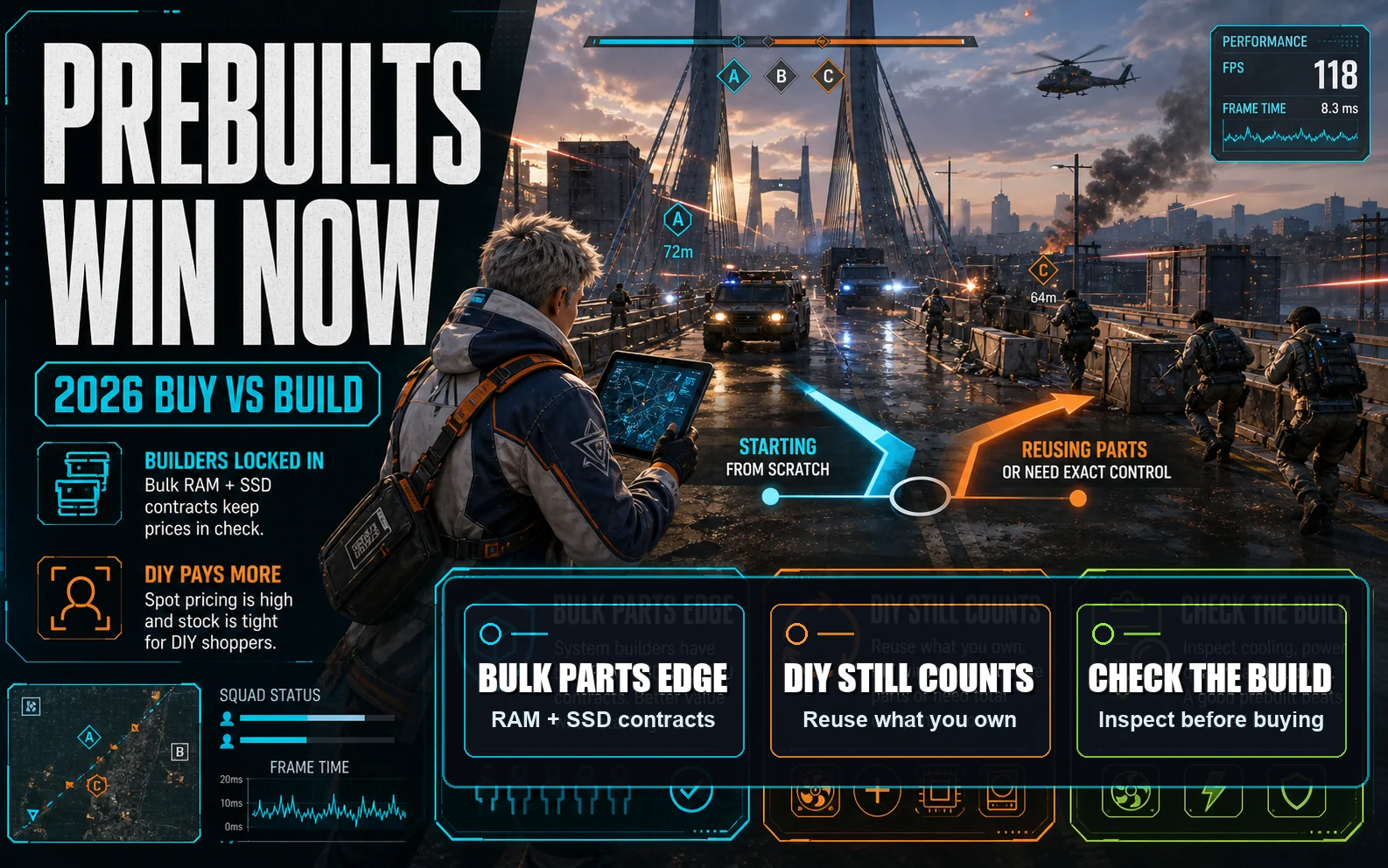
The mechanism is bulk purchasing. Big system builders — the CyberPowerPCs, Skytechs, and iBUYPOWERs of the world — buy RAM and SSDs on long-term contracts at volume pricing locked in before the spike. You, buying a single 32GB kit on the open market in June 2026, pay the inflated spot price that’s tripled in a year. So the component that’s hurting DIY builders the most is the exact one prebuilders are insulated against.
The fallout has been surreal. Some vendors are even selling prebuilt towers without memory, because RAM has become such a volatile line item. And in a growing number of configs, the finished, assembled, warrantied machine costs about the same as — or less than — the sum of its parts bought separately. For a budget builder, that’s not a small wrinkle. That’s the whole calculus turned over.
When a prebuilt is the smart buy in 2026
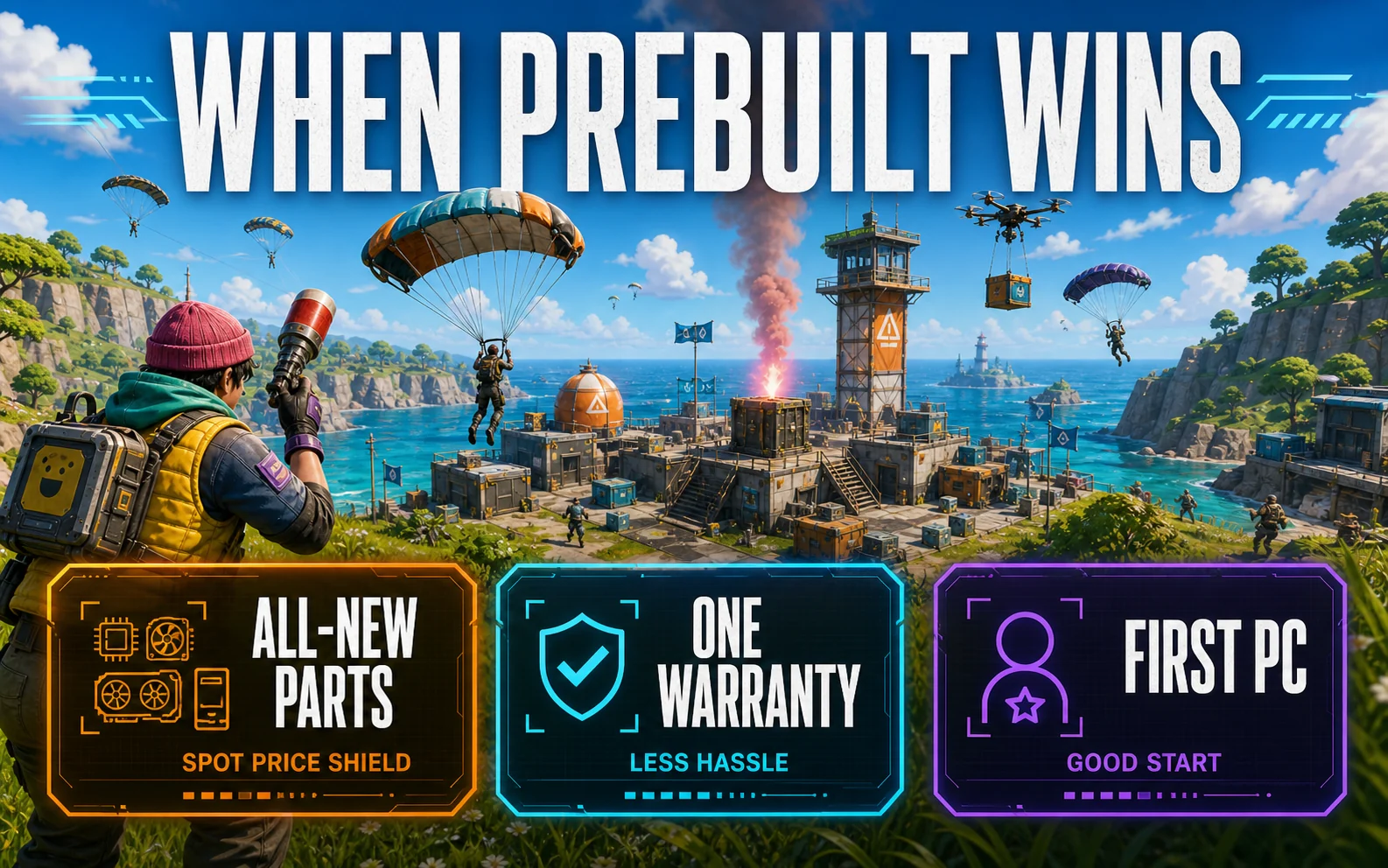
- You’d be buying all-new parts anyway. If you don’t have RAM or storage to carry over, you’re fully exposed to spot pricing — exactly where prebuilders beat you. A sub-$1,000 machine with an RTX 5060 or RX 9060 XT and 16GB of DDR5 is a legitimately good deal this year.
- You value the warranty and the time. One number to call when something breaks, no afternoon of cable management, no compatibility rabbit holes. That’s always been worth something; in a year when DIY barely saves money, it’s worth more.
- You’re new to this. First-timers used to “pay tuition” to learn by building. Right now the tuition discount is small enough that a good prebuilt is a perfectly respectable starting point.
The shrinking “prebuilt premium” is the headline. Where builders once expected to pay $150–300 extra for the convenience, that gap has narrowed to roughly $100–200 — and sometimes vanished entirely. Just bring the same scrutiny you’d bring to parts: our guide on spotting a good prebuilt deal covers the spec-sheet traps to check.
When DIY still wins
This isn’t a eulogy for building your own. There are clear cases where it remains the better move:
- You have parts to reuse. Got a DDR4 kit, a decent PSU, or an SSD from an old machine? Carrying those over sidesteps the priciest components entirely and tilts the math hard back toward DIY. Reused RAM in 2026 is basically free money.
- You want exact parts. Prebuilts cut costs somewhere, and it’s often the parts you can’t see — a no-name power supply, slow single-channel RAM, a cramped case with bad airflow. Building lets you put a quality PSU and proper cooling where a prebuilder might skimp.
- You want zero bloatware and full control. A clean Windows install, the cooler you chose, and a layout you can actually work in. Some of that is preference, but it’s real value to the people who care.
- You enjoy it. Never underestimate this. Building a PC is a satisfying afternoon for a lot of people, and that experience doesn’t show up on a spreadsheet.
If you go prebuilt, inspect these three things
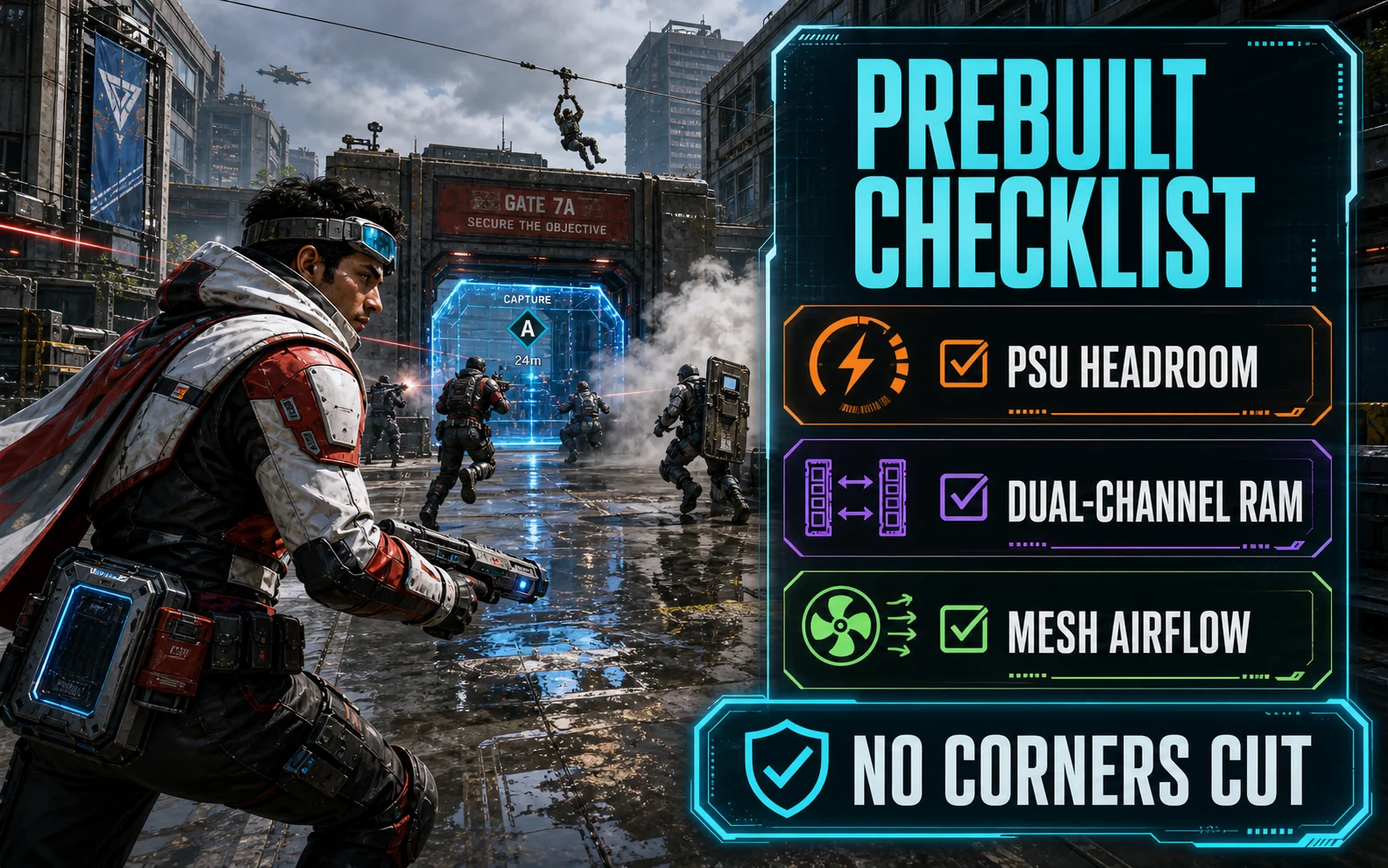
The corners get cut in predictable places. Before you buy, confirm the power supply is a known-brand unit with real wattage headroom, that the RAM runs in dual-channel at a sensible speed (not a single 16GB stick), and that the case has mesh airflow rather than a sealed glass front choking the GPU. A prebuilt that nails those three is genuinely hard to beat on price this year. One that fumbles them is the old cautionary tale. The same scrutiny we applied to the King 95 prebuilt applies at every price tier.
Common questions
Is it cheaper to build or buy a PC in 2026?
For the first time in years, often buy. System builders lock in bulk RAM and SSD pricing, so a prebuilt can match or beat the cost of buying the same parts individually at today’s inflated spot prices — especially if you’d be purchasing all-new memory and storage.
Why are prebuilts suddenly competitive on price?
The 2026 memory shortage tripled DDR5 prices and roughly doubled SSD prices on the open market. Prebuilders buy those parts in volume on contracts, insulating them from the spike, which erased much of the traditional DIY savings.
When is building your own PC still worth it?
When you can reuse parts like RAM, storage, or a PSU; when you want specific quality components a prebuilt might skimp on; or when you simply enjoy building. Reusing memory you already own is the single biggest cost advantage DIY still has.
What should I check before buying a prebuilt?
The power supply brand and wattage, whether the RAM is dual-channel at a reasonable speed, and whether the case has proper airflow. Those are the three spots builders most often cut costs, and they affect reliability and performance.
The honest answer
In 2026, the build-versus-buy decision is closer than it’s ever been, and that’s entirely the memory shortage’s doing. If you’re starting from scratch with all-new parts, a well-specced sub-$1,000 prebuilt is no longer the sucker’s choice it used to be — it might be the value play. If you’ve got parts to carry over or strong opinions about every component, DIY still rewards you. Either way, the old reflex of “always build, always save” deserves a fresh look this year. The numbers changed. Your decision should too.