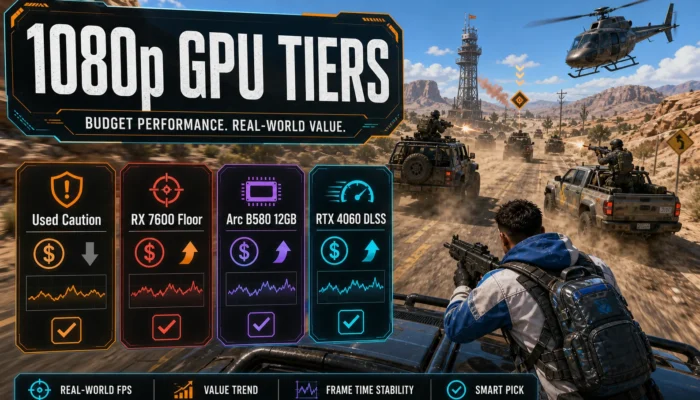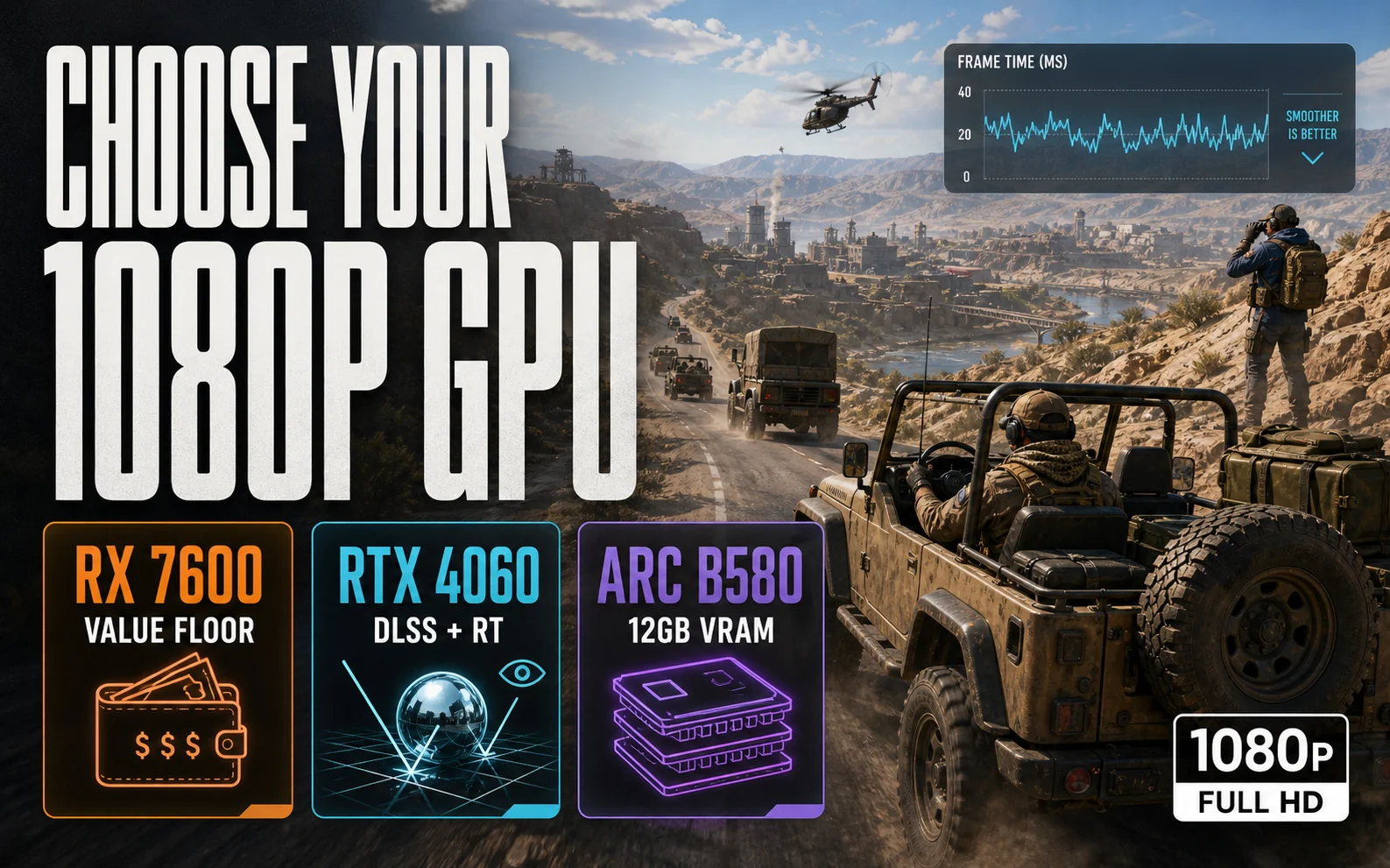
Choosing a budget GPU for 1080p gaming in 2026 comes down to three cards. Not a tier chart of fifteen options — three. The RTX 4060, the RX 7600, and the Intel Arc B580. Everything below them is either too old or too underpowered to recommend as a new purchase. Everything above costs more than a 1080p gaming budget justifies. Here’s how to pick between them.
RX 7600 — the cheapest real option at 1080p
At $199–$219, the RX 7600 is the floor of competent 1080p gaming in 2026. It delivers 60+ fps at high settings in virtually every current title, pushes 100+ fps in competitive games like Fortnite and Warzone, and supports FSR 3 Frame Generation in a growing list of titles.
The trade-offs are real: 8GB VRAM (same as the competition at this price), no DLSS, and roughly 165W power draw — noticeably higher than the RTX 4060. Ray tracing works but isn’t enjoyable in demanding games; you’ll want to turn it off in anything past a light implementation.
If your budget ceiling is firm around $220 and you primarily play competitive games or non-RT titles, the RX 7600 is the right card. You’re not missing anything that matters for what you’re actually running.
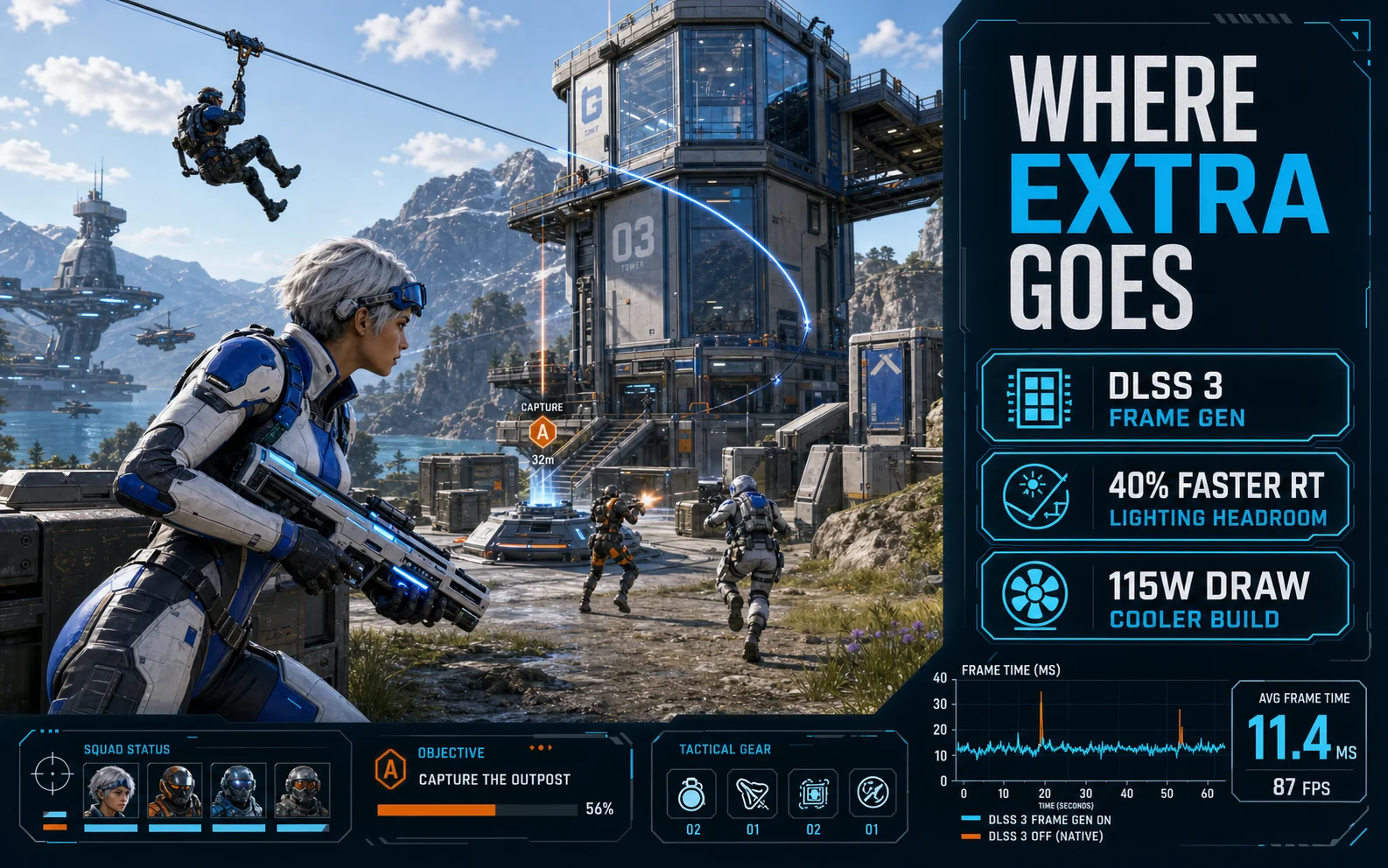
RTX 4060 — where the extra money goes
At $259–$289, the RTX 4060 costs $50–$70 more than the RX 7600 and earns it in specific ways. Ray tracing performance is about 40% faster — meaningful if you actually use RT settings. DLSS 3 Frame Generation is available in a growing library of supported titles and pushes framerates well past what raw rasterization delivers. Power draw sits around 115W, significantly lower than the RX 7600.
In pure rasterized 1080p performance, the two cards are effectively tied — neither one consistently wins across a broad game library. The RTX 4060 premium pays for the DLSS ecosystem, the RT headroom, and the lower thermal footprint. If your game list is heavy on titles with DLSS 3 support, the extra spend is worth it. If you mostly play competitive games or older titles where none of that matters, you’re paying for features you won’t touch.
Arc B580 — the 12GB wildcard
Intel’s Arc B580 sits at $249 and brings 12GB of VRAM — 4GB more than either rival. At 1080p that extra memory is mostly theoretical today, but at 1440p and in future titles with heavier texture budgets it becomes a real advantage. Raw gaming performance at 1080p is within a few percent of the RTX 4060 in rasterized workloads.
Two caveats matter. First, stock — the B580 sells out repeatedly, and when it does prices jump well above $249. If you see it at $249–$269, that’s the buying window; above $300 the value case collapses. Second, driver maturity — most games run fine, but a handful of titles still show unexpectedly low performance on Intel hardware. Check Arc-specific benchmarks for your main games before committing.
XeSS 3 Multi-Frame Generation now works on the B580 with frame multiplication comparable to DLSS 4 MFG in supported titles, which narrows Intel’s software disadvantage significantly compared to a year ago.
What the spec numbers actually tell you
CUDA core count, stream processor count, and shader numbers are not comparable across manufacturers. An RX 7600 has 2,048 stream processors; an RTX 4060 has 3,072 CUDA cores. This says nothing about relative performance because the architectures process work completely differently. Benchmark results in real games are the only number that matters.
Memory bus width is similarly misunderstood. The RTX 4060 uses a narrow 128-bit bus with a large cache to compensate. The Arc B580 uses 192-bit. Neither number alone tells you how the card performs — it’s one factor among many in the memory subsystem design.
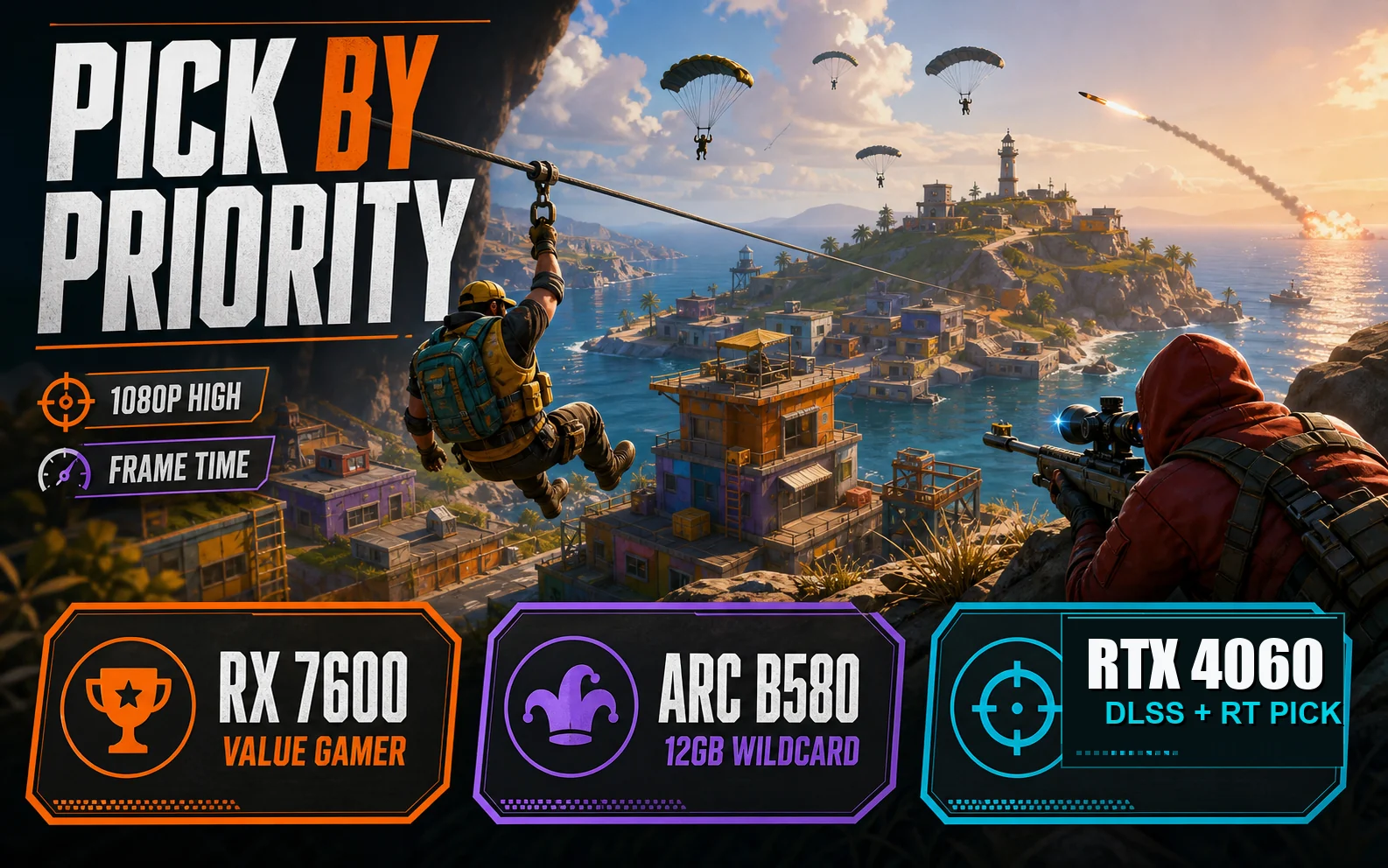
The buying decision in plain terms
Under $220: RX 7600. Between $240–$265 and the B580 is actually in stock: Arc B580. Up to $290 and you care about DLSS or ray tracing: RTX 4060. If you’re over $290 and still looking at these three, wait for a sale rather than overpaying for the same silicon. Check live pricing at Newegg and Amazon — GPU prices shift week to week and the gaps between these cards change with sales.