Most people building a budget gaming PC waste money before they even pick a part. They overspend on a case because it looks good, buy more RAM than games actually need, and then realize they don’t have enough left for a decent GPU. The GPU is what determines how games run. Everything else just needs to be good enough — and good enough is cheaper than most build guides admit.
Spend the budget in the right order
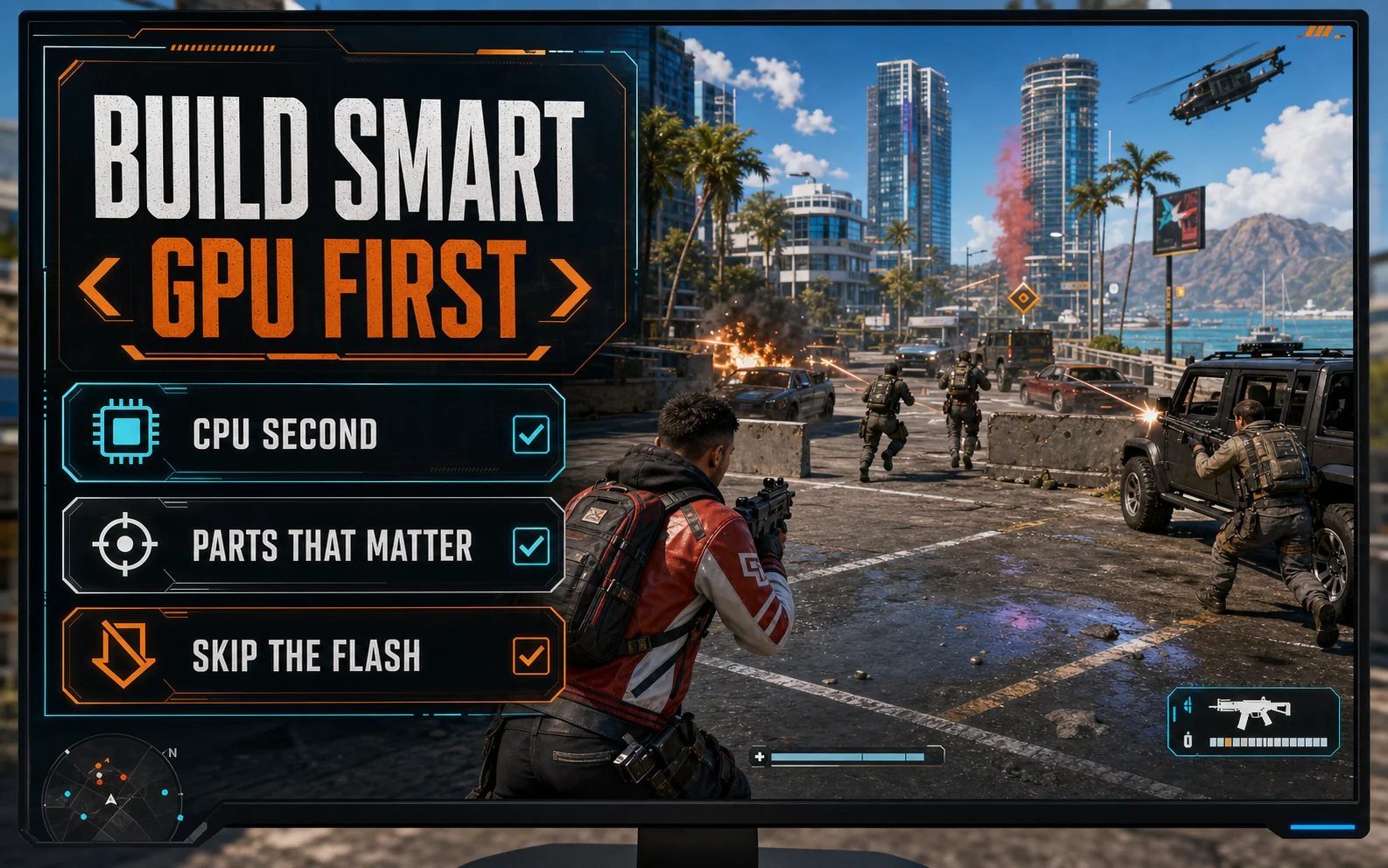
For a budget gaming PC in 2026, the priority order is: GPU first, CPU second, everything else third. The graphics card does the heavy lifting in every game you’ll play. A Ryzen 5 5600 paired with an RX 7600 will outperform a Ryzen 7 7700X paired with a GTX 1060 in every modern title. Get the GPU right and the rest of the build follows naturally.
The realistic target for most budget builds in 2026 is $650–$800 for a complete parts list. Here’s how to hit that without spending money in the wrong places.
The GPU — where most of the budget belongs
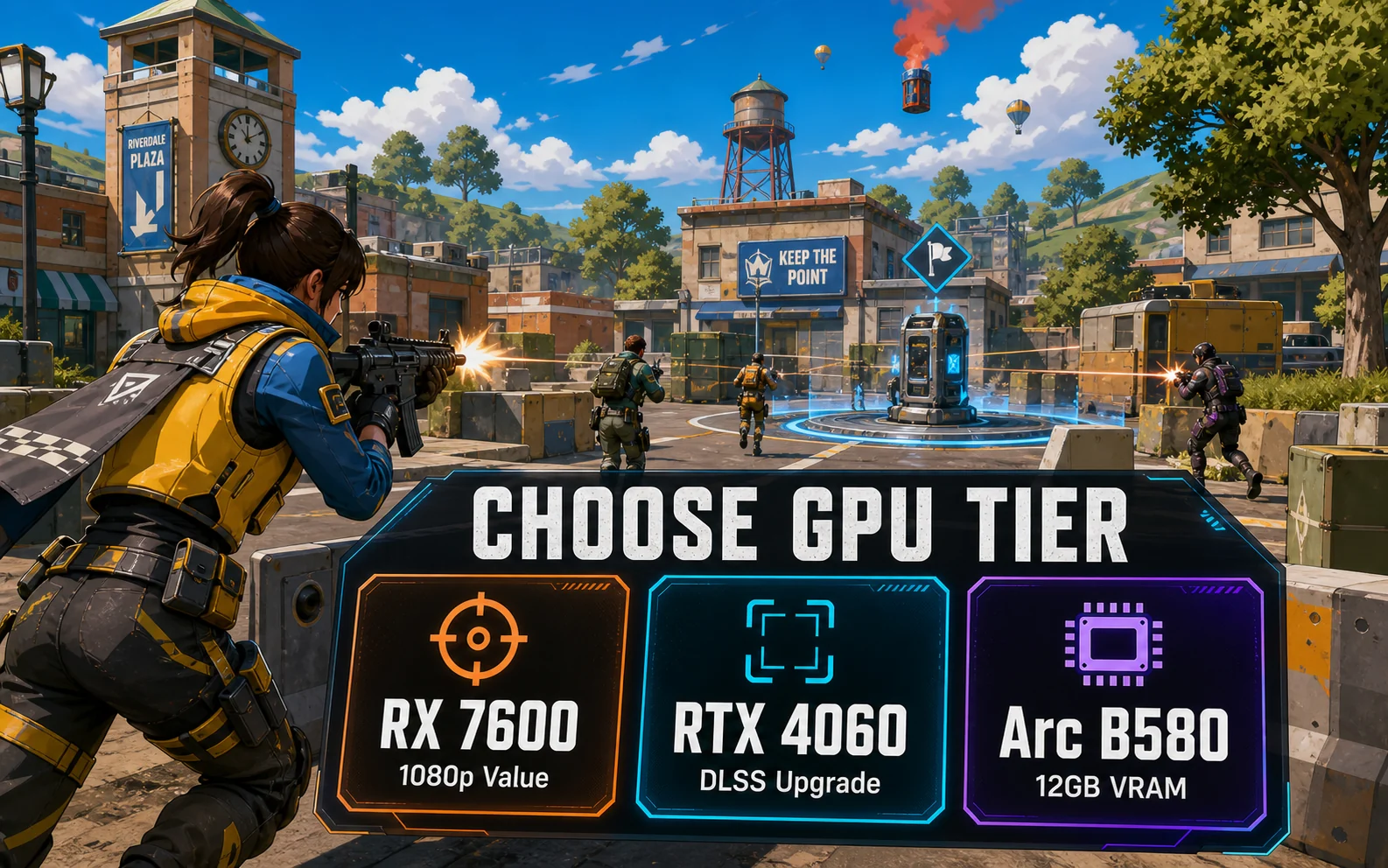
At 1080p you’re choosing between three cards worth considering. The RX 7600 at $199–$219 is the cheapest path to solid 1080p gaming — 60+ fps at high settings in every current title, 100+ fps in competitive games. The RTX 4060 at $259–$289 adds DLSS 3 Frame Generation and significantly better ray tracing. The Intel Arc B580 at $249 brings 12GB of VRAM — more than either rival — and has matured into a genuine recommendation in 2026.
Don’t drop below the RX 7600 tier on a new card. Anything cheaper is either older hardware that will struggle with newer titles or marketplace stock with no warranty to speak of.
CPU and platform — AM4 is still the value leader
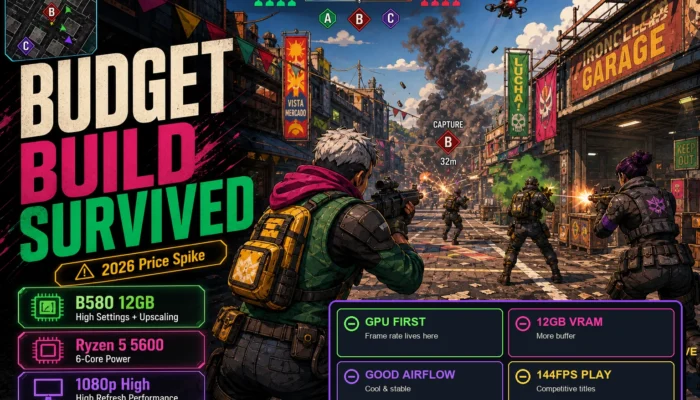
The Ryzen 5 5600 is the default CPU for a budget gaming build right now. Six cores, a 4.4GHz boost clock, and a boxed cooler included. Boards start around $75–$95 for a solid B550. The total CPU + motherboard cost lands around $200–$225 — the cheapest competent gaming platform available.
The i5-12400F is the Intel alternative and performs almost identically in games. LGA1700 B660 boards cost a bit more to get a solid model, pushing the total platform cost to $245–$280. If you find a B660 board on sale under $90, Intel becomes competitive. Without that deal, AM4 is the cleaner budget math.
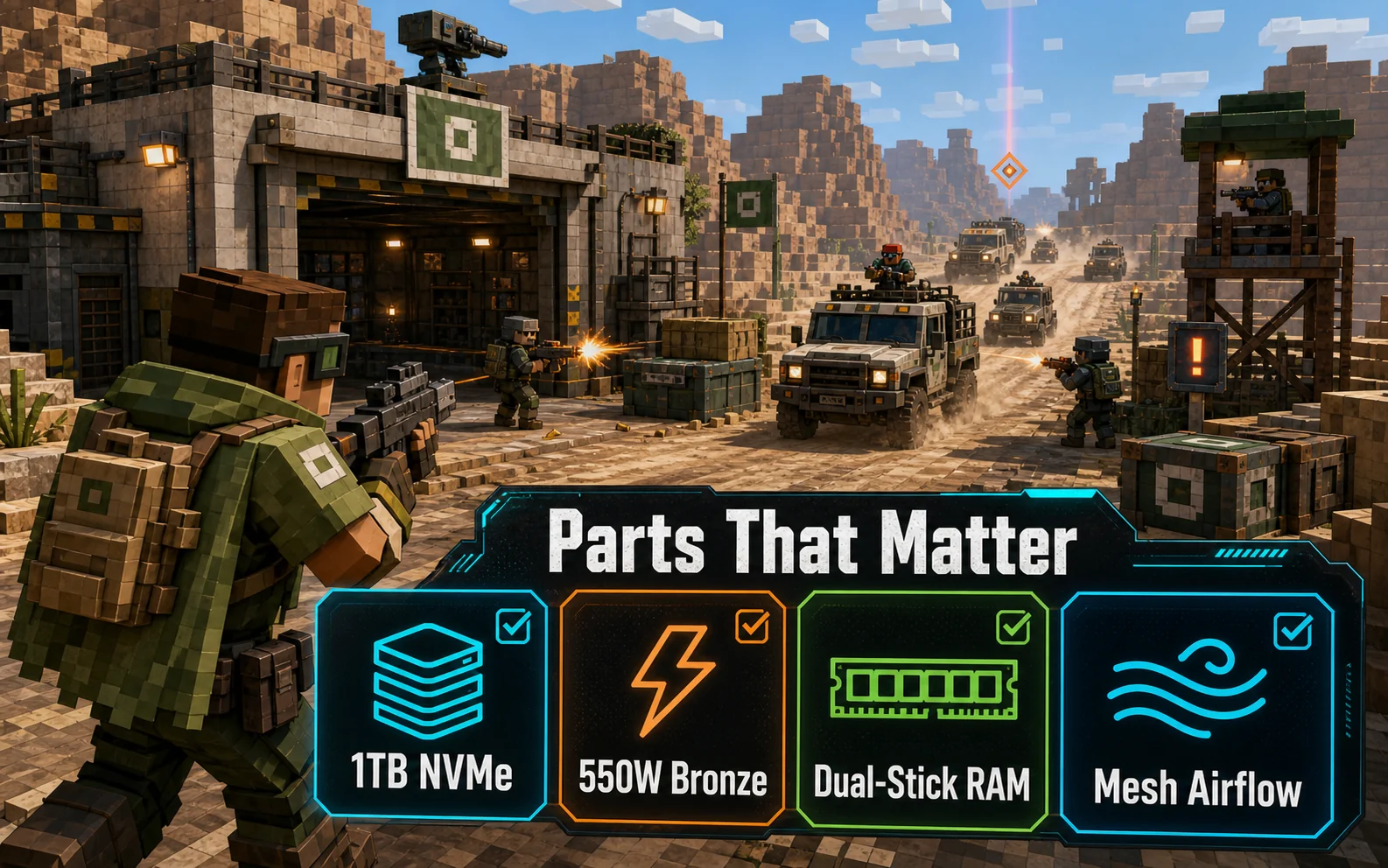
Either way: 16GB of DDR4 in two sticks is the minimum. A single 16GB stick runs in single-channel mode and measurably hurts gaming performance in CPU-sensitive titles. Pay slightly more for a dual-stick kit upfront.
Storage, power supply, and the parts people get wrong
Use a 1TB NVMe SSD as the boot and game drive. A 500GB drive fills up fast once Windows, Steam, and a couple of large games are installed — the cost difference between 500GB and 1TB is small enough that starting cramped makes no sense.
The power supply is where most budget builds quietly cut corners. A named 550W Bronze-rated unit from Corsair, EVGA, Seasonic, or be quiet! costs $50–$65 and protects the rest of your components. Generic no-name PSUs from Amazon marketplace sellers are a false saving — a failing unit can take other components with it when it goes.
The case matters less than reviews suggest, with one real exception: front intake airflow. A mesh front panel keeps the GPU cooler and quieter under load. It doesn’t need RGB, tempered glass, or a recognizable brand — just a clear airflow path from front to back.
Things that don’t move the needle
RGB lighting adds cost and zero performance. A CPU cooler beyond the stock Wraith Stealth (which comes in the boxed Ryzen 5 5600) is unnecessary unless you’re overclocking — which you shouldn’t be on a budget build. A Z-series motherboard is wasted money if you’re not overclocking; B550 for AM4 or B660 for Intel covers everything a gaming build needs. A 650W PSU is not meaningfully safer than 550W for mid-range GPUs. ATX3.0 connectors are not required for the RTX 4060 or RX 7600.
Pick the exact budget build for you
This guide covers the priorities. When you’re ready for a full part-by-part list, these builds target specific budgets and goals:
- What $800 Builds in 2026 — the balanced all-rounder.
- PC Gaming on a $500 Budget — the rock-bottom entry point.
- The AM4 Budget Build — cheapest viable platform right now.
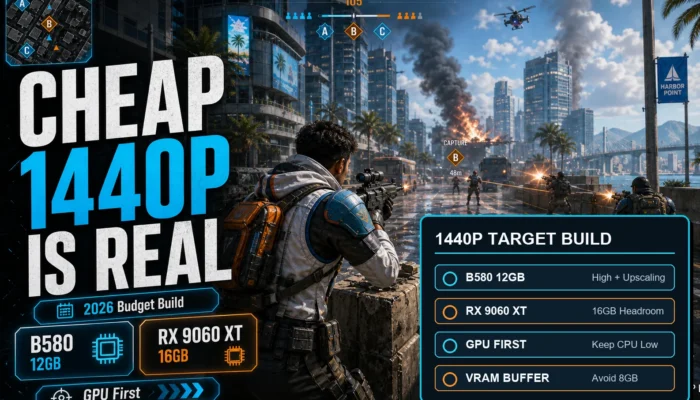
- The Cheap 1440p Build — step up from 1080p without overspending.
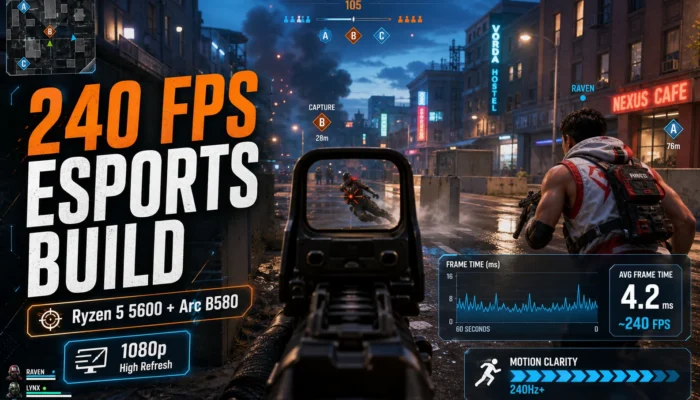
- The 240 FPS Esports Build — competitive high-refresh focus.
Where to verify prices
GPU pricing is the most volatile part of any build. Check Newegg and Amazon on the day you’re buying, not the day you read this. CPU and board prices move more slowly but still shift with sales. A build that pencils out to $700 one week can be $650 or $730 the next. The priority order — GPU first, platform second, storage and case last — stays the same regardless of where prices land that day.