Two years ago, $800 bought a comfortable 1080p gaming PC with room to spare — a current-gen CPU, 16GB of fast memory, a 1TB drive, and a graphics card that could flirt with 1440p. In June 2026, that same $800 buys a leaner machine. The AI-driven memory shortage has dragged RAM, SSDs, and even GPUs upward, and the budget tier absorbed most of the damage. The money still builds a good gaming PC. It just demands sharper choices.
So let’s spend it deliberately. Here’s where every dollar of an $800 build goes in this market, what you should refuse to cut, and the one build we’d hand a friend who texted “I’ve got eight hundred bucks, what do I get.”
What changed since the last time you priced a build
The short version: memory is the problem. A 32GB DDR5 kit that ran about $90 in early 2025 spent part of this spring near $500 before settling around $250–285. NVMe SSDs roughly doubled as the same NAND shortage spread to storage. Graphics cards are selling above their official launch prices because the GDDR memory on them got expensive too. None of this is your build’s fault — it’s the whole market — but it means the $800 envelope is tighter than your muscle memory expects.
The upside: the budget GPU you’ll lean on hasn’t moved much, and Intel in particular has held the line on price. That’s what makes $800 still workable.
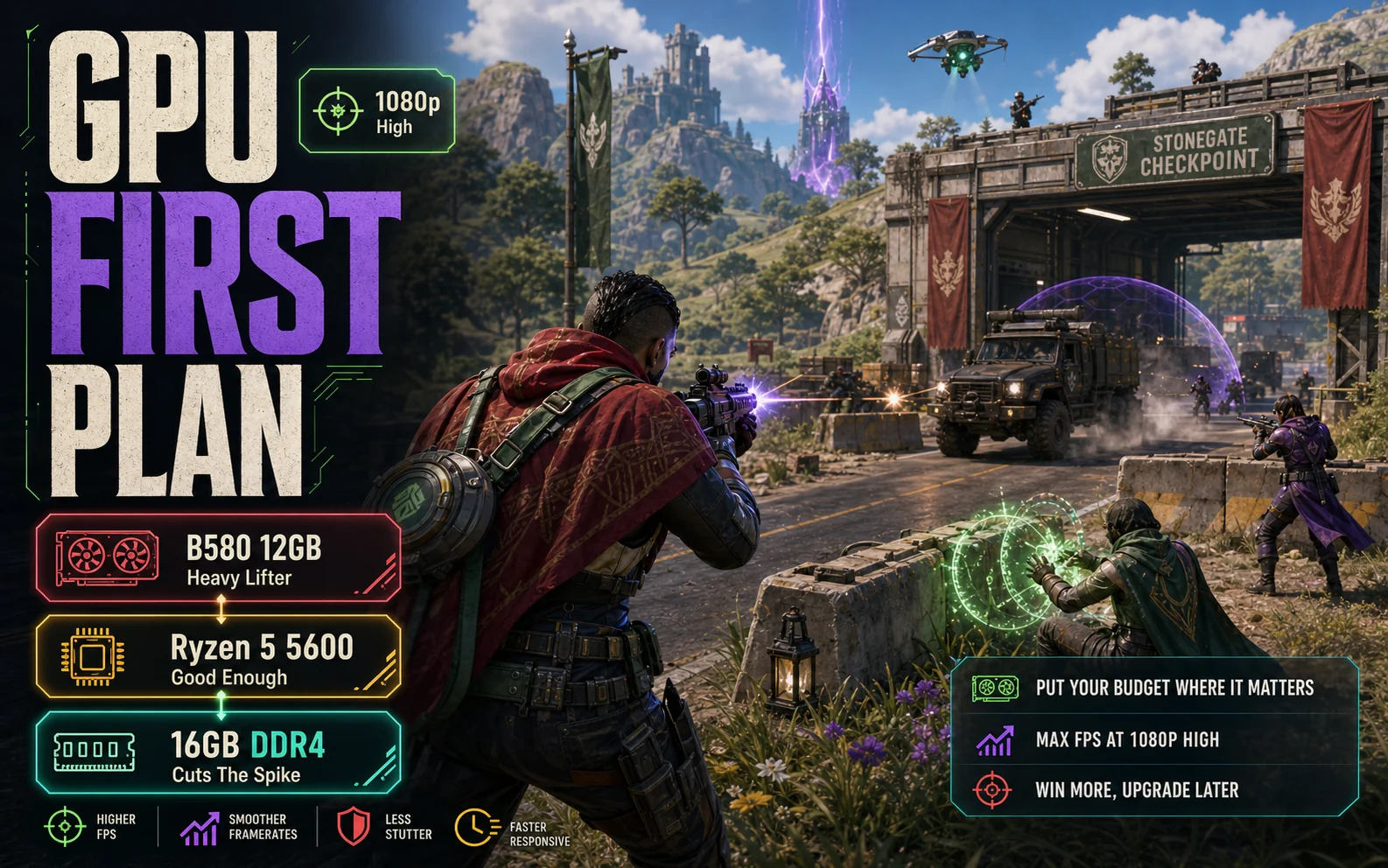
Spend GPU-first, then stop the bleeding everywhere else
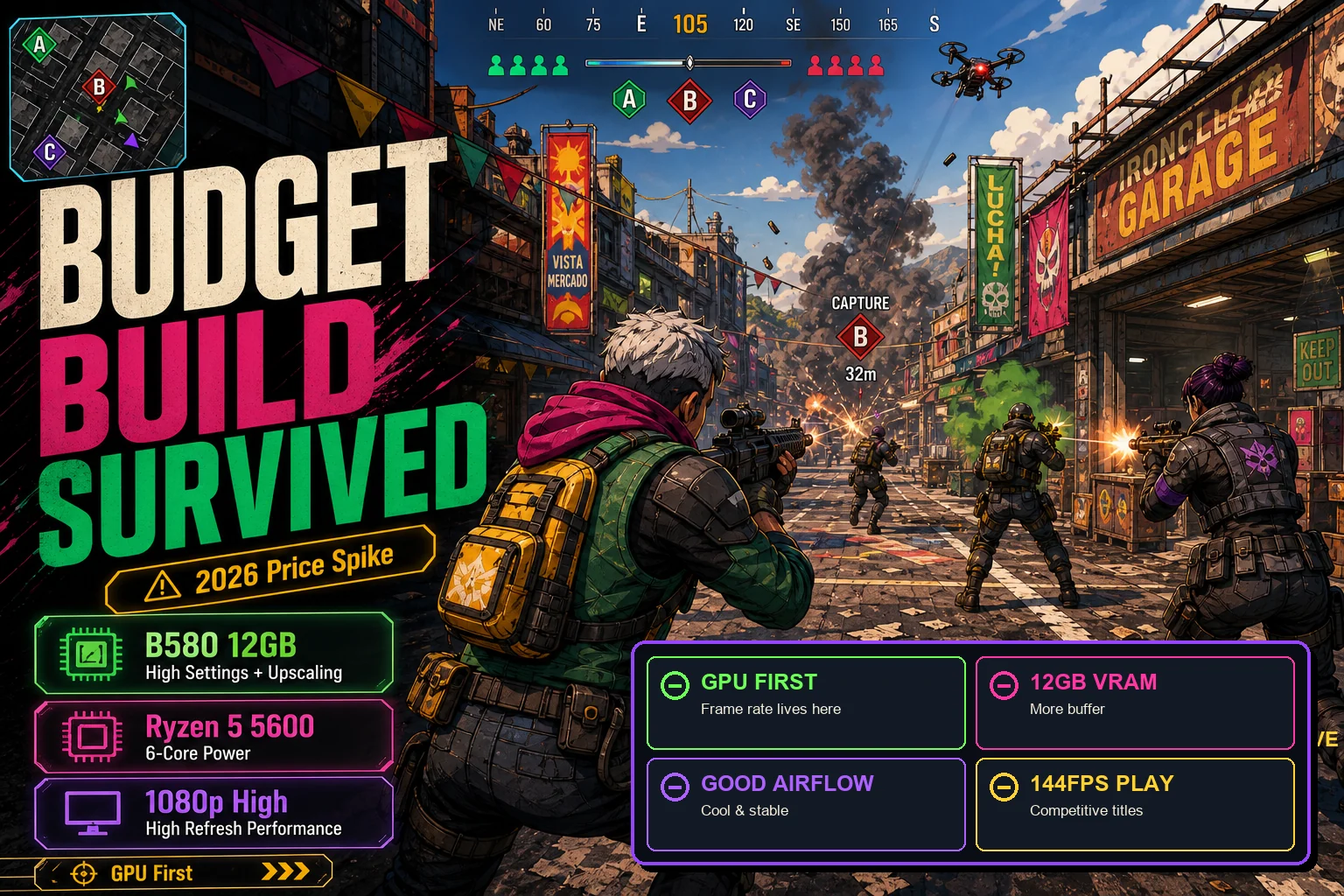
The single rule that makes a budget build sing is to put the graphics card first and treat everything else as the cheapest competent option that won’t bottleneck it. At 1080p, frame rate lives and dies on the GPU. A $130 CPU paired with a strong card beats a $250 CPU paired with a weak one in nearly every game that matters.
Here’s the allocation we’d run, built on AM4 to free up GPU budget:
| Part | Pick | Price | Why |
|---|---|---|---|
| GPU | Intel Arc B580 12GB | ~$250 | 12GB VRAM at this price is unmatched in 2026 |
| CPU | Ryzen 5 5600 | ~$130 | Won’t hold the B580 back at 1080p |
| Motherboard | B550M | ~$90 | Cheapest path to a 5600 |
| RAM | 16GB DDR4-3600 | ~$70 | DDR4 dodges the worst of the price spike |
| SSD | 1TB Gen4 NVMe | ~$120 | Don’t go below 1TB in 2026 |
| PSU | 650W 80+ Gold | ~$65 | The part you never cheap out on |
| Case | Mesh-front mid-tower | ~$70 | Airflow over looks |
| Total | ~$795 | ||
That’s a real 1080p-high machine that pushes past 60fps everywhere and clears 144fps in competitive titles. The Arc B580 is doing the heavy lifting, and its 12GB buffer means you’re not locked out of 1440p the way an 8GB card would be.
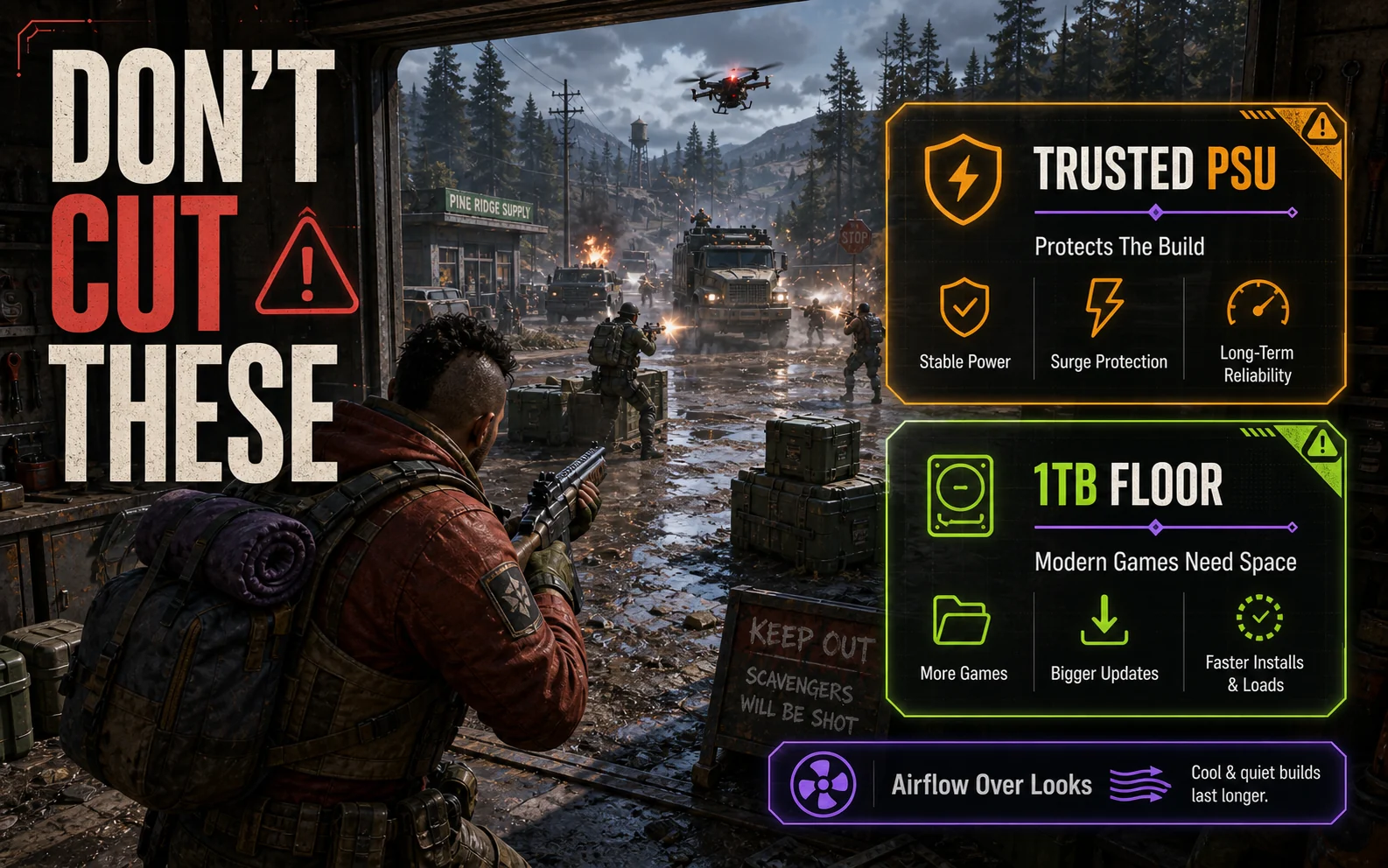
The two corners that look tempting and aren’t
When money is tight, the urge is to trim the parts you can’t see in a benchmark. Two of them will bite you.
The power supply. A no-name 600W unit saves $25 and risks every other part in the case. A 650W 80+ Gold from a known brand is cheap insurance, and it’ll carry over to your next build. Our guide to picking a budget PSU under $60 covers the units worth trusting.
Storage capacity. A 500GB drive feels fine until two modern games and Windows eat it alive — installs of 100–150GB are normal now. At 2026 prices, 1TB is the floor, and stepping to 2TB is worth it if Prime Day throws a deal your way.
The 8GB question at this budget
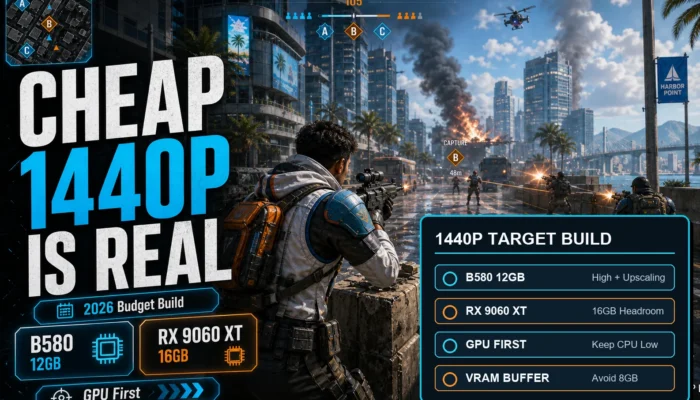
You’ll be tempted by 8GB cards in this price range — the RTX 5060 and the 8GB RX 9060 XT both hover around $339–359. They’re faster than the B580 in raw terms, but the 8GB frame buffer is increasingly the thing that breaks first in 2026’s heavier games, stuttering at 1440p and even tripping up at 1080p with ray tracing on. The community has turned sharply against 8GB at this price, and they’re not wrong. The B580’s 12GB is the safer bet for the next few years. If you can find another $100–200, the 16GB RX 9060 XT is the upgrade that future-proofs the build; below that, lean on VRAM, not raw speed.
If $800 still feels like a lot
It is a lot, and not everyone has it. The tier below still works — we walked through whether $500 PC gaming is still possible in 2026, and the short version is “barely, with used parts.” The tier above, around $1,000, is where 1440p stops requiring compromises. The $800 slot is the honest middle: a no-excuses 1080p machine that handles 1440p when you ask nicely.
Quick hits
Is $800 enough for a gaming PC in 2026?
Yes, but it builds a focused 1080p machine rather than the do-everything rig it would have two years ago. The memory shortage raised RAM, SSD, and GPU prices, so the budget goes further if you build on AM4 and put the savings into the graphics card.
AM4 or AM5 for an $800 build?
AM4. With DDR5 prices inflated, an AM4 platform (Ryzen 5 5600 + B550 + DDR4) costs roughly $150 less than the AM5 equivalent for nearly identical 1080p gaming, leaving more for the GPU. Choose AM5 only if a future CPU upgrade matters to you.
What graphics card should an $800 build use?
The Intel Arc B580 at around $250 is the pick — its 12GB of VRAM ages better than the 8GB cards in the same price range. If you can stretch the budget, the 16GB RX 9060 XT is the next step up.
Can this build do 1440p?
Yes, with realistic settings and upscaling, thanks to the B580’s 12GB buffer. Native high-refresh 1440p in demanding games is a job for a roughly $1,000 build with a 16GB card.
Where that $800 goes
Put it almost all into the graphics card and the parts that protect it. A Ryzen 5 5600, a cheap B550 board, 16GB of DDR4, and an Arc B580 lands right at $800, plays everything at 1080p without apology, and leaves a 12GB VRAM cushion for the games coming this year. The market is hostile to budget builders right now — the move is to spend where frames live and refuse to overpay for the memory the whole industry is gouging on.