For years the budget-build script barely changed: hop on AM5, grab a DDR5 kit, enjoy the upgrade path. That script fell apart in 2026. DDR5 prices have roughly tripled since last year as AI data centers swallow every memory chip the fabs can produce, and a 32GB DDR5-6000 kit that sold for around $90 in early 2025 spent part of this spring brushing up against $500.
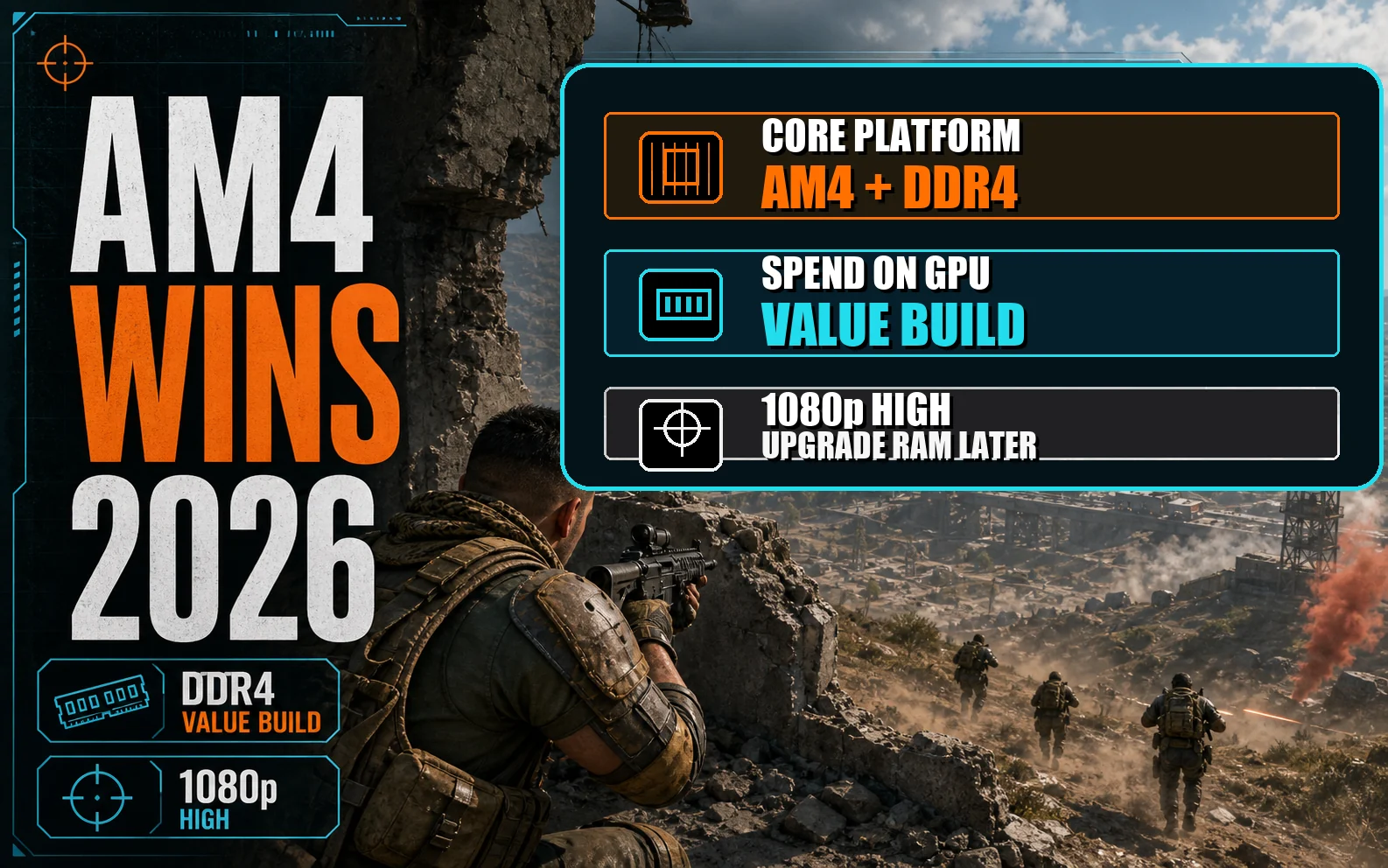
Which leads to a slightly absurd situation for June 2026: the cheapest way to put together a genuinely good gaming PC runs on a socket that launched in 2017. AMD clearly sees it too. At Computex on May 31 it brought back the Ryzen 7 5800X3D as a “10th Anniversary” chip and pushed out the budget 5500X3D, both aimed straight at AM4 holdouts who have been watching DDR5 prices climb. If you want the most frames per dollar today, AM4 is the answer again.
How a six-year-old socket became the value pick
None of this is because AM4 got faster. It’s because everything around AM5 got more expensive. The memory shortage hit DDR5 harder than DDR4, AM5 motherboards still carry a premium over their B550 equivalents, and the gap adds up fast on a tight budget.
Look at the platform cost alone — CPU, motherboard, and 16GB of RAM — as of early June:
| Platform | CPU | Board | 16GB RAM | Rough total |
|---|---|---|---|---|
| AM4 (DDR4) | Ryzen 5 5600 ~$130 | B550 ~$90 | DDR4-3600 ~$70 | ~$290 |
| AM5 (DDR5) | Ryzen 5 7600 ~$180 | B650 ~$130 | DDR5-6000 ~$150 | ~$460 |
That’s roughly $170 saved before you’ve touched the graphics card, for two chips that land within a few frames of each other at 1080p. On a $700 build, $170 is the difference between an Intel Arc B580 and a meaningfully weaker GPU. Prices bounce around weekly right now, so treat every number here as a snapshot — but the gap has held for months.
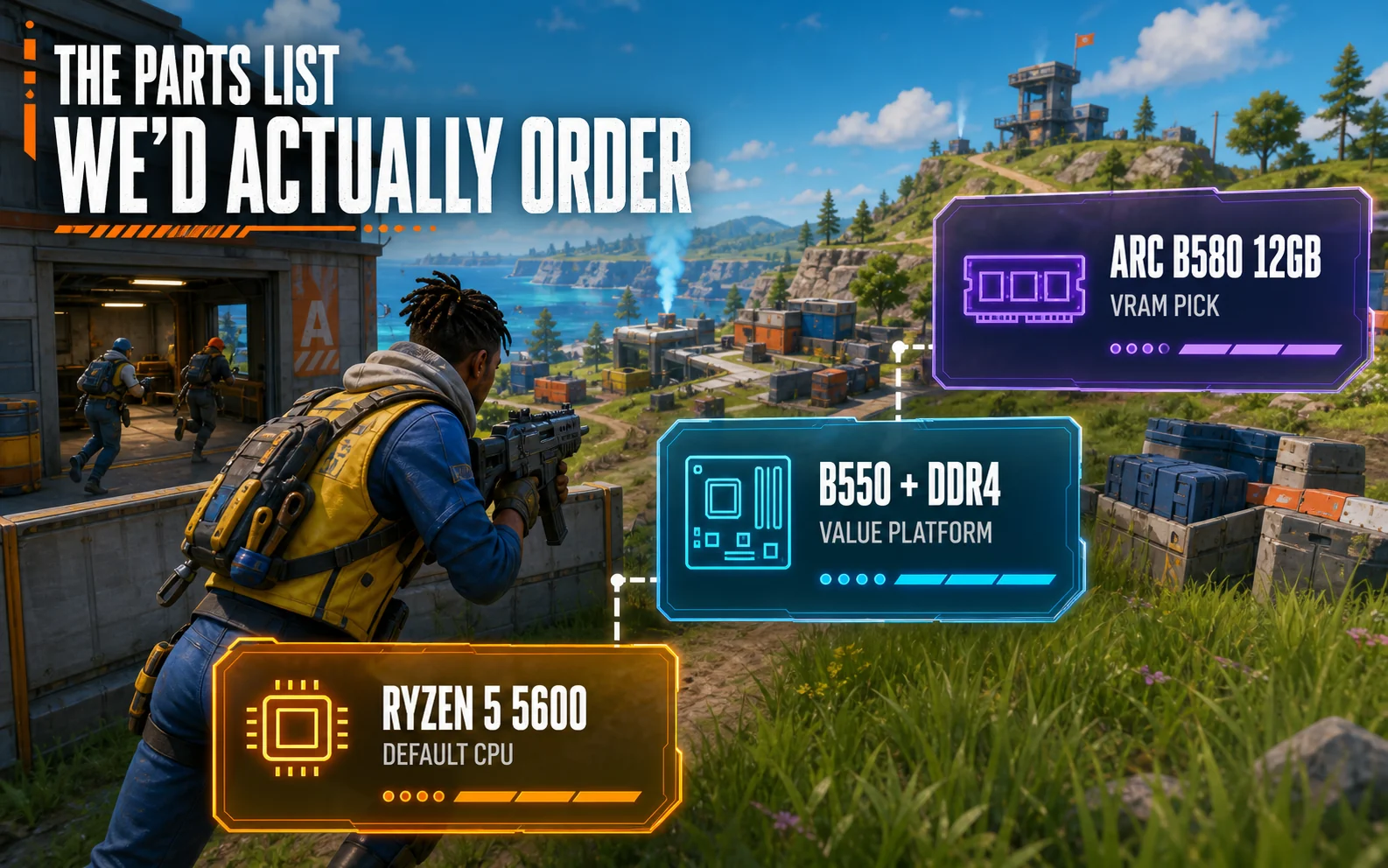
The parts list we’d actually order
This is a clean 1080p-to-1440p rig with no dead weight. Every pick assumes you’re shopping new in June 2026; used can shave more off, which we get into below.
| Part | Pick | Street price (Jun 2026) |
|---|---|---|
| CPU | Ryzen 5 5600 | ~$130 |
| Motherboard | B550M (any reputable brand) | ~$90 |
| RAM | 16GB DDR4-3600 CL16 | ~$70 |
| GPU | Intel Arc B580 12GB | ~$250 |
| SSD | 1TB Gen4 NVMe | ~$120 |
| PSU | 650W 80+ Gold | ~$65 |
| Case | Mesh-front mid-tower | ~$70 |
| Total | ~$795 | |
The Ryzen 5 5600 is still the spine of this whole category — it does about 95% of what a 5600X does in games and pairs with the cheapest boards AMD sells. The Arc B580 is the GPU we keep coming back to: 12GB of VRAM at the $250 tier is a genuine outlier in 2026, and unlike most cards this year, Intel has actually kept it in stock near MSRP. Intel often bundles a game with it too, which sweetens an already good deal.
One real tradeoff worth naming: the RAM crisis touched DDR4 as well. A 16GB kit that cost $35 a year ago is closer to $70 now, and 32GB DDR4 has climbed past $150. DDR4 is still much cheaper than DDR5 — it just isn’t the throwaway line item it used to be. If your budget can stretch, 32GB is the safer call for 2026’s heavier games, but 16GB clears the bar for nearly everything competitive. Our breakdown of how much RAM 1080p gaming actually needs goes deeper on where the line sits.
5600, 5700X3D, or that new 5800X3D?
The 5600 is the value floor, not the ceiling. AM4 has a quietly stacked lineup of gaming chips, and the right one depends on how long you plan to ride this platform.
- Ryzen 5 5600 (~$130) — the default. Six cores, plenty for any current game paired with a budget GPU. Buy this if the goal is lowest total cost.
- Ryzen 7 5700X3D (~$240–280) — officially end-of-life, so prices have crept up, but the 96MB of 3D V-Cache still makes it the strongest pure-gaming chip the socket ever got. Worth it if you chase 1% lows in CPU-heavy games.
- Ryzen 7 5800X3D “10th Anniversary” ($349, on sale June 25) — the same silicon as the original with new branding, brought back specifically because AMD knows AM4 buyers are stranded by DDR5 pricing. A clean way to get top-tier AM4 gaming performance new with a warranty.
For a build at this price, the 5600 is the honest pick. Spend the $110–220 you’d put toward an X3D chip on a better GPU instead — it’ll do more for your frame rate in nearly every game.
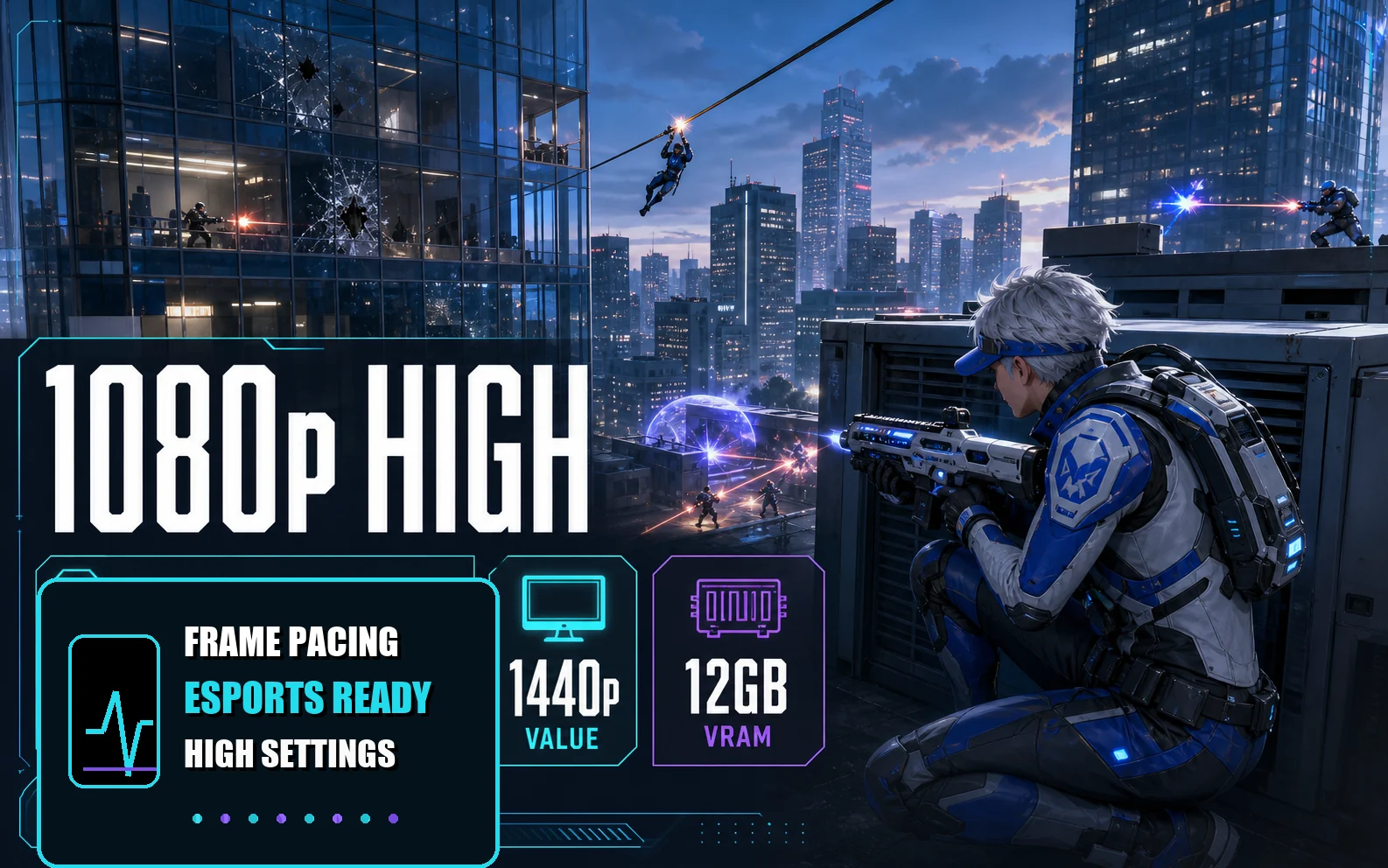
What this thing actually runs
Plenty. With the B580 doing the heavy lifting, this build holds high settings at 1080p across the board and pushes well past 60fps. Competitive titles are a non-event — Counter-Strike 2, Valorant, Marvel Rivals, and Fortnite all clear 144fps with settings tuned, and the lighter esports games go far beyond that. The 12GB frame buffer means 1440p is on the table too, especially with upscaling, which is where the B580 earns its reputation. Budget GPUs have gotten pricier and stingier on VRAM across the board, so a 12GB card at this price stands out more than it would have two years ago.
The one place AM4 shows its age is the heaviest new releases. Something like Borderlands 4, which wants 32GB of RAM and punishes weak hardware, will ask you to drop settings. That’s a software optimization problem more than an AM4 problem, but it’s real.
The honest catch
AM4 is a dead end, and pretending otherwise would do you a disservice. The 5800X3D is as far as this socket goes — there’s no future CPU jump waiting for you. AMD has confirmed AM5 support runs through 2029, so if you want to drop in a Zen 6 chip in a couple of years without replacing the board, that’s the platform built for it.
For a “build it, gam on it, forget about it for four years” budget rig, that ceiling rarely matters. You’re buying a complete machine, not a foundation. But if upgrading the CPU later is part of your plan, pay the AM5 tax now with eyes open.
Questions builders keep asking
Is AM4 still worth buying in 2026?
For a budget gaming build, yes — and arguably more than last year. The DDR5 price spike widened the cost gap between AM4 and AM5 to around $150–200 on the core platform, while AM4 chips like the 5600 and 5700X3D still game beautifully. The only reason to skip it is if you specifically want a CPU upgrade path, which only AM5 offers.
Should I get 16GB or 32GB of DDR4?
16GB handles every competitive game and most current AAA titles at sensible settings. A few 2026 releases (Borderlands 4 being the notorious one) really want 32GB. If you can absorb the extra ~$80, 32GB is the more future-proof call; if not, 16GB is fine to start and you can add more later.
Is the new 5800X3D worth it over the 5600?
Only if pure gaming performance is your priority and you’ll keep the build a long time. For most people on a budget, the $220 gap between the two chips buys a better graphics card, which raises frame rates more than the CPU swap would.
Can I reuse DDR4 from an old PC?
Absolutely, and right now that’s a genuine money-saver given memory prices. As long as it’s DDR4 (not DDR3) and ideally 3200MHz or faster, it’ll work in a B550 board. Reusing 16GB you already own effectively makes this build $70 cheaper.
What we’d actually buy
If you’re spending your own money this month and want the most game per dollar, build it on AM4: a Ryzen 5 5600, a B550 board, a 16GB DDR4 kit you can expand later, and an Arc B580. It lands near $800 fully new, dips well under that if you reuse RAM or storage, and it’ll play anything you throw at it at 1080p without drama. The platform won’t get a next-gen CPU someday — but in a year where everything is overpriced, a complete machine that dodges the worst of the memory tax is the win.