The best budget GPU for 1080p gaming depends on how much you actually have to spend — not on a single card recommendation that assumes everyone has the same budget. This guide covers every realistic price tier from $150 used to $299 new, so you can find the right card for where your money actually sits.
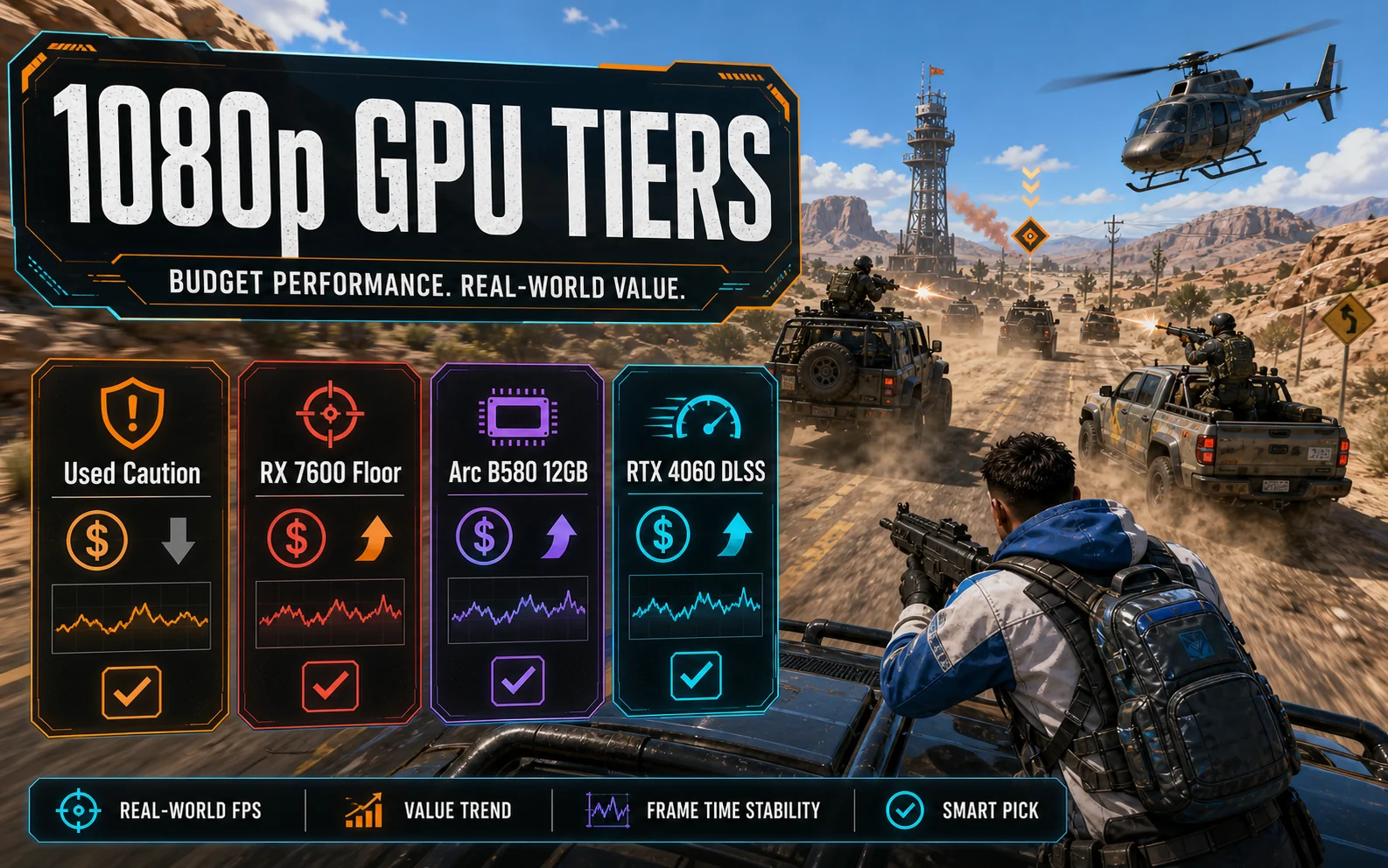
| Price tier | Best pick | 1080p target | Watch out for |
|---|---|---|---|
| Under $180 | Used RX 6600 / GTX 1660 Super | 60+ fps high | Seller risk, no warranty |
| $180–$220 | RX 7600 (new) | 80+ fps high | 8 GB VRAM ceiling |
| $240–$265 | Intel Arc B580 | 90+ fps high | Availability is patchy |
| $260–$299 | RTX 4060 | 90+ fps high w/ DLSS | 8 GB VRAM |
| $299+ | RTX 5060 / RX 9060 | 100+ fps high | Modest jump over the 4060 |
Under $180 — used only, tread carefully
New cards worth buying don’t exist below $180 in 2026. This tier is entirely used market: RTX 2070, RX 5700 XT, RTX 2060 Super. These cards still handle 1080p gaming in most titles, but they’re 5–6 years old, have no warranty, and are increasingly showing their age in newer releases. An RTX 2070 at $140 is a viable temporary solution if you need a GPU this week and will upgrade in six months. It’s a questionable long-term purchase.
If you’re in this price range, the used RTX 3060 12GB at $130–$160 is the only card worth specifically targeting — 12GB of VRAM at that price is hard to argue with, and the 3060 still handles 1080p in modern titles without struggling. Watch eBay listings rather than Amazon for this tier; Amazon used GPU listings are riddled with inflated pricing and questionable sellers.
$180–$220 — the RX 7600
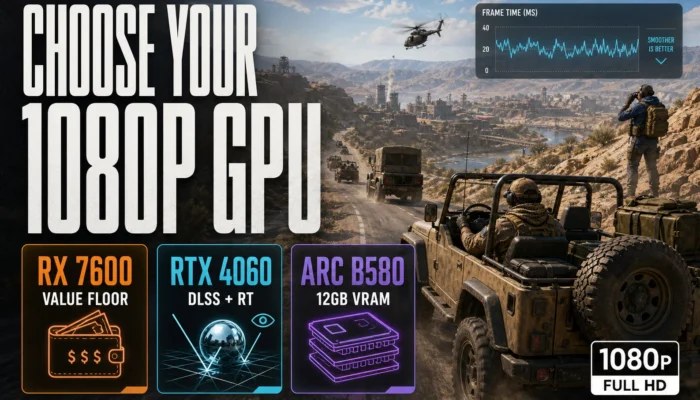
The RX 7600 at $199–$219 is the cheapest new card worth recommending in 2026. It delivers 60+ fps at 1080p high settings across the current game library, pushes 100+ fps in competitive titles like Fortnite and Warzone, and has proper new retail warranty coverage.
FSR 3 Frame Generation support is available in a growing list of titles and can push framerates significantly higher in supported games. Ray tracing works but isn’t enjoyable in demanding implementations — use selective RT or turn it off entirely for smooth performance.
The 165W power draw is higher than Nvidia’s equivalent, so factor in airflow if you’re building in a tight case. Otherwise this is a clean recommendation at its price. Check current pricing at Amazon and Newegg.
$240–$265 — the Arc B580 if you can find it
Intel’s Arc B580 at $249 is the best value at this price point when it’s actually in stock. The 12GB VRAM is the headline — more than either the RX 7600 or RTX 4060 — and gaming performance at 1080p sits within a few percent of the RTX 4060 in rasterized workloads.
The persistent problem is availability. The B580 sells out regularly and prices spike to $300+ when it does. Set up a stock alert at NowInStock if you want to buy at MSRP. Above $285, the value case compared to the RTX 4060 disappears. XeSS 3 Multi-Frame Generation is now available and competitive with DLSS 4 MFG in supported titles, which strengthens the B580’s position significantly versus a year ago.
$260–$299 — the RTX 4060
The RTX 4060 at $259–$289 is the most complete budget GPU at 1080p. About 40% faster than the RX 7600 in ray-traced workloads, significantly better DLSS 3 Frame Generation support, and lower 115W power draw. In pure rasterized gaming at 1080p both it and the RX 7600 are effectively tied — you’re paying for the RT headroom, the upscaling ecosystem, and the lower thermal footprint.
If you’re gaming in titles with strong DLSS 3 support (Cyberpunk 2077, Alan Wake 2, Space Marine 2), the RTX 4060 earns its price premium. If your game list is competitive titles and older releases, the RX 7600 at $200 is the smarter spend. Find current pricing at Amazon and Newegg.
$299 — the RTX 5060
Nvidia’s RTX 5060 launched at $299 — same price as the RTX 4060’s original MSRP — with 16GB GDDR7, roughly 22% faster rasterization, and DLSS 4 Multi-Frame Generation exclusive to Blackwell hardware. For new builds, it’s the right call at this price tier over the RTX 4060 if you can find it at MSRP.
For existing RTX 4060 owners, the upgrade math only works if you sell the 4060 quickly while used prices are still $150–$170. The raw performance gain alone (22%) doesn’t justify replacing a card you already own.
Frequently asked questions
What's the cheapest GPU worth buying for 1080p in 2026?
A used RX 6600 at $130–$160 if you trust the seller. New: the RX 7600 at $189 is the floor for a card with warranty.
Is the Arc B580 actually available?
Stock is patchy. When in stock at $249 it's the best value at the tier — 12 GB VRAM, solid 1080p performance, and Intel's drivers have matured. If it's out, the RTX 4060 is the safe alternative.
Should I skip the RTX 5060 and get a 4060?
Mostly yes. The 5060 is roughly 10–15% faster than the 4060 at street prices that are 15–20% higher. The per-dollar uplift is weak unless you find a 5060 at clearance pricing.
Is the RX 7600 better than the RTX 4060?
At pure 1080p raster they're a wash. The 4060 wins on ray tracing (+40%), power draw, and DLSS 3 Frame Gen. The 7600 wins on raw $/frame and lower entry price. See our full RTX 4060 vs RX 7600 breakdown.
How long will an 8 GB card last?
For 1080p at high settings: 2–3 more years comfortably. For 1440p or ultra textures: already showing strain. If you want a 4-year card, the Arc B580 (12 GB) or stepping up to a 12 GB Nvidia card is the smart play.
The short version
Under $180: used RTX 3060 12GB if you can find a clean listing. $199–$219: RX 7600. $249 if in stock: Arc B580. $260–$289: RTX 4060. $299: RTX 5060. Don’t stretch past your tier chasing marginal gains — each step up delivers real improvement, but only if the card is actually available near MSRP. Verify live prices before buying; GPU pricing shifts weekly.