GPUs

RTX 3060 12GB Is Coming Back, But Budget Buyers Should Wait for the Price

By CheapFPS Team / May 1, 2026 / 14 views

RTX 3060 12GB graphics card PCB and heatsink on a clean studio background

The RTX 3060 12GB comeback should be treated as a price watch, not a green light. Current Amazon and Newegg rows still show too many $400-plus, no-featured-offer, renewed, or marketplace-messy listings. New production only helps CheapFPS readers if it creates a clean larger-memory option below newer budget cards.

Affiliate disclosure: CheapFPS may earn from Amazon or Newegg links. The checked rows below do not create a buy-now CTA because the visible older-card listings were often above newer Nvidia, Radeon, or Intel budget lanes.

How this page was checked: This page uses live retailer checks from Amazon and Newegg on May 1, 2026, plus Nvidia’s official specs and named third-party testing from TechSpot’s 40-game 4060/Radeon comparison, 15-game Radeon review, and 50-game 4060/Intel comparison. Prices and availability checked May 1, 2026.

The deal score depends on where July stock lands

New-card street priceDeal scoreFitAvoid whenChange trigger
Under $2608/10Texture-pack players, modded-game builds, CUDA-side budget work, and local-AI tinkering that needs the larger memory buffer.The listing is renewed, overseas marketplace stock, or missing normal warranty clarity.A clean newer Nvidia card drops near the same money.
$260 to $2807/10Buyers who can explain exactly why the larger memory buffer beats lower power draw or newer Nvidia features.The PC is a tight compact tower with a weak PSU or a small case that favors a cooler 115W-class card.The Intel Arc option stays near $300 and the buyer’s games behave well on Intel drivers.
$280 to $3305/10Buyers with a named larger-memory Nvidia need, such as CUDA-side software or memory-heavy mods, who have ruled out Intel Arc for their game list.The build is ordinary 1080p gaming with no mod, creator, CUDA, or local model need.Radeon or newer Nvidia stock stays clean below it.
Above $3302/10Only a buyer with a very specific larger-memory Nvidia requirement should keep looking.Most Fortnite, Apex, esports, school-PC, compact-tower streaming, and general 1080p gaming builds.New stock actually becomes cheaper than the current visible legacy rows.

The 8/10 and 7/10 rows only make sense for a new ASUS, MSI, Colorful, or GALAX card under $280 when the buyer names a memory-heavy case such as The Last of Us Part I at ultra textures, modded Skyrim, CUDA-side tools, or a small local model.

I would skip the high band for ordinary 1080p gaming because a 115W-class GeForce board fits weak-PSU compact towers better, the checked Radeon rows were cleaner around the high-$200s, and Intel can put the larger memory buffer below the visible ASUS 3060 row.

The call changes if new partner cards arrive with normal warranty terms and pricing inside the first two scorecard rows.

The report is credible enough to watch, not official enough to chase

TechPowerUp reported that Chinese Board Channels expects new twelve-gig Ampere supply in June with ASUS, MSI, Colorful, and GALAX involved. VideoCardz opened the same Board Channels lead and described limited partner allocations, with mass production around July. TechSpot framed the story as a possible July retail return tied to the memory-supply squeeze and the delayed 9GB RTX 5050 rumor.

Because Nvidia has not announced a new SKU or MSRP, a May buyer should treat the Amazon and Newegg rows as the only buyable shelf. A shopper who needs a GPU this week should judge the actual shelf, not a July rumor. A shopper who can wait should keep this on a price alert because fresh supply could pressure old 3060 listings, Intel Arc rows, and low-end 4060 stock at the same time.

OC3D’s explanation is the useful company-context piece: newer RTX 40 and RTX 50 GPUs use TSMC 4nm-class capacity, while the older Ampere card came from Samsung’s 8nm node. Samsung 8nm production would let Nvidia add budget boards without using the TSMC capacity it needs for newer RTX 40, RTX 50, and AI products.

The spec sheet has one strong answer and two ownership costs

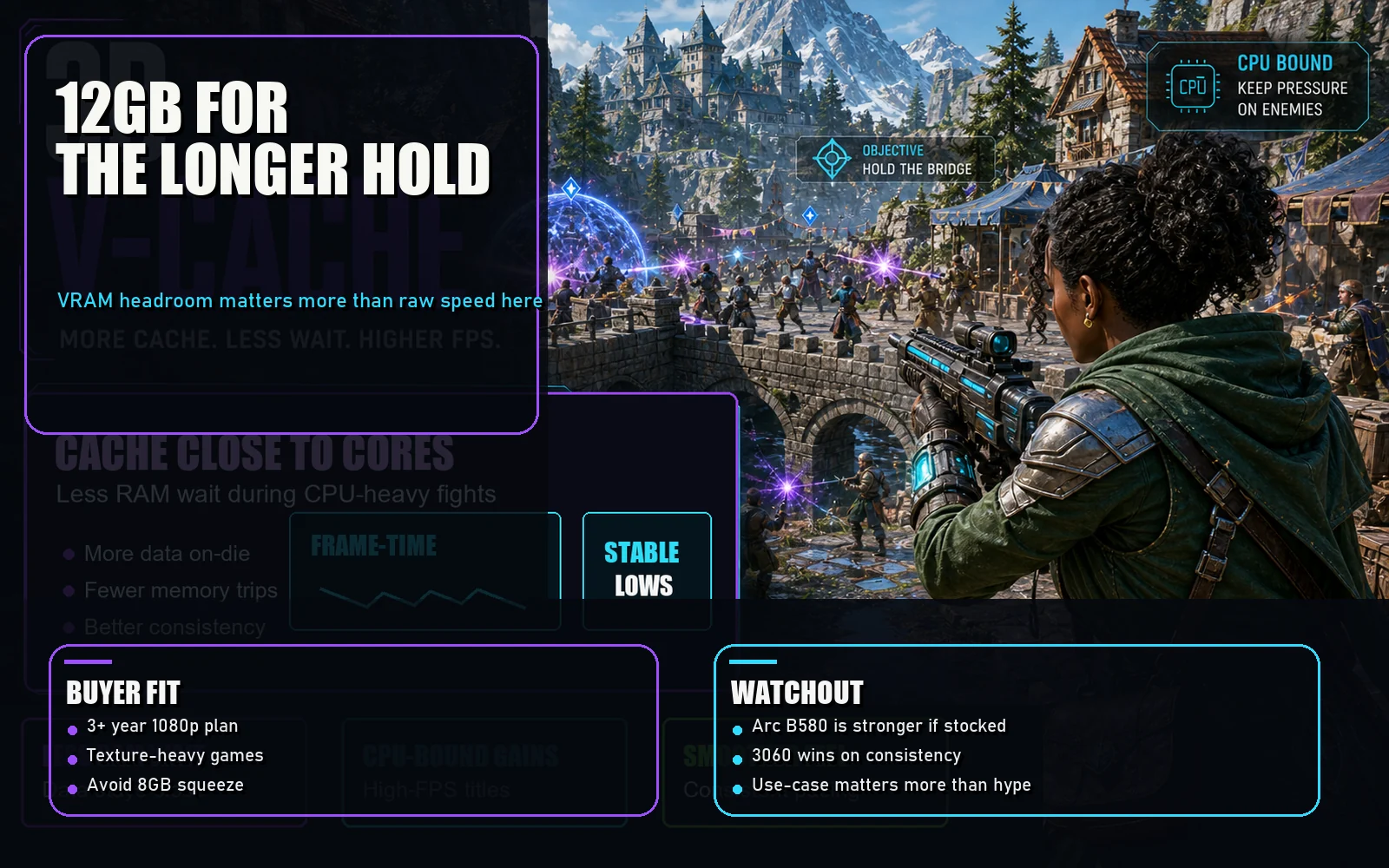
Nvidia’s official family page lists the larger-memory configuration with 3584 CUDA cores, a 192-bit memory bus, GDDR6 memory, and 170W graphics card power. The 192-bit bus plus the larger buffer gives high-texture games more room for asset data than an eight-gig card, especially when 1% lows collapse under memory pressure. That 170W board power can force higher fan speeds in a sealed-front compact tower or a small case with a basic PSU.

A 170W graphics card can be perfectly fine in a normal tower with a decent PSU and airflow. In a compact case where the seller does not disclose PSU headroom, front-panel airflow, or cooler size, the higher draw creates more noise risk. A 4060-class board at roughly 115W puts less heat into that same case and gives the fan curve more room before the PC starts sounding cheap.

The second cost is Nvidia feature age. OC3D notes that the old card lacks DLSS Frame Generation and Multi Frame Generation support. That does not ruin normal 1080p raster gaming, but it does weaken the argument for paying close to newer GeForce money. If someone wants Nvidia for the newest DLSS feature stack, this reported return does not solve that.

Unbranded RTX 3060 12GB class graphics card on a clean bright background.

Live listings make the comeback look like a correction, not a bargain yet

Amazon’s May 1 search rows showed ASUS and MSI larger-memory examples around $416 to $418 through used/new offer lines, while a Gigabyte Windforce row appeared at $529.99. Newegg showed an ASUS Dual card at $418.99, an MSI Ventus row at $470.34, and several partner boards higher than that. Those rows explain why new supply matters: the current shelf is acting like legacy stock, not budget stock.

Newer Nvidia listings set the practical ceiling. Amazon showed a renewed ASUS Dual row at $279.99 and new partner-board examples around $319.99.

Newegg’s first page had inflated marketplace cards, but one MSI Ventus row showed lower option lines from $289.99.

Radeon stock looked cleaner in the same checks. Amazon showed the ASRock Challenger eight-gig card at $279.99 and the XFX SWFT210 at $299.99. Newegg showed the ASRock Challenger at $279.99 and the Sapphire Pulse at $284.99. TechSpot’s 40-game Nvidia-versus-Radeon comparison found the AMD card only 2% slower at 1080p when ray tracing results were removed, so a cheaper Radeon listing is still a real 1080p answer when Nvidia features are not part of the job.

Intel Arc is the memory rival buyers should not ignore

The Intel card complicates the larger-memory pitch. Amazon showed an ASRock Challenger row in the low-$300 range. Newegg showed two Intel partner rows below the current Newegg ASUS 3060 row. Those are the listings a budget buyer should check before paying legacy-stock prices for the older Nvidia card.

TechSpot’s 50-game Nvidia-versus-Intel test used a Ryzen 7 9800X3D and found Intel’s card 1% slower at 1080p and 5% faster at 1440p. Intel becomes a credible memory-per-dollar rival in games where its driver path behaves well. The same TechSpot piece also warned about CPU overhead and inconsistent game behavior, which matters for buyers using older Ryzen 5 systems or playing titles where Arc still has frame pacing problems.

Ars Technica’s Intel review landed in a similar place from a buyer-risk angle. The card offered more memory than the newer Nvidia and Radeon budget cards, but Nvidia still had structural advantages in DLSS support, mature drivers, and long-term certainty. Intel can win the spec-and-price check when the listing is near the scorecard pass band, while the newer GeForce card still fits compact towers, streamers, and buyers who want mature DLSS support.

The buyer who can still use the old larger-memory Nvidia card

Modded Skyrim, high-resolution texture packs, older CUDA software, Blender experiments, Stable Diffusion tinkering, and small local models can all make the extra memory more useful than a newer eight-gig gaming feature. The buyer also needs a case with real airflow and a PSU that makes a 170W-class card boring to own.

I would not choose it for a generic 1080p esports build. TechSpot’s Radeon review tested 15 games with a Ryzen 7 7800X3D and found the AMD card 11% faster than the old larger-memory Nvidia card on average at both 1080p and 1440p. The same review also showed why the memory headline is not fake: in The Last of Us Part I at 1080p ultra, the larger-memory Nvidia card had nearly 40% higher 1% lows than the Radeon because eight-gig cards were under memory pressure.

For Fortnite, Apex, Valorant, and other tuned competitive games, a cheaper Radeon or lower-power 4060 is usually easier to justify than paying extra for unused memory. Memory-heavy single-player libraries need the buyer to name the exact game, mod pack, or texture setting that breaks an eight-gig card before paying for the older Nvidia board. Older CUDA software buyers should compare this card against used workstation options and the Intel Arc option before paying new-card money.

The current shelf still decides the May buy

The May 1 Amazon and Newegg rows make the old larger-memory Nvidia card a poor immediate buy when the visible examples sit above cheaper Nvidia, Radeon, or Intel alternatives. Check the newer Nvidia card first for small cases, weak PSUs, recording, streaming, and Nvidia software. Use Radeon first for simple 1080p raster gaming when the Radeon row is clearly cheaper. Treat Intel Arc as the first check when the larger memory buffer is the point and your main games are not known Arc problem cases.

If your current GPU still runs your games, set retailer alerts for a new ASUS, MSI, Colorful, GALAX, or another partner card under $280 with normal U.S. warranty terms. Until that listing exists, the comeback is leverage for shoppers, not a reason to reward bad legacy pricing.

Checked today: what I would update first

I checked the report trail, official specs, Amazon rows, Newegg rows, and the linked TechSpot game-test articles on May 1, 2026. The reported June supply and July retail timing remains unconfirmed by Nvidia.

  • Report trail: Board Channels lead carried by TechPowerUp, VideoCardz, TechSpot, and OC3D.
  • Current shelf issue: visible older-card rows were often renewed, no-featured-offer, marketplace-heavy, or far above the old $329 launch price.
  • Alternatives checked: newer Nvidia, Radeon, and Intel Arc search rows at Amazon and Newegg.
  • Update trigger: revise the call if Nvidia confirms or cancels the run, if new ASUS/MSI/Colorful/GALAX cards appear below the old $329 launch price in new condition with normal warranty terms, or if Amazon/Newegg newer Nvidia, Radeon, and Intel Arc rows undercut those cards by a full scorecard tier.

Sources: TechPowerUp, VideoCardz, TechSpot news, OC3D, Nvidia specs, TechSpot Nvidia/Radeon comparison, TechSpot Radeon review, TechSpot Nvidia/Intel comparison, and Ars Technica Intel review.

Tags 1080p Gaming Budget GPU GPU Buying Guide GPU Deals Intel Arc PC Gaming Hardware RTX 3060 12GB RTX 4060 RX 7600